CART
PCI DSS scope is the first decision of a compliance programme and the one that
determines its cost. Get it too wide and you are hardening systems that never touch card data. Get it
too narrow and your assessor finds the gap, usually late, usually expensively. Almost everything else
in PCI DSS is downstream of this one judgement.
Free gap assessment
How much of PCI DSS v4 is actually in place?
Score all twelve requirements at sub-requirement level, free, including the ones that stopped being future-dated in 2025.
Run the free PCI DSS 4.0 gap assessment → or View premium report sample
The cardholder data environment — the CDE — is the starting point, but it is not the
whole of scope. PCI DSS reaches beyond the systems holding card data to the systems that can affect
their security, which is the part organisations consistently underestimate.
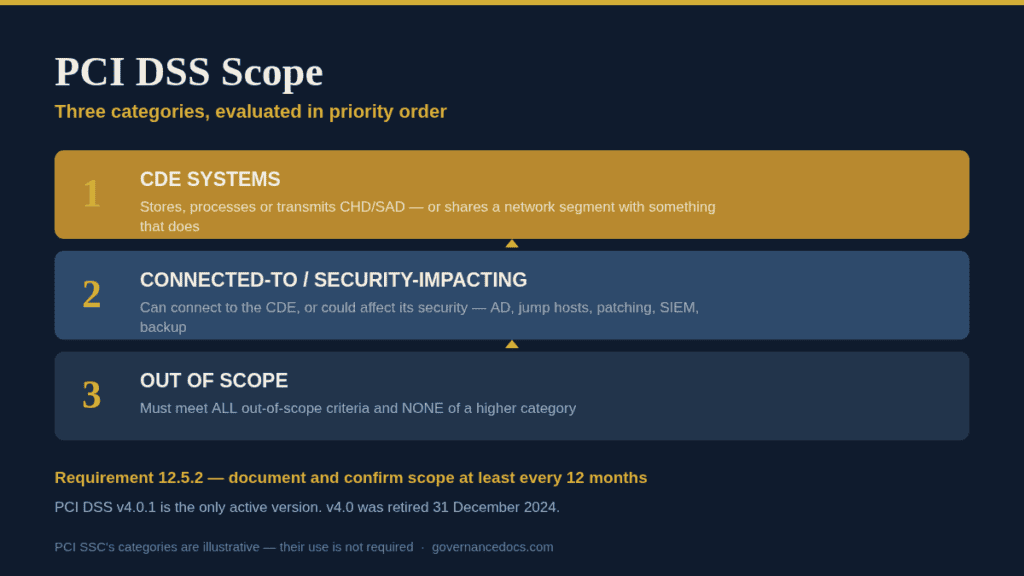
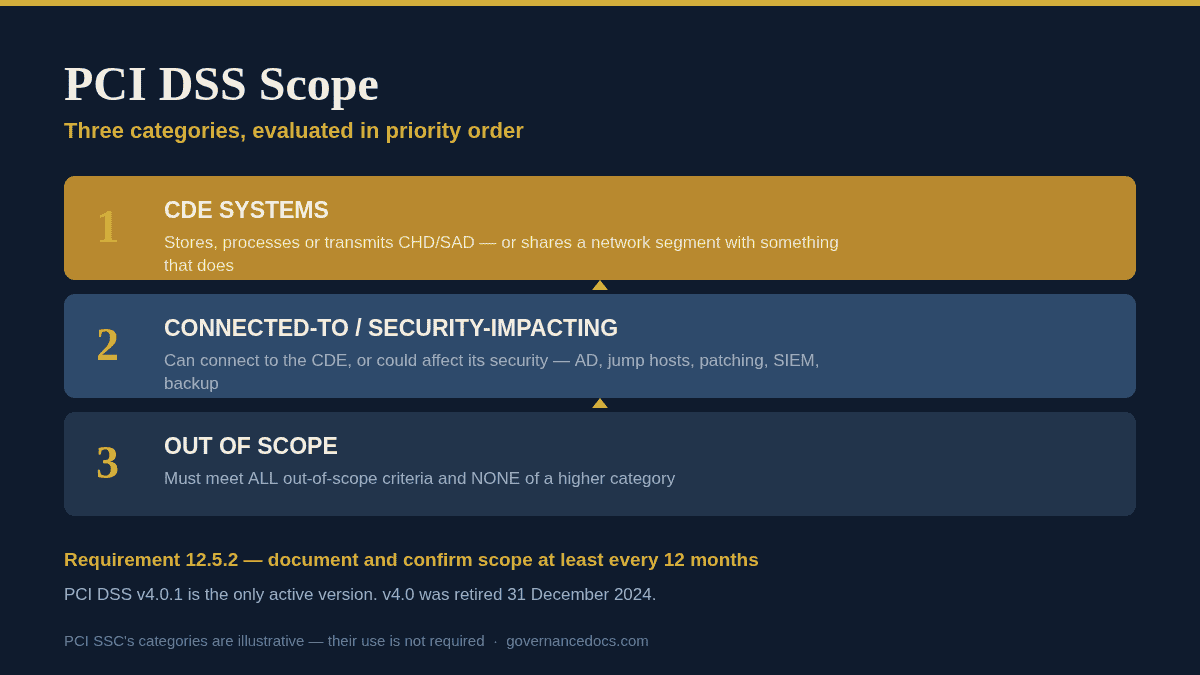
PCI SSC’s scoping guidance works through system components in a strict priority order, and the
order matters because a system can appear to fit more than one description:
| Category | What puts a system here | Effect |
|---|---|---|
| 1. CDE systems | Stores, processes or transmits cardholder data or sensitive authentication data — or sits on the same network segment as something that does | In scope; every requirement assessed for applicability |
| 2. Connected-to or security-impacting | Can connect to the CDE, or could affect the security of it — directory services, monitoring, patching, admin workstations | In scope; assessed against the requirements that apply |
| 3. Out of scope | Meets every out-of-scope criterion and none of the criteria above | Out — but you must be able to demonstrate it |
The rule that decides the hard cases is the one people skip. To be out of scope, PCI SSC’s guidance
says a system must meet “ALL the criteria of the out-of-scope category and NONE” of a higher one. It
is not a balance of probabilities. One qualifying criterion anywhere above pulls the system in.
Category two. Systems that never see a card number but could compromise the CDE if breached are in
scope, and that catches infrastructure nobody thinks of as payment infrastructure: Active Directory,
the jump host, the patching server, the SIEM collector, the backup system, the monitoring agent
installed everywhere.
The test is not “does card data pass through it?” but “could a compromise of this system affect the
security of the CDE?” Applied honestly, that question usually expands a first-draft scope
considerably — which is uncomfortable, and much cheaper to discover now than during an
assessment.
Worth knowing, because most PCI DSS scope articles present this three-way split as though it were
mandatory. PCI SSC’s own supplement is explicit that the categories are illustrative examples and
their use is not required — an organisation may use another evaluation process at its
discretion.
What is not optional is the outcome: knowing which systems are in scope and being able to justify
it. The categories are a well-tested route to that answer, and if you use another one, the burden of
explaining it to your assessor is yours.
Under PCI DSS v4.x, Requirement 12.5.2 obliges an entity to document and confirm
its PCI DSS scope at least once every 12 months, and after any significant change to the environment.
Scope is not a one-off exercise recorded in a project document; it is a maintained artefact with a
review cycle, and the confirmation itself is evidence an assessor will ask to see.
The version position matters here too. PCI DSS v4.0.1 is the only active version
— v3.2.1 was retired on 31 March 2024 and v4.0 on 31 December 2024. Of the 64 new requirements
introduced in v4.x, 51 were future-dated and became effective on 31 March 2025, so
they are no longer best practice: they are assessed.
A scope inventory you can hand to an assessor.
The PCI-DSS Toolkit ships 180+ editable templates including a PCI Scope Inventory workbook, the cardholder data environment definition, targeted risk analysis and customised approach documents, the shared responsibility matrix, and the policies and procedures the standard mandates — aligned to PCI DSS v4.0.1.
Outsourcing payment processing genuinely reduces PCI DSS scope, sometimes dramatically. It does not
transfer accountability. You remain responsible for confirming which requirements your provider covers
and which remain yours, and that split needs to be written down — which is what a shared
responsibility matrix is for.
The common failure is assuming a provider’s compliance covers everything they touch. It covers what
their attestation says it covers, and the boundary is frequently narrower than the sales conversation
implied.
The original scoping guidance was written for networks with perimeters. PCI SSC published a newer
information supplement, PCI DSS Scoping and Segmentation Guidance for Modern Network
Architectures, in September 2024, addressing micro-segmentation, multi-cloud and the verification
of scope and segmentation controls in environments where “the network” is a set of policies rather
than a set of cables. If your CDE lives in a cloud account or a service mesh, that is the document to
read alongside the standard.
Scope reduction is the highest-return work in a PCI programme, because every system removed is
removed from all twelve requirement areas at once. Four approaches do most of the work, and all of
them are architectural rather than documentary.
What does not reduce PCI DSS scope is describing it differently. Redrawing a boundary without
changing where card data flows or what can reach it produces a document that disagrees with the
network, and the network wins.
What is PCI DSS scope?
Every system component that stores, processes or transmits cardholder data, plus every system that
connects to or could affect the security of those systems. It is broader than the systems holding card
data.
Is network segmentation required?
No. Segmentation is optional, but without it the whole network is generally in scope. Where it is
used, the segmentation controls must be tested and the testing evidenced.
How often must PCI DSS scope be confirmed?
Requirement 12.5.2 requires documented confirmation at least once every 12 months, and after
significant changes to the environment.
Does using a payment service provider put us out of scope?
It narrows scope, often substantially, but does not eliminate it. You still need to confirm which
requirements the provider covers and document the ones that remain yours.
Which PCI DSS version applies?
v4.0.1 — the only active version since v4.0 was retired on 31 December 2024. The 51 future-dated
requirements have been effective since 31 March 2025.
Scope works differently under PCI PIN Security, where there are no thresholds and the answer is decided by activity rather than by data flow — see PCI PIN scope and PCI PIN vs PCI DSS.
All of these are covered by the PCI-DSS Toolkit, or start with the free ISO templates.

October 11, 2026
October 11, 2026

October 11, 2026
October 11, 2026
October 11, 2026

