If you sell software to the US federal government, or you run systems inside an agency, sooner or later someone asks you to explain NIST RMF vs FedRAMP — and the honest answer is that they are not two competing options you pick between. One is the process an agency runs to authorize a system it is accountable for. The other is a program that lets many agencies reuse a single cloud security assessment instead of each repeating the work. Getting that relationship right decides how much you spend, who signs your authorization, and which documents you need on day one.
This guide sets out what each one is in 2026, where they overlap, and how to tell which applies to you. If you only take one thing from the NIST RMF vs FedRAMP comparison, take this: they are layers, not alternatives.
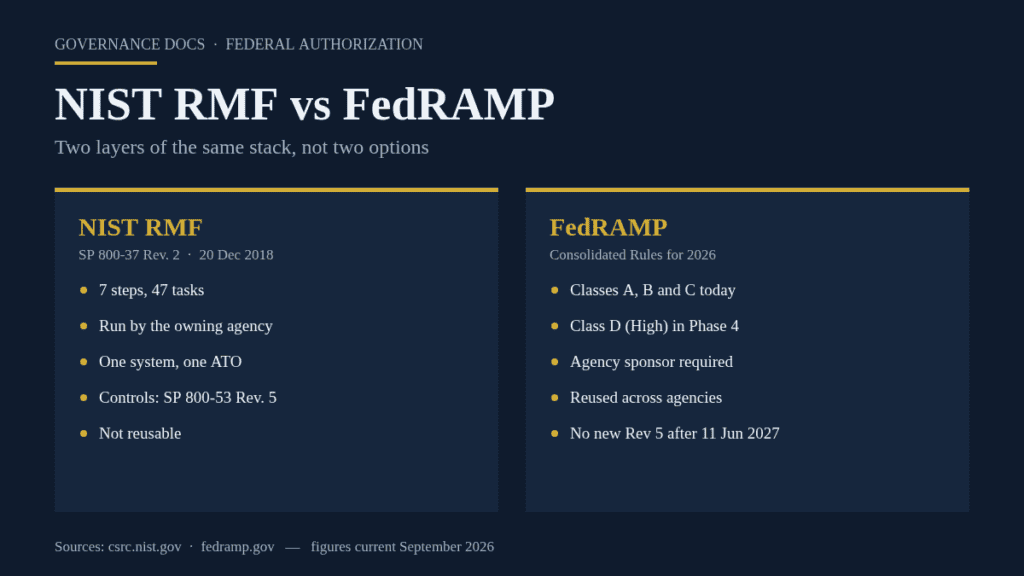
NIST RMF vs FedRAMP at a glance
NIST RMF
FedRAMP
What it is
A risk management process for information systems
A government-wide program for authorizing cloud services
Federal information systems, and contractors operating systems on an agency’s behalf
Cloud service providers selling to federal agencies
Structure
7 steps, 47 tasks
Certification classes under the Consolidated Rules for 2026
Control set
NIST SP 800-53 Revision 5
NIST SP 800-53 Revision 5, plus FedRAMP-specific requirements
Result
An Authorization to Operate from that agency
A listing other agencies can reuse
Reusable?
No — one agency, one system
Yes — that is the point of it
What NIST RMF actually is
Half of every NIST RMF vs FedRAMP argument comes from people describing the same control catalog and assuming they are describing the same obligation. They are not.
The Risk Management Framework is the process federal agencies use to decide whether a system is safe enough to run, and to keep deciding that over its life. It is set out in NIST Special Publication 800-37 Revision 2, published on 20 December 2018 and still the current revision.
It has seven steps and 47 discrete tasks:
Prepare — 18 tasks, split between organization level (P-1 to P-7) and system level (P-8 to P-18). Revision 2 added this step, and it is where most programs are actually weak.
Categorize — 3 tasks (C-1 to C-3). What would it cost if this system lost confidentiality, integrity or availability?
Select — 6 tasks (S-1 to S-6). Choose the SP 800-53 baseline and tailor it.
Implement — 2 tasks (I-1 to I-2). Put the controls in and record how.
Assess — 6 tasks (A-1 to A-6). Test whether they work.
Authorize — 5 tasks (R-1 to R-5). A named official accepts the residual risk in writing.
Monitor — 7 tasks (M-1 to M-7). Keep watching, and re-authorize when the risk picture changes.
The controls themselves come from SP 800-53 Revision 5, which NIST updated to Release 5.2.0 on 27 August 2025 in response to Executive Order 14306. If your control baseline predates that release, it is out of date.
The critical feature of RMF is that the authorization decision belongs to one agency official for one system. Nothing about it travels. Our guide to the NIST Risk Management Framework walks through the seven steps in detail.
Free ISO 27001 risk assessment
Which of your risks sit above your appetite line?
Set your own risk criteria, pick from 61 information security risk scenarios, rate likelihood and impact, and decide how to treat each one. You get a heat map, a process score and the findings an auditor would raise, free.
FedRAMP exists because the alternative was absurd. Without it, a cloud provider selling the same service to twelve agencies would sit through twelve separate assessments of the same infrastructure. FedRAMP standardizes the assessment once so that other agencies can rely on it.
The program has changed substantially. FedRAMP 20x, announced under OMB Memorandum M-24-15, replaces point-in-time document review with continuously validated evidence. Its rollout has been staged:
Phase 1 (FY25 Q3–Q4) — a low-impact pilot that took 26 submissions, with 13 reviews completed by September 2025.
Phase 2 (November 2025 – March 2026) — moderate impact, 14 qualifying submissions, six providers authorized by April 2026.
Phase 3 (FY26 Q3–Q4, current) — requirements formalized in the Consolidated Rules for 2026, with the submission pipeline running July to September 2026.
Phase 4 (estimated FY27 Q1–Q2) — Class D, for high impact, still in development.
Phase 5 (estimated FY27 Q3–Q4) — no new Revision 5 certifications after 11 June 2027.
Certification classes now run Class A (pilot, for mature providers entering the federal market), Class B (low), and Class C (moderate). As of September 2026 the FedRAMP marketplace lists 533 certified services, 30 of them certified under 20x.
That last date matters more than anything else on this page. If you are planning a traditional Revision 5 authorization, you are planning against a closing window.
It also changes the NIST RMF vs FedRAMP calculation for anyone weighing whether a federal cloud offering is worth building at all: the program you would be entering in 2027 is not the one described in most guidance written before 2025.
NIST RMF vs FedRAMP: the five differences that decide your path
Once you strip away the acronyms, the NIST RMF vs FedRAMP question comes down to five things.
1. Who owns the decision. Under RMF, an Authorizing Official inside the agency signs. Under FedRAMP, an authorizing agency signs but the result is published for others to leverage.
2. Whether the work is reusable. An RMF authorization covers one system at one agency. A FedRAMP listing is designed to be reused, which is the entire economic argument for going through it.
3. Who assesses you. RMF assessments can be performed by agency staff or an independent assessor. FedRAMP has always leaned on accredited third-party assessment organizations, and 20x adds automated, continuously reported evidence on top.
4. What the deliverable looks like. RMF produces a system security plan, an assessment report, a plan of action and milestones, and an authorization letter. FedRAMP produces a certification package built to a published rule set, sized to your class.
5. How much of it is continuous. Both require ongoing monitoring, but 20x pushes much harder on machine-readable, always-current evidence rather than an annual assessment cycle.
Which one applies to you
Work through this in order:
You are a federal agency authorizing a system you operate. That is RMF. FedRAMP does not replace it.
You are a cloud service provider selling to federal agencies. That is FedRAMP. You will need an agency sponsor and a certification package.
You are a contractor operating a system on an agency’s behalf, not selling a cloud service. That is RMF, run by the agency, with you doing most of the work.
You are a cloud provider whose service an agency then builds on. Both. You certify under FedRAMP; the agency inherits your controls into its own RMF authorization for the system it builds.
That last case is where the NIST RMF vs FedRAMP framing misleads people most. FedRAMP does not exempt an agency from RMF. It supplies a pre-assessed layer the agency can inherit, so its own RMF package covers only what it added on top.
What NIST RMF vs FedRAMP means for your documentation
The two paths share a control set and diverge almost everywhere else in the paperwork.
RMF wants evidence that the process ran: a categorization decision you can defend, a tailored baseline with the tailoring justified, an assessment plan, a POA&M that is actually maintained, and a continuous monitoring strategy with named owners and real frequencies. Most RMF packages fail on the Prepare step, because the organization-level tasks — risk management strategy, risk tolerance, common control identification — were never written down and cannot be produced on demand.
FedRAMP wants a package that matches a published rule set exactly, with evidence that can be validated rather than asserted.
Before you commit budget to either, it is worth knowing where you actually stand. Our free NIST RMF gap assessment scores you against every task in SP 800-37 Revision 2 and returns a prioritized list of what is missing, at no cost. If the gaps are mostly documentation, the NIST Cyber Risk Management Toolkit supplies the risk strategy, categorization, control selection and monitoring templates already aligned to the seven steps.
Frequently asked questions
Is the NIST RMF vs FedRAMP choice really a choice?
Usually not. Agencies run RMF; cloud providers pursue FedRAMP; and a provider selling into an agency ends up inside both, with the agency inheriting what FedRAMP already assessed.
Is FedRAMP based on NIST RMF?
Yes. FedRAMP applies the RMF process to cloud services and uses the same SP 800-53 Revision 5 control catalog, then adds standardized requirements and a reusable authorization so agencies do not each repeat the assessment.
Can a FedRAMP authorization replace an agency’s RMF process?
No. An agency still runs RMF for the system it is accountable for. What FedRAMP changes is how much of that work it can inherit rather than perform.
Which is more expensive?
FedRAMP, in almost every case, because it requires independent assessment, a sponsor, and continuous evidence for a service rather than a single system. RMF costs vary widely with the system’s impact level. Treat any single published figure with suspicion — the range is genuinely wide.
Is NIST SP 800-37 Revision 2 still current?
Yes. Revision 2 was published on 20 December 2018 and remains the current revision. The final public draft that preceded it was obsoleted on the same date, which is why some search results still show a “withdrawn” label against it.
Do I need to worry about the 11 June 2027 date?
If you are a cloud provider planning a traditional Revision 5 certification, yes. FedRAMP’s published plan stops accepting new Revision 5 certifications after that date, so a program starting now should be scoped against 20x rather than the legacy path.