CART
The NIST RMF is the seven-step process a federal system goes through to be authorized to operate — and it is a different thing from the Cybersecurity Framework, which is where most of the confusion around “the NIST risk framework” starts. The RMF is a lifecycle process defined in SP 800-37 Revision 2; the CSF is a set of outcomes. You can run both, and large organizations do.
This guide walks the seven steps as NIST states their purpose, shows which publication does the work at each one, and sets out plainly when the RMF applies to you and when the CSF is the better instrument.
Free gap assessment
How far through the RMF are you really?
Walk all 47 tasks across the seven steps, free, with the organisation-level answers separated so they carry over to your next system.
Run the free NIST RMF gap assessment → or View premium report sample
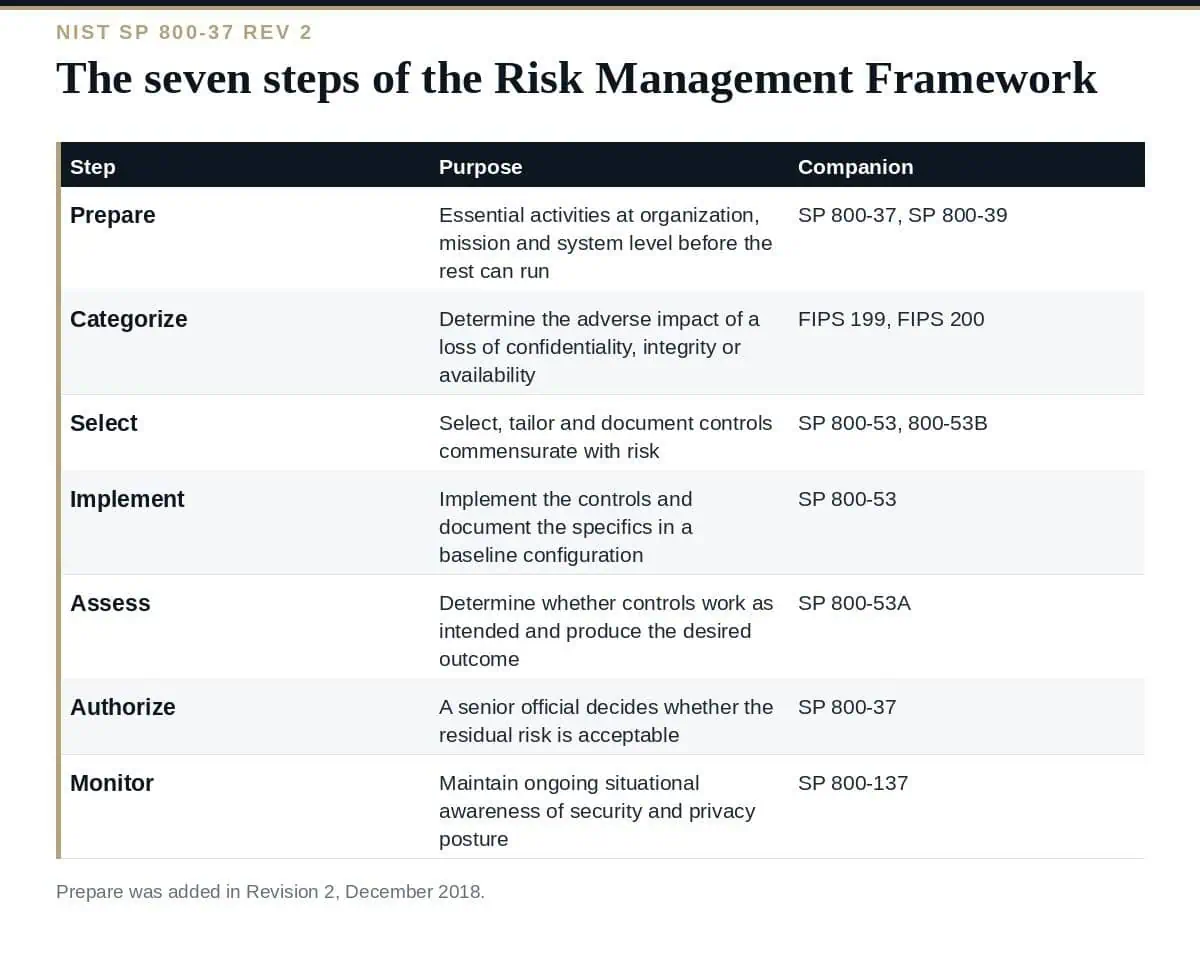
| Step | Purpose | Companion |
|---|---|---|
| Prepare | Carry out essential activities at organization, mission and system level so the rest can be executed consistently | SP 800-37, SP 800-39 |
| Categorize | Determine the adverse impact of a loss of confidentiality, integrity or availability | FIPS 199, FIPS 200 |
| Select | Select, tailor and document the controls needed, commensurate with risk | SP 800-53, SP 800-53B |
| Implement | Implement the controls and document the specifics in a baseline configuration | SP 800-53 |
| Assess | Determine whether controls are implemented correctly, operating as intended and producing the desired outcome | SP 800-53A |
| Authorize | Provide accountability by requiring a senior official to determine whether the risk is acceptable | SP 800-37 |
| Monitor | Maintain ongoing situational awareness of the security and privacy posture to support risk decisions | SP 800-137 |
Revision 2, published in December 2018, is where Prepare arrived. It exists because organizations kept starting at Categorize with no risk strategy, no defined roles and no common controls identified — and then rebuilt the same foundations on every system. NIST’s framing is that Prepare leverages activities already running in security, privacy and supply chain programmes, and it splits into organization-level and system-level preparation.
Two steps of the NIST RMF consume most of a first authorization. Select is where tailoring happens — starting from a control baseline and justifying every addition, removal and parameter value. Teams that treat the baseline as a checklist end up implementing controls their system does not need and cannot evidence.
Authorize is where the process becomes a decision rather than an exercise. The purpose NIST states is accountability: a senior official determines whether the risk, including supply chain risk, is acceptable. That official is signing their name to a residual risk position, which is why a package full of unresolved findings does not get signed — and why the Assess step’s honesty determines how the Authorize step goes.
They answer different questions and they are not alternatives.
In practice the two interlock. CSF outcomes map to SP 800-53 controls through informative references, so a target profile can drive control selection, while the RMF supplies the assessment and authorization discipline the CSF deliberately leaves open. If your obligation is a federal ATO, the RMF is the process; if your obligation is to show a board where you stand, the CSF is the language.
Free ISO 27001 risk assessment
Which of your risks sit above your appetite line?
Set your own risk criteria, pick from 61 information security risk scenarios, rate likelihood and impact, and decide how to treat each one. You get a heat map, a process score and the findings an auditor would raise, free.
Run the free risk assessment → or View premium report sample
Federal agencies and their systems, by law. Contractors inherit it indirectly: a system operated on an agency’s behalf goes through the same process, and FedRAMP is the RMF applied to cloud services with a shared evidence package on top — the reason its vocabulary of categorization, control baselines and authorization is identical. Our guide to the FedRAMP ATO covers how that agency decision now works.
For a private-sector organization with no federal customers, the RMF is optional and often heavier than needed. What travels well is its sequence: decide impact before selecting controls, tailor deliberately, assess before you claim, make somebody senior accept the residual risk, and monitor continuously rather than annually.
What does RMF stand for?
Risk Management Framework. NIST defines it in SP 800-37 Revision 2, Risk Management Framework for Information Systems and Organizations: A System Life Cycle Approach for Security and Privacy.
How many steps does the NIST RMF have?
Seven: Prepare, Categorize, Select, Implement, Assess, Authorize and Monitor. Prepare was added in Revision 2 in December 2018.
Is the RMF the same as the Cybersecurity Framework?
No. The RMF is a lifecycle process ending in an authorization decision; the CSF is a voluntary set of outcomes used to describe and prioritize posture.
Do private companies have to follow the RMF?
No, unless they operate a system for a federal agency or are contractually required to. The sequence is still a sound model for any system authorization process.
Which publication supports each step?
FIPS 199 and 200 for Categorize, SP 800-53 and 800-53B for Select and Implement, SP 800-53A for Assess, SP 800-37 for Authorize, and SP 800-137 for continuous monitoring under Monitor.
Run the NIST RMF in order and it is a coherent lifecycle; run it as seven deliverables and it becomes documentation nobody trusts. Do the Prepare work once at organization level so system teams inherit it, categorize honestly because everything downstream depends on it, justify every tailoring decision at the time you make it, and treat the authorization as a real risk acceptance by a named official. If you are not federal, borrow the sequence and pair it with the CSF for the language your board actually wants.
Categorization, control selection and assessment templates are in the NIST Cyber Risk Management Toolkit, or start with the free ISO templates.

October 14, 2026
October 13, 2026
October 12, 2026
October 12, 2026
October 12, 2026

