CART
An IVDR notified body is the organisation designated by a Member State under Regulation (EU) 2017/746 to assess whether an in vitro diagnostic device conforms before it is CE marked, and under the IVDR almost every manufacturer needs one. Article 48 involves a notified body for every class B, C and D device and for the sterility of class A sterile devices; only class A non-sterile devices are self-declared.
That is the reverse of the Directive it replaced, under which most IVDs never met a notified body at all, and it collides with a supply problem: the IVDR list on NANDO is far shorter than the MDR list, and Article 110’s transitional route for legacy devices depends on a signed written agreement with one of those bodies by a fixed date. This guide sets out the four conformity assessment routes and what the notified body does in each, the extra steps for class D, self-testing and companion diagnostics, what the engagement looks like from application to surveillance, what Article 46 requires bodies to publish about fees, and how to choose and secure one while capacity is the constraint.
Free gap assessment
How much of ISO 13485 could you evidence today?
Score clauses 4 to 8, free, with the FDA QMSR and EU MDR duties kept separate so you can see what is the standard and what is the regulator.
Run the free ISO 13485 gap assessment → or View premium report sample
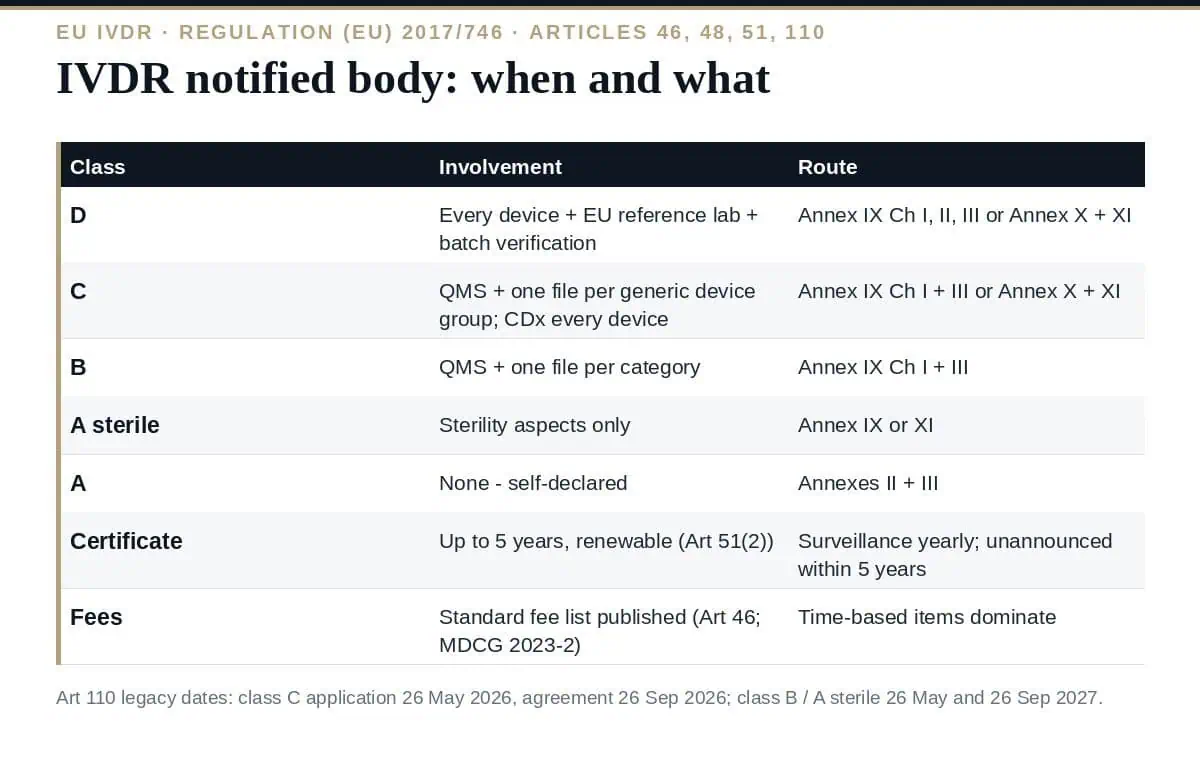
| Class | Notified body involvement (Article 48) | Route options |
|---|---|---|
| D | Yes — every device | Annex IX Chapters I, II (except Section 5) and III (QMS plus technical documentation for every device); or Annex X type examination plus Annex XI production quality assurance |
| C | Yes | Annex IX Chapters I and III plus technical documentation assessment for at least one representative device per generic device group; or Annex X plus Annex XI (except Section 5) |
| B | Yes | Annex IX Chapters I and III plus technical documentation assessment for at least one representative device per category of devices |
| A sterile | Yes — limited to sterility | Annex IX or Annex XI, involvement limited to establishing, securing and maintaining sterile conditions |
| A non-sterile | No | EU declaration of conformity on Annexes II and III technical documentation (Article 48(10)) |
| In-house devices under Article 5(5) | No | Exempt from conformity assessment under Article 48(2) if all nine conditions are met |
Because class B is the residual class under Annex VIII rule 6, a manufacturer who cannot place a device in class A by rule 5 needs a notified body. Our guide to IVDR classification works through the rules; the class you land in decides the route, the sampling basis and the price.
| Route | What the IVDR notified body does | Certificate |
|---|---|---|
| Annex IX Chapter I — quality management system | Audits the QMS covering design, manufacture and final inspection, including the post-market surveillance system and performance evaluation procedures; annual surveillance audits (Section 3.3); unannounced audits at least once every five years with product or process sampling (Section 3.4) | EU quality management system certificate |
| Annex IX Chapter II — technical documentation | Assesses the Annex II and III file for every class D device (Section 4), with additional steps for self-testing and near-patient devices (Section 5.1) and companion diagnostics (Section 5.2) | EU technical documentation assessment certificate |
| Annex X — type examination | Examines a representative sample of the device against the Regulation, including the performance evaluation, and issues a type certificate; the manufacturer then follows Annex XI | EU type-examination certificate |
| Annex XI — production quality assurance | Audits the production QMS to ensure devices conform to the approved type | EU production quality assurance certificate |
Under Article 51(2) every IVDR notified body certificate is valid for the period it states, not exceeding five years, and is renewed on re-assessment for further periods of up to five years. The written agreement under Annex VII Section 4.3 obliges the manufacturer to inform the body of vigilance reports and gives the body the right to suspend, restrict or withdraw certificates.
Article 46 is one sentence: notified bodies “shall establish lists of their standard fees for the conformity assessment activities that they carry out and shall make those lists publicly available”. MDCG 2023-2, published January 2023 with an IVDR form, adds that the list must be reachable on the body’s NANDO-registered website without registration, should say whether each item is flat or time-based, and that duly justified external costs — the EU reference laboratory testing for class D is the IVDR-specific one — may be charged on top.
The Commission links each body’s list from its notified bodies page. The price list gives the rate; the number of assessment days is set by the quality of the file, which is why IVDR technical documentation is the largest controllable cost. Our guide to notified body fees reads three published MDR price lists line by line; the IVDR lists use the same MDCG 2023-2 headings.
Which IVDs need an IVDR notified body?
Every class B, C and D device, and class A sterile devices for their sterility aspects, under Article 48. Only class A non-sterile devices are self-declared, and in-house devices meeting all Article 5(5) conditions are exempt from conformity assessment.
How long is an IVDR certificate valid?
Up to five years under Article 51(2), renewable for further periods of up to five years on re-assessment. Surveillance audits run at least every 12 months and unannounced audits at least once every five years.
Do notified bodies have to publish their fees?
Yes. Article 46 requires each body to publish a list of its standard fees, and MDCG 2023-2 provides the IVDR form and requires the list to be freely accessible on the body’s website.
What is different for class D?
Every technical file is assessed, an EU reference laboratory verifies claimed performance and CS compliance where one is designated, the expert panel is consulted for a first-of-type without CS, and batches are verified before release.
What are the Article 110 notified body deadlines?
For legacy devices: a formal application by 26 May 2026 and a signed written agreement by 26 September 2026 for class C; 26 May 2027 and 26 September 2027 for class B and class A sterile. Class D’s dates — 26 May and 26 September 2025 — have passed.
Treat the IVDR notified body as a supply-constrained input: classify, pick the route, check the designation codes on NANDO, lodge the application and sign the written agreement before the Article 110 dates if the device is legacy, read the Article 46 fee list for the time-based items, and submit a file that keeps the question rounds short. The certificate is the output; the engagement is the programme.
The Notified Body Application and Interaction Procedure, the Notified Body and Certificate Log, the Device Classification Procedure and the Transition Deadline and Condition Tracker are in the EU IVDR Toolkit, or start with the free templates.

October 12, 2026
October 12, 2026

October 12, 2026

October 12, 2026
October 12, 2026

