

ISO 42001 Toolkit: What a Complete One Contains (2026)
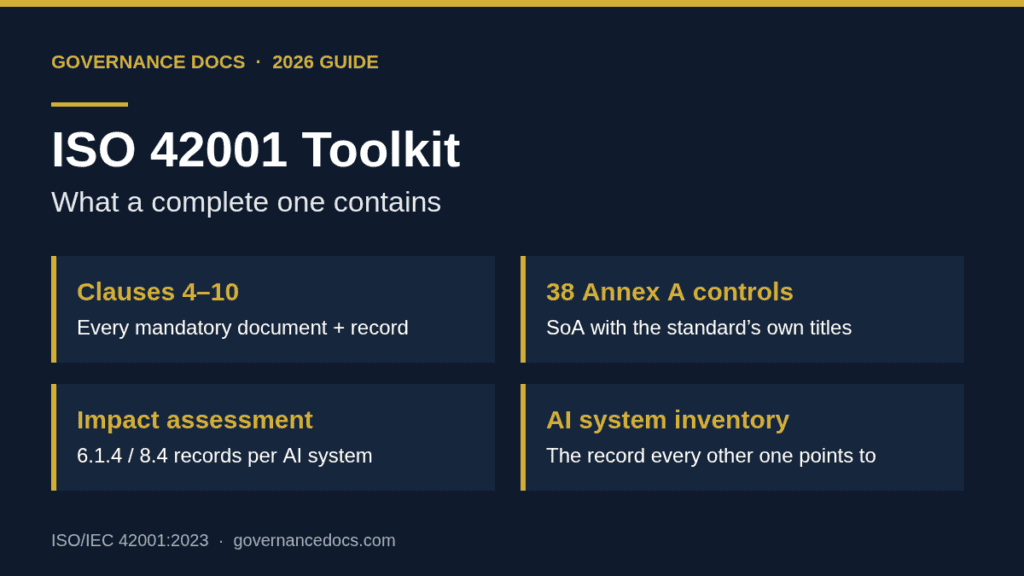
An ISO 42001 toolkit is only worth buying if it covers every piece of documented information the standard requires and gives you working records for the AI-specific parts that a quality or security pack never had: the AI system impact assessment, the AI system inventory and a Statement of Applicability built on the 38 Annex A controls. Many packs sold as ISO 42001 templates are an older management-system set with “AI” pasted over the headings. They look complete in a file listing and come apart at stage 1, when the auditor asks to see an impact assessment for a real system.
This guide sets out what a complete toolkit for ISO/IEC 42001:2023 has to contain, clause by clause, the AI records thin packs leave out, the gaps that turn into findings, and how to check a pack before you pay for it.
Free gap assessment
How much of ISO 42001 could you evidence today?
Score every clause and Annex A control of the AI management standard, free, and see where the programme really sits.
Run the free ISO 42001 gap assessment → or View premium report sample
What an ISO 42001 toolkit has to cover
ISO/IEC 42001:2023 is the international requirements standard for an artificial intelligence management system (AIMS). It was published in December 2023 as edition 1, runs to 51 pages and is developed by ISO/IEC JTC 1/SC 42. As of November 2026, ISO’s page shows it as the current published edition with no amendment, so a toolkit written against the 2023 text is still the right target.
The standard uses the same harmonized structure as ISO 27001 and ISO 9001, with requirements in clauses 4 to 10. On top of that sits Annex A, a reference set of 38 controls grouped under nine control objectives (A.2 to A.10), with implementation guidance for each in Annex B. A toolkit has to give you three things:
- The documented information you must maintain — scope, AI policy, roles, the risk and impact assessment processes, objectives and the Statement of Applicability.
- The records you must retain — risk assessment and treatment results, impact assessment results, competence evidence, monitoring results, audits, management review and corrective actions.
- The working tools that produce those records — registers, forms and checklists, so the system generates evidence as a side effect of running it.
An ISO 42001 toolkit that delivers policies and procedures but no registers leaves you designing your own impact assessment form the month before the audit, which is exactly the work a toolkit is meant to save.
The mandatory documents inside a complete ISO 42001 toolkit
Documents describe how the AIMS works; records prove it ran. Our clause-by-clause list of ISO 42001 mandatory documents covers each one in detail. The table below maps each requirement to what a complete pack should hand you.
| Clause | Requirement | What the toolkit should provide |
|---|---|---|
| 4.1, 4.2 | Context, interested parties and their requirements | Context procedure, context analysis form, AI legal and regulatory register |
| 4.3 | Scope of the AIMS | Scope procedure and a scope statement naming the AI systems and roles covered |
| 5.2, 5.3 | AI policy; roles, responsibilities and authorities | Editable AI policy, roles procedure, organization chart and job descriptions |
| 6.1.2 | AI risk assessment process and results | Risk assessment procedure plus a working AI risk register |
| 6.1.3 | AI risk treatment and the Statement of Applicability | Risk treatment procedure and an SoA listing all 38 Annex A controls with justifications |
| 6.1.4, 8.4 | AI system impact assessment process and results | Impact assessment procedure and a completed-record template per AI system |
| 6.2 | AI objectives and plans to achieve them | Objectives procedure and an objectives register with measures and owners |
| 7.2, 7.5 | Competence evidence; control of documented information | Training needs, training records, document control procedure and master list |
| 8.1–8.3 | Operational control; results of risk assessment and treatment | Operational planning procedure, AI system inventory, development and deployment policy |
| 9.1–9.3 | Monitoring results; internal audit; management review | Monitoring procedure, audit programme, plan and report, review minutes |
| 10.1, 10.2 | Continual improvement; nonconformity and corrective action | Improvement and corrective action procedures, nonconformity report, action log |
Note what is not on the list. ISO 42001 does not require an AIMS manual. Most toolkits include one, and it is a convenient place to hold the scope, roles and process map, but an auditor gives no credit for a long manual that restates the standard. What earns credit is evidence that the processes ran.
Why an impact assessment procedure is not an impact assessment
The AI system impact assessment is the requirement that separates ISO 42001 from every other management system standard, and it is where thin packs fail first. Clause 6.1.4 requires a defined process for assessing the potential consequences of AI systems for individuals, groups and societies, and clause 8.4 requires you to carry those assessments out at planned intervals and retain the results.
Many buyers stop at the procedure. An auditor will not. They will pick one AI system from your inventory and ask to see its completed assessment: the intended use, the people affected, the foreseeable misuse, the potential harms, and how the results fed into risk treatment. A good ISO 42001 toolkit gives you a record template with those fields, not just a procedure that says an assessment should happen. Our ISO 42001 impact assessment guide walks through the content, and ISO/IEC 42005:2025 now provides dedicated guidance on the method.
Free AI risk assessment
Which of your AI systems could harm people, or you?
List your AI systems, models and data, pick from 54 AI risk scenarios, including the attacks on AI described in ISO 27090, rate them for the people affected and for you, and plan treatment with ISO 42001 Annex A controls. You get a heat map, a process score and the findings an auditor would raise, free.
Run the free AI risk assessment → or View premium report sample
The same logic applies to risk. A risk procedure with an empty register does not satisfy 6.1.2, and the register has to deal with AI risk sources, such as data quality, lack of transparency and model behavior changing over time, rather than generic business risks. For the method, see ISO 42001 risk assessment.
The Statement of Applicability decides the rest of the pack
Clause 6.1.3 requires a Statement of Applicability that lists the necessary controls, justifies their inclusion and justifies any exclusion of Annex A controls. The 38 controls sit under nine objectives:
| Annex A objective | Controls | Typical evidence |
|---|---|---|
| A.2 Policies related to AI | 3 | AI policy, alignment with other policies, review records |
| A.3 Internal organization | 2 | Roles and a route for reporting concerns |
| A.4 Resources for AI systems | 5 | Inventories of data, tooling, compute and people |
| A.5 Assessing impacts of AI systems | 4 | Impact assessment process and completed records |
| A.6 AI system life cycle | 9 | Design, verification, deployment and event-log records |
| A.7 Data for AI systems | 5 | Data provenance, quality and preparation records |
| A.8 Information for interested parties | 4 | User information, external reporting, incident communication |
| A.9 Use of AI systems | 3 | Responsible-use processes and intended-use records |
| A.10 Third-party and customer relationships | 3 | Supplier and customer allocation of responsibilities |
Two things to check in any SoA template. First, the control titles must match the standard exactly; a template that paraphrases them, or names controls that do not exist, will be noticed by any auditor who has the standard open. Second, each row should point to the document or record that evidences the control. If you include a control, you need proof it operates; if you exclude one, you need a reason that survives questioning. Our ISO 42001 Statement of Applicability guide covers the justifications.
The AI records a thin ISO 42001 toolkit leaves out
Registers and records are where cheap packs cut corners, because they take the most work to design well. A complete ISO 42001 toolkit includes:
- AI system inventory — every AI system in scope, its owner, purpose, your role for it (for example provider, producer or user) and its risk level. Almost every other record refers back to it.
- AI risk register — AI-specific risk sources, ratings, owners and the treatment chosen.
- Impact assessment records — one per AI system, with the effects on individuals, groups and society.
- Training data register — sources, provenance and quality checks for the data behind each model.
- Legal and regulatory register — the laws that apply to your AI use, including the EU AI Act where relevant.
- Objectives register — measurable AI objectives with owners and target dates.
- Nonconformity and corrective action log — findings, root causes, actions and effectiveness checks under 10.2.
If a pack lists sixty files and none of them is an inventory or an impact assessment record, the count is padding.
Six gaps that make an ISO 42001 toolkit fail an audit
These are the problems that show up most often in systems built from templates:
- A re-skinned quality or security pack. Procedures that still say “quality manual”, or a risk form listing slippery floors and vehicle movement, show the pack was relabelled rather than written for AI.
- No AI system inventory. Without one, the scope is vague, the impact assessments have nothing to attach to and the auditor cannot sample.
- An SoA with wrong control titles. Paraphrased or invented Annex A titles undermine the one document the auditor reads line by line.
- Impact assessments never completed. A procedure for 6.1.4 with no completed records against named systems fails 8.4.
- Supplier and customer relationships ignored. A.10 covers how responsibilities are allocated with suppliers and customers. If you buy models or APIs, or sell AI features, expect questions here.
- Placeholder text left in place. “[Organization name]” in an approved AI policy tells the auditor nobody read it.
Most of these are fixed by the people using the templates, not by the templates themselves. A template can prompt for the right evidence; it cannot run the impact assessment for you. If you want to know where you stand before you buy anything, our ISO 42001 gap analysis guide shows how to score your current position.
Does an ISO 42001 toolkit cover the EU AI Act?
Not on its own. ISO 42001 is a voluntary management system standard; the EU AI Act (Regulation (EU) 2024/1689) is law, and ISO 42001 has not been cited as a harmonized standard under it, so certification does not give a presumption of conformity. What the standard does give you is the management framework that many AI Act duties fit into. The dates that matter now, after the July 2026 Digital Omnibus on AI (Regulation (EU) 2026/1744):
- The original Article 5 prohibitions and the AI literacy duty have applied since 2 February 2025.
- The new prohibited categories added by the Omnibus apply from 2 December 2026.
- High-risk obligations for Annex III systems move to 2 December 2027, and for AI embedded in Annex I regulated products to 2 August 2028.
A toolkit aimed at EU-facing organizations should therefore include a crosswalk from AI Act obligations to ISO 42001 clauses, flagging the obligations that no clause covers, plus records such as prohibited-practice screening and human oversight logs. Our comparison of ISO 42001 vs the EU AI Act sets out where they overlap.
Toolkit, consultant or software platform
| Route | Best for | Main trade-off |
|---|---|---|
| Document toolkit | Organizations with an in-house lead who can adapt templates | You supply the time and the knowledge of your AI systems |
| Consultant | Complex AI estates, tight deadlines or no internal governance expertise | Highest cost; knowledge can leave with the consultant |
| Software platform | Larger organizations that want workflows and dashboards | Recurring subscription; you still need the content |
| Toolkit plus targeted help | Most small and mid-sized firms | Needs a clear split of who writes what |
Many organizations combine a toolkit with a few consultant days for the impact assessment workshop or a pre-audit review. For budgeting, see our breakdown of ISO 42001 certification cost.
How to check an ISO 42001 toolkit before you buy
Ask the seller, or read the listing, for answers to these:
- Is there a full file list, not just a document count?
- Does every clause in the first table above have a document or record behind it?
- Is there an AI system inventory and an impact assessment record, not just a procedure?
- Does the SoA list all 38 Annex A controls with the standard’s own titles?
- Are the registers working spreadsheets, or Word tables you will rebuild?
- Is there any trace of another standard or another company in the documents?
- Does it map the EU AI Act, if you sell into the EU?
- Does the licence cover your use, for example one organization versus several clients?
Our own ISO 42001 Toolkit is organized by clause, with 68 editable Word and Excel templates: the AIMS manual and policies, procedures for risk, risk treatment and impact assessment, the AI system inventory, training data registry, a Statement of Applicability for the Annex A controls, an EU AI Act crosswalk, and impact assessment, bias testing, human oversight and prohibited-practice records. It is a one-time $199 download. Run it against the list above like any other pack; for supplier and customer arrangements under A.10, plan to add your own contract records.
Frequently asked questions
Is an ISO 42001 toolkit enough to get certified?
No toolkit gets you certified on its own. Certification depends on a certification body confirming that your AIMS is implemented and effective, which means records of real activity: risk and impact assessments, training, monitoring, internal audit and management review. Bodies certifying against ISO 42001 work to ISO/IEC 42006:2025, published in July 2025. A toolkit removes the drafting work so your time goes into running the system. The full sequence is in our guide to ISO 42001 certification.
How many documents should an ISO 42001 toolkit contain?
There is no correct number. The standard names a limited set of documented information to maintain and records to retain, and Annex A adds evidence depending on which controls you include. A complete pack typically lands between 50 and 70 files once procedures, registers and forms are counted. Judge it on clause coverage, the inventory and the impact assessment record, not on the total.
Can I reuse my ISO 27001 documents?
Partly. The shared harmonized structure means document control, internal audit, management review and corrective action procedures can serve both systems. The AI-specific parts cannot be borrowed: the impact assessment, AI risk sources, the AI system inventory and the 38 Annex A controls all need their own content.
Will an auditor reject template documents?
Not because they started as templates. Auditors reject documents that do not match how the organization works: unfilled placeholders, processes nobody follows, or AI systems that are missing from the inventory. Adapt every document to your systems and the origin does not matter.
The short version
A complete ISO 42001 toolkit maps every clause 4–10 requirement to a document or record, gives you an AI system inventory and a completed-record template for impact assessments, carries an SoA with the 38 Annex A controls under their real titles, and was written for AI rather than relabelled from another standard. Check the file list against the clause table, then spend your effort where auditors look hardest: the inventory, the impact assessments and the risk register. For the standard itself, see ISO/IEC 42001:2023 on iso.org, and for the clause-level detail read our ISO 42001 requirements guide.

Governance Docs
Governance Docs LLC
Recent Posts
November 17, 2026
November 16, 2026
November 15, 2026
November 14, 2026
November 13, 2026