

ISO 9001 Nonconformity: Complete 2026 Major vs Minor Guide
An ISO 9001 nonconformity is a written finding that some requirement of your quality management system, of ISO 9001 itself, or of your customers or regulators is not being met, backed by objective evidence an auditor can point to. How that finding is graded, major or minor, decides whether your certificate is issued on time, whether a surveillance audit ends quietly, and in the worst case whether the certificate is suspended. This guide covers how certification bodies classify findings, the clock that starts at the closing meeting, and how to close a finding the first time.
The rules below come from ISO/IEC 17021-1:2015, the standard every accredited certification body must follow, and from clause 10.2 of ISO 9001:2026. Where a deadline is set by your certification body’s own procedure rather than by a standard, we say so.
Free gap assessment
Are you ready for the 2026 edition of ISO 9001?
Score yourself against the new edition, free, including the risk and opportunity split and the clause 10 renumbering that breaks converted checklists.
Run the free ISO 9001 gap assessment → or View premium report sample
What Counts as an ISO 9001 Nonconformity
ISO/IEC 17021-1 defines a nonconformity simply as the non-fulfilment of a requirement. In a certification audit, the requirement can come from four places:
- ISO 9001 itself, for example no evidence that management review covered the items clause 9.3.2 lists.
- Your own QMS documents. If your procedure says calibration is checked every six months and the records show twelve, that is a nonconformity even though ISO 9001 sets no interval.
- Customer requirements you have accepted, such as a contractual inspection step that was skipped.
- Statutory and regulatory requirements that apply to your products and services.
Clause 9.4.5.3 of ISO/IEC 17021-1 requires every finding to be recorded against a specific requirement, with a clear statement of the nonconformity and the objective evidence it rests on. It also says the auditor must not suggest the cause or the solution. That is why your report reads “the requirement, the evidence, the gap” and stops there: diagnosing the cause is your job.
Two things are not an ISO 9001 nonconformity at all. An opportunity for improvement (clause 9.4.5.2 allows auditors to record them) needs no corrective action, although a sensible organization logs it. An area of concern raised at stage 1 is a warning; under clause 9.3.1.2.3 it can become a nonconformity at stage 2 if it is still open.
Major vs Minor ISO 9001 Nonconformity
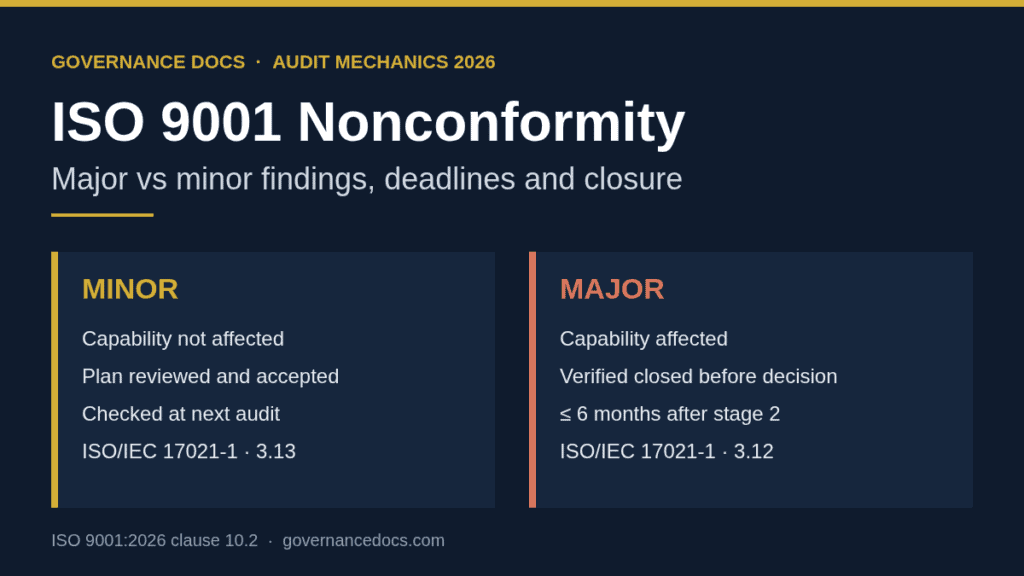
ISO/IEC 17021-1 separates the two grades by one test: capability. A major nonconformity (definition 3.12) is one that affects the capability of the management system to achieve its intended results. A minor nonconformity (3.13) is one that does not. The standard’s notes add that a major can be raised where there is significant doubt that effective process control is in place, or where several minor findings against the same requirement show a systemic failure.
| Question | Minor nonconformity | Major nonconformity |
|---|---|---|
| Does it affect the QMS’s capability to deliver its intended results? | No | Yes |
| Typical pattern | Isolated lapse in an otherwise working process | A required process is missing, or a process is failing repeatedly |
| Example | One training record missing from an otherwise complete file | No internal audits performed in the cycle, or nonconforming product shipped with no control |
| Before initial certification (17021-1, 9.5.2) | Certification body reviews and accepts your corrective action plan | Correction and corrective action must be verified as closed |
| Hard limit after stage 2 (9.5.3.2) | None in the standard; plan due within the time the body sets | Verified within 6 months of the last day of stage 2, or stage 2 is repeated |
| Verification method (9.4.10) | Usually documented evidence, confirmed at the next audit | Documented evidence or a follow-up visit, full or limited |
| Risk to the certificate | Low if the plan is credible and actually delivered | Certificate withheld, recertification not granted, or suspension |
Grading an ISO 9001 nonconformity is a judgment made by the audit team against that definition, not a formula. If you disagree with a grade, say so at the closing meeting: clause 9.4.5.4 requires the team leader to try to resolve diverging opinions and to record any point left unresolved. You also have access to the certification body’s appeals process, which it must explain at the closing meeting (9.4.7.2 f).
The Clock That Starts at the Closing Meeting
At the closing meeting the certification body must tell you, under clause 9.4.7.2, how findings are graded, its process for handling nonconformities and the consequences for your certification status, and the timeframe for you to present a plan for correction and corrective action. Write those dates down before you leave the room, because the clock on every ISO 9001 nonconformity runs from here. Then clause 9.4.9 applies: you must analyse the cause and describe the specific correction and corrective action, taken or planned, within a defined time.
| Stage | What happens | Who sets the deadline |
|---|---|---|
| Closing meeting | Findings presented, grades and response timeframe stated | Certification body (9.4.7.2) |
| Response | Root cause, correction and corrective action submitted | Certification body’s procedure; plans are commonly due within weeks, not months |
| Review | Body decides whether your causes and actions are acceptable | Certification body (9.4.10) |
| Verification | Evidence reviewed, or a follow-up visit for a major | Certification body (9.4.10) |
| Initial certification, major open | Must be verified within 6 months of the last day of stage 2 | ISO/IEC 17021-1, 9.5.3.2 |
| Recertification, major open | Must be closed before the current certificate expires | ISO/IEC 17021-1, 9.6.3.2.2 |
The exact response window, often expressed in days, sits in your certification body’s procedure and contract, so check it rather than relying on a figure from another company’s audit. The six-month and expiry limits are the ones the standard fixes, and they are not negotiable.
Where ISO 9001 Nonconformity Findings Cluster
No public body publishes a reliable league table of ISO 9001 findings, so treat any precise percentage you see online with suspicion. From an auditor’s chair, though, the same few requirements produce most reports:
- Internal audit (9.2): the programme does not cover all processes, auditors audit their own work, or findings are raised and never closed.
- Management review (9.3): minutes exist but do not show the required inputs, such as customer satisfaction, supplier performance, or the effectiveness of actions on risks and opportunities.
- Corrective action itself (10.2): the response treats the symptom, the root cause is “human error”, and nobody checks effectiveness.
- Competence (7.2): the required competence is not defined, or there is no evidence that training worked.
- Control of external providers (8.4): suppliers are approved once and never re-evaluated.
- Nonconforming outputs (8.7): rejected product is not segregated or the disposition is not recorded.
- Calibration and monitoring resources (7.1.5): overdue or missing calibration status.
Note the third item. A weak response to an earlier finding is itself a nonconformity against clause 10.2, and at surveillance the auditor must review the actions taken on nonconformities from the previous audit (17021-1, 9.6.2.2 b). A finding that recurs is one of the surest ways for a minor to become a major.
How to Close an ISO 9001 Nonconformity the First Time
Clause 10.2 of ISO 9001:2026 sets the sequence, and the certification body’s reviewer reads your response against it. A response that gets accepted at first submission has five parts.
- Correction. Fix the immediate problem: complete the missing record, quarantine the product, recalibrate the gauge. Clause 10.2 calls this reacting to the nonconformity and dealing with the consequences.
- Extent check. Ask whether the same gap exists elsewhere. If one training record was missing, sample the others. Clause 10.2 requires you to determine whether similar nonconformities exist or could occur.
- Root cause. Use a method you can show, such as 5 Whys or a fishbone diagram, and stop at a cause you can act on. “Operator forgot” is not a root cause; “the onboarding checklist has no training sign-off step” is.
- Corrective action. Change the process so the cause is removed, with an owner and a date. If the finding reveals a new risk, update your risks and opportunities, and change the QMS where needed, as clause 10.2 also requires.
- Effectiveness evidence. Say how and when you will check that the action worked, then keep the evidence. Clause 10.2 requires documented information to be retained as evidence of the nature of the nonconformity, the actions taken and the results.
Submit the evidence, not just the plan, wherever you can; an ISO 9001 nonconformity response that only promises action is the kind most likely to be sent back. For a major, the certification body must verify that the correction and corrective action are effective (9.4.10), and a well-organized evidence pack is often what lets it do so from documents instead of sending an auditor back on site at your cost.
Mistakes That Turn a Minor Finding Into a Major One
- Missing the response deadline. Under 9.6.5.2, failing to meet certification requirements is a ground for suspension, and a suspended certificate is temporarily invalid (9.6.5.3).
- Closing on paper only. If the next auditor samples the same process and finds the same gap, expect the grade to rise.
- Retraining as the default action. Retraining fixes a knowledge gap. If the person already knew the rule, the cause is elsewhere.
- Arguing the grade after the meeting. Raise disagreement at the closing meeting, where it can be recorded, or through the formal appeal route.
- Ignoring minors that share a clause. Several minors against one requirement can be graded together as a major, because together they show the process is not under control.
If you are preparing for your first certification, the ISO 9001 stage 1 audit guide shows how areas of concern are raised before they become findings, and the ISO 9001 surveillance audit guide covers how open findings are followed up in years one and two. The full route from gap analysis to certificate is in our guide on how to get ISO 9001 certified.
ISO 9001 Nonconformity: Frequently Asked Questions
How long do we have to close out an ISO 9001 nonconformity?
Your certification body sets the response deadline and must tell you at the closing meeting. Two limits come from ISO/IEC 17021-1: after an initial stage 2 audit, any major must be verified within six months of the last day of stage 2 or stage 2 is repeated; at recertification, a major must be closed before the existing certificate expires.
Can we get certified with an open minor nonconformity?
Yes. Before the certification decision, the certification body must have reviewed and accepted your corrective action plan for minors (9.5.2 c). The actions are then checked at the next surveillance audit, so the plan has to be real.
Can a major nonconformity cost us the certificate?
A major found at initial certification delays the certificate until it is verified closed. A major at surveillance or recertification that is not resolved in time can lead to suspension, withdrawal, or a reduced scope under clause 9.6.5 of ISO/IEC 17021-1.
What is the difference between an observation and a nonconformity?
A nonconformity is a requirement not met, backed by evidence, and needs a cause analysis and corrective action. An observation or opportunity for improvement is the auditor’s advice; it needs no formal response, although an unaddressed observation is often where the next finding comes from.
Does ISO 9001:2026 change how nonconformities are graded?
No. Grading comes from ISO/IEC 17021-1, which did not change with the new edition. ISO 9001:2026 keeps nonconformity and corrective action in clause 10.2, so the response steps above apply to audits against either edition while organizations transition.
Building a Corrective Action System Auditors Trust
The fastest way to handle an ISO 9001 nonconformity is to have the machinery ready before the audit: a written procedure, a request form that forces a root cause, and a register that shows every finding from opening to verified closure. Auditors read that register at every surveillance visit, and a clean one is the best evidence that your QMS corrects itself.
If you are building that machinery now, the ISO 9001 Toolkit includes a Nonconformity and Corrective Action Procedure, a Corrective Action Request Form and a Corrective Action Register written for ISO 9001:2026, alongside the rest of the 84 templates. For the certification body rules behind every deadline in this guide, see ISO/IEC 17021-1 on iso.org.

Governance Docs
Governance Docs LLC
Recent Posts
November 15, 2026
November 14, 2026
November 13, 2026
November 12, 2026
November 11, 2026