CART

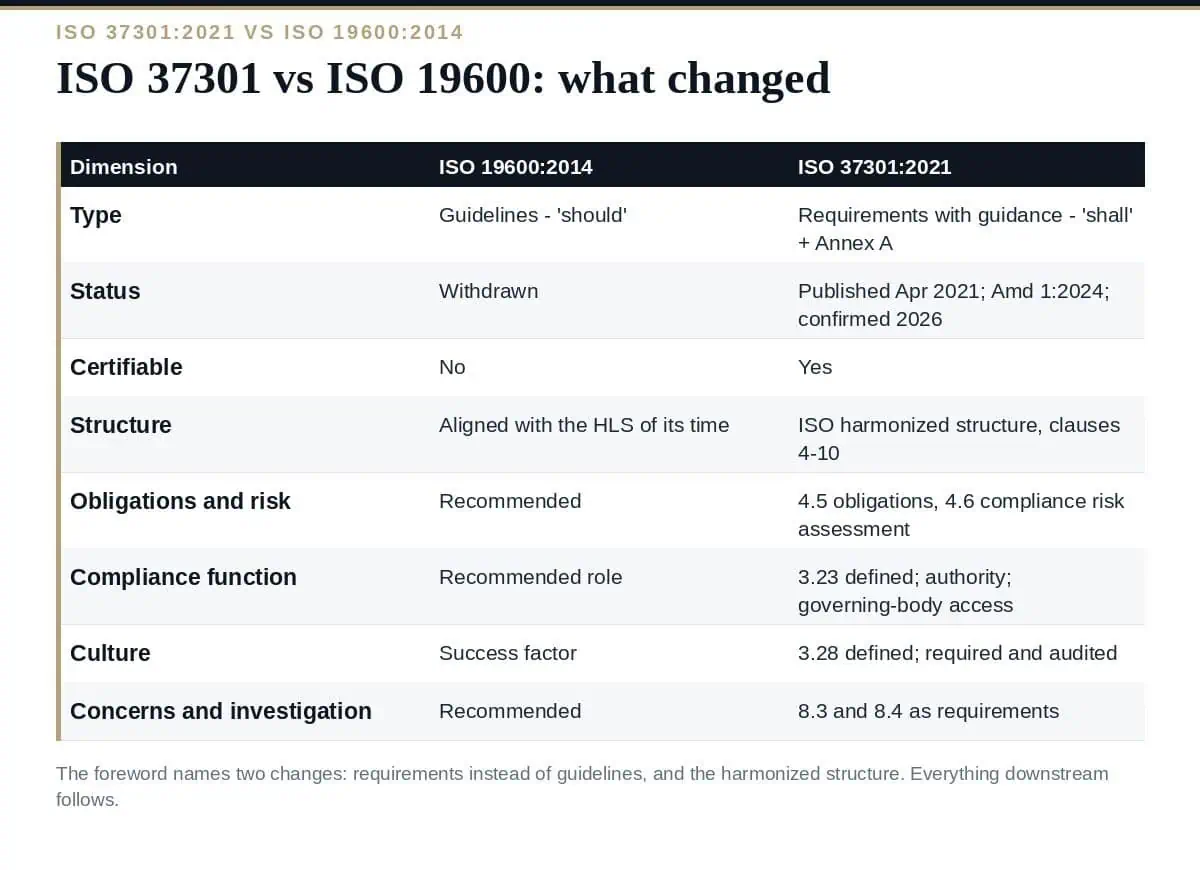
ISO 37301 vs ISO 19600 is a comparison between a standard you can certify to and one you never could. ISO 19600:2014 was guidance — “Compliance management systems — Guidelines” — written entirely in “should”, auditable by nobody, and useful as a description of good practice. ISO 37301:2021 replaced it in April 2021 as “Compliance management systems — Requirements with guidance for use”, and its foreword names exactly two main changes: it “now contains requirements with additional guidance for use based on those requirements”, and it “follows ISO’s requirements for a harmonized structure for management system standards”.
Those two sentences change everything downstream — the compliance function, the obligations register, the risk assessment, the culture requirement and the raising-concerns route became things an accredited certification body tests rather than things a consultant recommends. ISO 19600 is withdrawn; ISO 37301 has a free 2024 climate amendment and was confirmed unchanged by ISO in 2026. This guide sets out what changed clause by clause, what the shift from “should” to “shall” means for a system built on the old guidance, the five requirements that catch ISO 19600 users out, and how to migrate documentation that still cites the withdrawn text.
Free gap assessment
Is risk management actually changing decisions?
A maturity assessment against all eight principles, the framework and the process, free. Nobody can certify you to ISO 31000, so this scores distance from good practice instead.
Run the free ISO 31000 maturity assessment → or View premium report sample
| Dimension | ISO 19600:2014 | ISO 37301:2021 |
|---|---|---|
| Title | Compliance management systems — Guidelines | Compliance management systems — Requirements with guidance for use |
| Status | Withdrawn; replaced by ISO 37301 | Published April 2021; Amd 1:2024 (climate change); reviewed and confirmed 2026 (stage 90.93) |
| Type | Type B guidance standard — recommendations only | Type A requirements standard — “shall” clauses with Annex A guidance |
| Certifiable | No | Yes, by accredited certification bodies |
| Structure | Broadly aligned with the high-level structure of the time | ISO harmonized structure: clauses 4–10, identical core text, common terms |
| Committee | ISO/PC 271 (project committee) | ISO/TC 309, Governance of organizations |
| Compliance obligations and risk | Recommended identification and assessment | 4.5 Compliance obligations and 4.6 Compliance risk assessment as requirements |
| Compliance function | Recommended role | 3.23 defined; responsibility and authority for the CMS required; access to the governing body |
| Culture | Discussed as a success factor | 3.28 defined; the introduction states organisations “need to establish and maintain a culture of compliance”; requirements follow |
| Raising concerns and investigation | Recommended | 8.3 and 8.4 as requirements |
| ISO 37301:2021 clause | What it requires | How ISO 19600 treated it |
|---|---|---|
| 4.1–4.4 Context and CMS | Determine external and internal issues, interested parties and their requirements, the scope, and establish the CMS; Amd 1:2024 adds climate change as a context consideration | Recommended context analysis |
| 4.5 Compliance obligations | Systematically identify and maintain the obligations — mandatory and voluntarily chosen (3.25) — and their implications | Recommended; the register was good practice, not a requirement |
| 4.6 Compliance risk assessment | Identify, analyse and evaluate compliance risks — the likelihood and consequences of noncompliance (3.24) — and review on change | Recommended assessment |
| 5 Leadership | Governing body and top management commitment; compliance policy; roles — the compliance function, management and personnel | Recommended commitment |
| 6 Planning | Actions to address risks and opportunities to the CMS; compliance objectives; planning of changes | Recommended objectives |
| 7 Support | Resources, competence, awareness, communication, documented information | Recommended |
| 8.1 Operational planning and control | Processes planned, implemented and controlled | Recommended |
| 8.2 Establishing controls and procedures | Controls proportionate to the assessed compliance risks | Recommended controls |
| 8.3 Raising concerns | A mechanism for reporting suspected noncompliance with protection for the person raising it | Recommended |
| 8.4 Investigation processes | Documented investigation of noncompliance | Recommended |
| 9 Performance evaluation | Monitoring and measurement; internal audit; management review | Recommended |
| 10 Improvement | Nonconformity and corrective action; continual improvement | Recommended |
Every row on the right is a “shall” — that is the whole of ISO 37301 vs ISO 19600 in one column. The content is recognisably ISO 19600’s — the drafters kept the model — but an organisation that “aligned with ISO 19600” can now be non-conformant in ways it could never be before. Our guide to ISO 37301 covers what the certifiable standard contains.
| Step | What to do | Output |
|---|---|---|
| 1 Retire the citation | Replace every reference to ISO 19600:2014 with ISO 37301:2021 (and Amd 1:2024); the old standard is withdrawn | Updated policy, manual and procedures |
| 2 Re-map the structure | Cross-reference existing documents to clauses 4–10 of ISO 37301; identify gaps where a ‘should’ you skipped is now a ‘shall’ | Gap register |
| 3 Rebuild the obligations register | By operation, with owners, requirements and review dates; link to the risk assessment (4.6) | Register and risk assessment |
| 4 Fix the function | Define responsibility, authority, competence, independence and access to the governing body | Roles and reporting lines |
| 5 Evidence culture | Governing-body decisions, consequences for noncompliance, communication, training records, survey data | Culture evidence file |
| 6 Run the cycle | Internal audit and management review against ISO 37301; corrective actions; then certification if wanted | Audit-ready CMS |
Is ISO 19600 still valid?
No. ISO 19600:2014 was withdrawn when ISO 37301:2021 replaced it in April 2021. Documents, tenders and policies that cite ISO 19600 should be updated.
What are the main differences between ISO 37301 and ISO 19600?
ISO 37301’s foreword names two: it contains requirements (with guidance) rather than guidelines, and it follows ISO’s harmonized structure. The consequence is that a compliance management system can now be certified, and its obligations register, risk assessment, compliance function, culture, raising-concerns route and investigation process are tested against ‘shall’ clauses.
Can we be certified to ISO 19600?
No, and you never could — it was a guidance standard. Certification is available only against ISO 37301:2021.
Does ISO 37301 have an amendment?
Yes, Amd 1:2024 on climate change, added to the context clause; ISO confirmed the standard unchanged in its 2026 systematic review, so it is stable ground.
How does ISO 37301 relate to ISO 37001?
ISO 37301 covers all compliance obligations at a generic level; ISO 37001:2025 covers bribery in depth. Many organisations nest ISO 37001 inside an ISO 37301 system; our guide to ISO 37001 vs ISO 37301 covers the combination.
Treat ISO 37301 vs ISO 19600 as a change of kind, not degree: the model is the same, the verb changed, and with it the consequences. Retire the old citation, re-map to clauses 4–10, rebuild the obligations register with owners and risk links, give the compliance function authority and access, evidence the culture, and run the audit-and-review cycle — because a system that aligned with ISO 19600 is not yet one that conforms to ISO 37301.
The compliance policy and manual, the obligations register, the compliance risk assessment, the compliance function charter, the raising-concerns and investigation procedures and the audit set — written to ISO 37301:2021 — are in the ISO 37301 Compliance Management Toolkit, or start with the free templates.

October 12, 2026
October 12, 2026
October 12, 2026

October 12, 2026
October 12, 2026

