CART
A compliance obligations register is the artifact ISO 37301 builds everything else on, and it is the one most organizations discover they do not really have. Clause 4.5 requires compliance obligations to be identified; clause 4.6 requires the compliance risks associated with them to be assessed. Both sit in the context clause — before leadership, before planning — because nothing downstream means anything until you know what actually binds you.
This guide covers what belongs in the register, the columns that make it usable, how the risk assessment attaches to it, and the maintenance that keeps it true.
Free gap assessment
Is risk management actually changing decisions?
A maturity assessment against all eight principles, the framework and the process, free. Nobody can certify you to ISO 31000, so this scores distance from good practice instead.
Run the free ISO 31000 maturity assessment → or View premium report sample
Wider than most first drafts assume. A compliance obligations register should capture requirements the organization must comply with and those it chooses to comply with:
The last category is the one that surprises people. A voluntary commitment, once made publicly, becomes a compliance obligation in the standard’s terms — and an auditor will ask how you assure it.
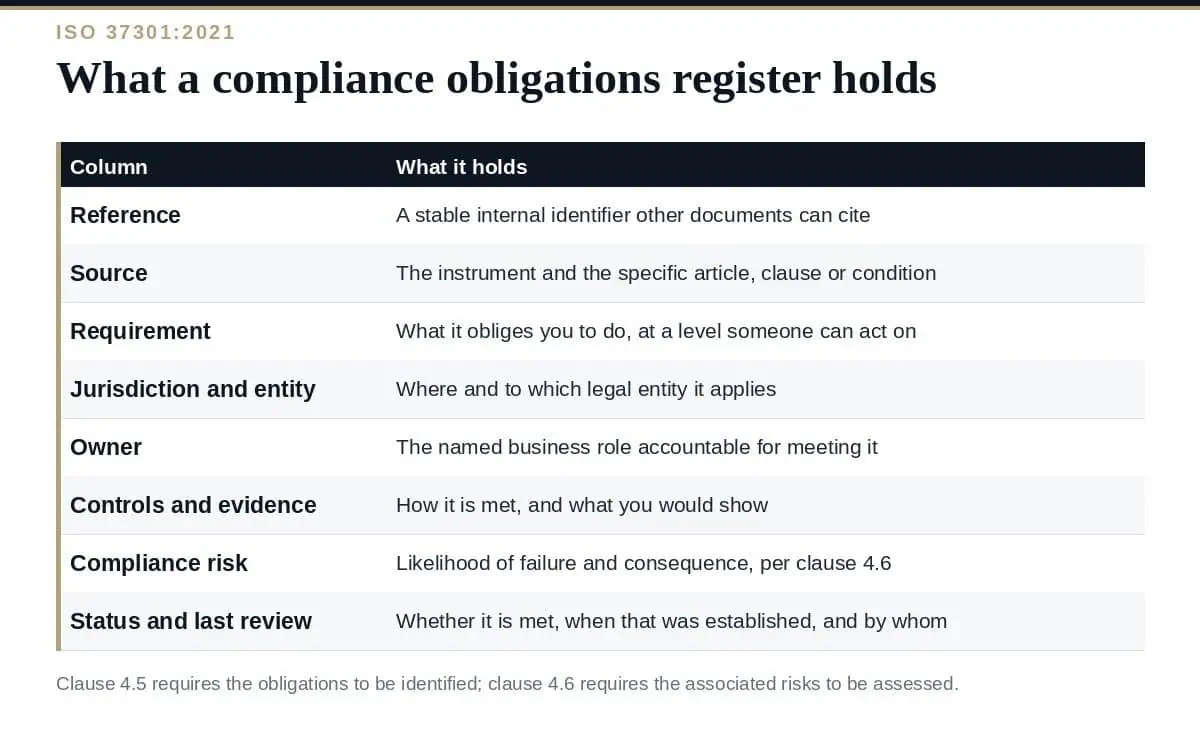
| Column | What it holds, and why |
|---|---|
| Reference | A stable internal identifier, so other documents can cite the obligation |
| Source | The instrument and the specific article, clause or condition — not just its title |
| Requirement | What it obliges you to do, in your own words, at a level someone can act on |
| Jurisdiction and entity | Where and to which legal entity it applies — the column that stops a group register becoming fiction |
| Owner | The named role accountable for meeting it, in the business rather than in compliance |
| Controls and evidence | How it is met, and what you would show — the link to the policy, process or record |
| Compliance risk | Likelihood of failure and consequence if it fails, per clause 4.6 |
| Status and last review | Whether it is currently met, when that was last established, and by whom |
Two columns do the heavy lifting. Source has to be specific to the clause: “the GDPR” is not an obligation, “Article 30 — maintain records of processing activities” is, because only the second can be tested. And owner has to be a business role. A register where compliance owns every line records the compliance function’s workload, not the organization’s obligations.
Clause 4.6 asks for the compliance risks to be assessed — identifying them by relating obligations to activities, products, services and operations, and analysing their consequences and likelihood. The efficient way to satisfy it is to assess in the register rather than in a separate document, so each obligation carries its own risk position.
Three practices keep that honest:
A compliance obligations register decays faster than any other compliance artifact because the law moves without asking. Four habits keep it current:
The register also feeds the rest of the management system: it scopes the compliance policy, drives the objectives, sets the internal audit programme and populates management review. Our guide to ISO 37301 and what a compliance management system must contain covers those connections, and where anti-bribery obligations are prominent the same register can carry them — see ISO 37001.
Where does ISO 37301 require a compliance obligations register?
Clause 4.5 requires compliance obligations to be identified and clause 4.6 requires the associated compliance risks to be assessed. The standard does not mandate the word “register” — it mandates the outcome, and a register is how organizations achieve it.
Do voluntary commitments belong in it?
Yes. Requirements you choose to comply with sit alongside those you must comply with, and a public commitment you cannot evidence is a compliance risk of its own.
How detailed should each row be?
Specific enough to be testable. One row per discrete requirement beats one row per statute — otherwise the evidence column has to cover a dozen unrelated duties.
Can we merge it with the ISO 14001 or ISO 45001 legal register?
Often yes, and it saves duplication. Keep a column identifying which management system each obligation belongs to so the scopes stay legible at audit.
Who should own the register itself?
The compliance function maintains it; the business owns the lines. Conflating those is why registers go stale — the maintainer cannot know that a process changed.
Build the compliance obligations register before anything else in the management system, because clause 4.5 sits where it does for a reason. Cite sources at clause level, put a business owner on every line, assess the compliance risk in the register rather than beside it, and reconcile a sample to the evidence once a year. A register that is specific, owned and current makes the rest of ISO 37301 mostly mechanical; one that lists statutes without owners makes the whole system unauditable.
Register templates, risk scoring and the supporting procedures are in the ISO 37301 Compliance Management Toolkit, or start with the free ISO templates.

October 13, 2026
October 12, 2026
October 12, 2026

October 12, 2026

October 12, 2026

