CART
ISO 37001 vs ISO 37301 is a question of depth against breadth. ISO 37001:2025 is the anti-bribery management system standard — “applicable only to bribery”, as its scope says, with requirements that go deep into one risk: a bribery risk assessment, due diligence, financial and non-financial controls, gifts and hospitality, raising concerns and investigation. ISO 37301:2021 is the compliance management system standard — the successor to ISO 19600 guidance, now certifiable — that covers every compliance obligation an organisation has, from competition law to data protection to sanctions, at a level that lets each obligation be identified, assessed, controlled and monitored.
Both come from ISO/TC 309, both use the harmonized structure, both are certifiable, and ISO 37001’s introduction says an anti-bribery policy “is a component of an overall compliance policy” and names ISO 37301 as the standard that specifies “requirements for a general compliance management system”. This guide compares the two clause by clause, sets out the six differences that decide which you need, explains the 2025 and 2026 edition position of each, and shows how to run ISO 37001 nested inside ISO 37301 as one system with one audit.
Free gap assessment
Is risk management actually changing decisions?
A maturity assessment against all eight principles, the framework and the process, free. Nobody can certify you to ISO 31000, so this scores distance from good practice instead.
Run the free ISO 31000 maturity assessment → or View premium report sample
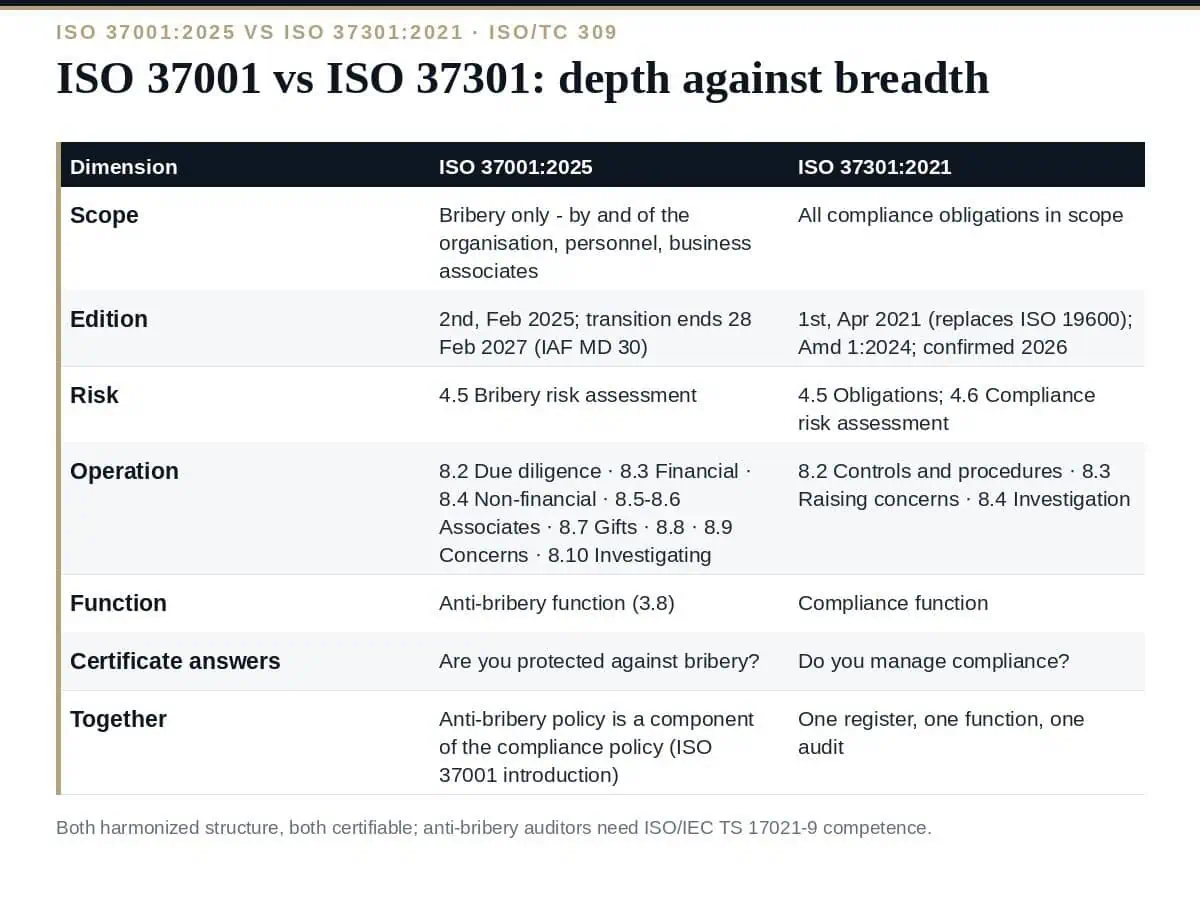
| Dimension | ISO 37001:2025 | ISO 37301:2021 |
|---|---|---|
| Title | Anti-bribery management systems — Requirements with guidance for use | Compliance management systems — Requirements with guidance for use |
| Edition | Second edition, February 2025 (replaces 2016 and its Amd 1:2024); CHF 196; transition ends 28 February 2027 under IAF MD 30 | First edition, April 2021 (replaces ISO 19600:2014 guidance); Amd 1:2024 (climate change); reviewed and confirmed 2026 |
| Committee | ISO/TC 309, Governance of organizations | ISO/TC 309 |
| Scope | Bribery only — by and of the organisation, its personnel and business associates, direct and indirect | All compliance obligations — legal, regulatory, contractual, voluntary — the organisation chooses to bring into scope |
| Risk assessment | 4.5 Bribery risk assessment | 4.5 Compliance obligations; 4.6 Compliance risk assessment |
| Operational clauses | 8.2 Due diligence; 8.3 Financial controls; 8.4 Non-financial controls; 8.5 Controlled organisations and business associates; 8.6 Anti-bribery commitments; 8.7 Gifts, hospitality, donations; 8.8 Managing inadequacy of controls; 8.9 Raising concerns; 8.10 Investigating and dealing with bribery | 8.2 Establishing controls and procedures; 8.3 Raising concerns; 8.4 Investigation processes |
| The function | Anti-bribery function (3.8): person(s) with responsibility and authority for the ABMS | Compliance function with access to the governing body |
| Certifiable | Yes; auditor competence under ISO/IEC TS 17021-9 | Yes |
On ISO 37001 vs ISO 37301 the shared ground is most of the text. Clauses 4.1–4.4, 5, 6, 7, 9 and 10 are harmonized core text in both, with anti-bribery or compliance wording: context, interested parties, scope, leadership and policy, roles, risks and opportunities to the system, objectives, resources, competence, awareness, communication, documented information, monitoring, internal audit, management review and improvement.
Both standards define compliance culture (ISO 37301, 3.28) or anti-bribery culture (ISO 37001, 3.30 — adapted, the standard says, from ISO 37301’s definition), both require a raising-concerns route and an investigation process, and ISO 37001’s introduction states it “can be used in conjunction with” ISO 37301 and ISO 37002. ISO 37001’s definition of anti-bribery culture as “values, ethics, beliefs and conduct that exist throughout an organization” is the compliance-culture idea applied to one risk.
| Situation | Recommendation | Why |
|---|---|---|
| Sales through agents or intermediaries; public-sector customers; operations in high-risk countries | ISO 37001 | The exposure is bribery; the deep controls and due diligence are what buyers and prosecutors look for |
| Regulated business with many obligations — financial services, pharma, energy | ISO 37301, with ISO 37001 nested if bribery risk is material | The obligations register is the problem; bribery is one row that may deserve its own depth |
| Tender or customer clause naming ISO 37001 | ISO 37001 | Meet the clause; add ISO 37301 later if governance wants it |
| Board wants one compliance framework and one certificate | ISO 37301 | Breadth first; the anti-bribery controls become 8.2 controls inside it |
| Adequate-procedures defence under the UK Bribery Act or equivalent | ISO 37001 | Its structure follows the six principles of the UK guidance closely: proportionate procedures, top-level commitment, risk assessment, due diligence, communication, monitoring |
| Already certified to one | Integrate the other | Shared core text; one audit under Global ACI-TECH-3-008 (ex-IAF MD 11) |
Is ISO 37301 a replacement for ISO 37001?
No. ISO 37301 covers all compliance obligations at a generic level; ISO 37001 covers bribery in depth with requirements — due diligence, financial and non-financial controls, gifts and hospitality — that ISO 37301 does not contain. ISO 37001’s introduction positions the anti-bribery policy as a component of an overall compliance policy.
Can we certify to both with one audit?
Yes. Both use the harmonized structure and come from ISO/TC 309; integrated audits reduce audit time under Global ACI-TECH-3-008. Anti-bribery auditors must meet ISO/IEC TS 17021-9.
Which edition of each applies?
ISO 37001:2025 — with certification to the 2025 edition only from 31 August 2026 and the 2016 edition’s certificates expiring 28 February 2027 under IAF MD 30 — and ISO 37301:2021 with Amd 1:2024, confirmed by ISO in 2026.
Is ISO 19600 still relevant?
ISO 19600:2014 was guidance, not certifiable, and was withdrawn when ISO 37301:2021 replaced it. Documents citing ISO 19600 should be updated.
Which one do customers ask for?
Customers, lenders and public buyers concerned about bribery ask for ISO 37001. Regulators and boards concerned with governance across all obligations ask for ISO 37301. Many organisations end up with both, nested.
Decide ISO 37001 vs ISO 37301 by the question being asked of you. Bribery exposure, a tender clause or an adequate-procedures defence points to ISO 37001:2025; a wide obligations landscape and a board wanting one framework points to ISO 37301:2021; and where both are true, nest the anti-bribery system inside the compliance system, run one register, one function and one audit, and let the 37001 clause 8 controls be the deep row in the 37301 table.
The anti-bribery policy and manual, the bribery risk assessment workbook, the due diligence procedures, the gifts and hospitality register, the raising-concerns and investigation procedures and the cross-mapping to ISO 37301 are in the ISO 37001 Anti-Bribery Toolkit, or start with the free templates.

October 12, 2026
October 12, 2026
October 12, 2026

October 12, 2026
October 12, 2026

