CART
IEC 31010 is the companion to ISO 31000 that answers the question the guidelines standard deliberately leaves open: how, exactly, do you assess a risk? IEC 31010:2019, Risk management — Risk assessment techniques, is the second edition, published jointly by IEC and ISO in June 2019 to replace the 2009 edition, and it describes 41 techniques in Annex B — from brainstorming and checklists through HAZOP, FMEA, fault tree and bow tie analysis to Bayesian networks, Monte Carlo simulation and cost-benefit analysis — organised by what they are for: eliciting views, identifying risk, determining sources and causes, analysing controls, understanding consequences and likelihood, analysing dependencies, providing a measure of risk, evaluating significance, choosing between options, and recording and reporting. Its main clauses explain the core concepts, the uses of risk assessment, how to plan and implement an assessment and how to select a technique, and Annex A tabulates the techniques against the process step, the inputs they need and the outputs they produce. Like ISO 31000 it is a guidance document, not a requirement. This guide explains what IEC 31010 covers and what changed in 2019, sets out the technique categories with the techniques in each, describes how clause 7 says to choose, walks through the assessment process in clause 6, and names the techniques most organisations actually need.
Free gap assessment
Is risk management actually changing decisions?
A maturity assessment against all eight principles, the framework and the process, free. Nobody can certify you to ISO 31000, so this scores distance from good practice instead.
Run the free ISO 31000 maturity assessment → or View premium report sample
| ISO 31000:2018 | IEC 31010:2019 | |
|---|---|---|
| Title | Risk management — Guidelines | Risk management — Risk assessment techniques |
| Role | Principles, framework and process | Techniques for the risk assessment step of the process (identification, analysis, evaluation) and for treatment selection |
| Length and form | Sixteen pages; no techniques | A substantial document; 41 technique descriptions with strengths, limitations, inputs and outputs |
| Status | Guidance; not certifiable | Guidance; not certifiable; IEC and ISO dual logo |
| Edition | Second, 2018 | Second, 2019 — replacing ISO/IEC 31010:2009, which described 31 techniques |
The 2019 edition of the standard rewrote the main text around how to plan, implement and choose rather than around the process steps, added techniques for consequence and likelihood analysis, dependencies, and evaluation — Bayesian analysis, cross-impact analysis, value-at-risk, frequency-number diagrams, S-curves among them — and dropped or merged some 2009 entries. Our guide to ISO 31000 covers the process the techniques serve.
Free business impact analysis
How long can each activity really be down?
Rate the impact of an outage over time, set RTOs and maximum tolerable periods of disruption, map the people, systems and suppliers behind each activity, and get a recovery sequence back, free.
Run the free business impact analysis → or View premium report sample
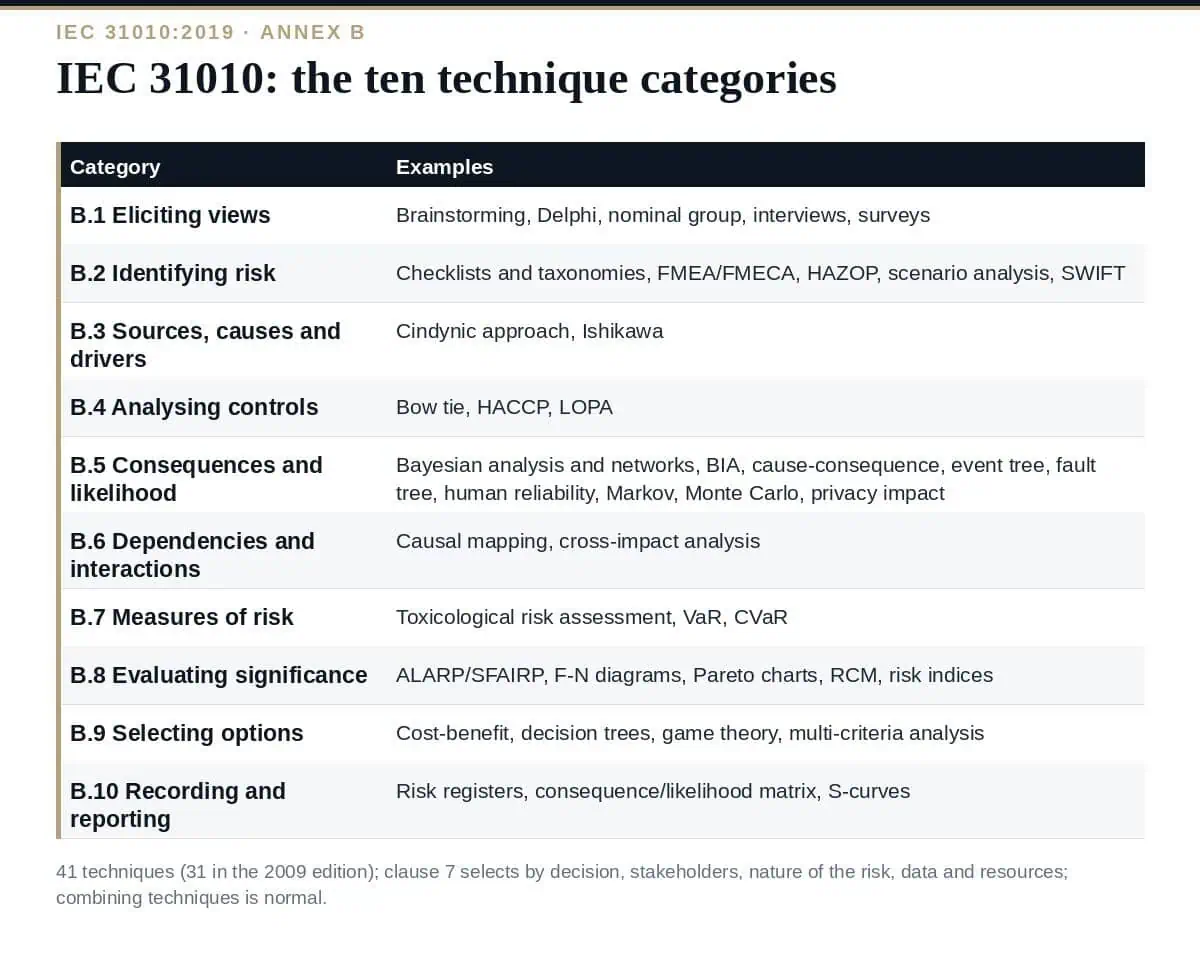
| Category (Annex B) | Purpose | Techniques |
|---|---|---|
| B.1 Eliciting views from stakeholders and experts | Gathering knowledge and opinion | Brainstorming; Delphi technique; nominal group technique; structured or semi-structured interviews; surveys |
| B.2 Identifying risk | Finding what could happen and how | Checklists, classifications and taxonomies; failure modes and effects analysis (FMEA) and FMECA; hazard and operability study (HAZOP); scenario analysis; structured what-if technique (SWIFT) |
| B.3 Determining sources, causes and drivers of risk | Understanding why | Cindynic approach; Ishikawa (fishbone) analysis |
| B.4 Analysing controls | Testing what stands between cause and consequence | Bow tie analysis; hazard analysis and critical control points (HACCP); layers of protection analysis (LOPA) |
| B.5 Understanding consequences and likelihood | Estimating outcome and chance | Bayesian analysis; Bayesian networks; business impact analysis; cause-consequence analysis; event tree analysis; fault tree analysis; human reliability analysis; Markov analysis; Monte Carlo simulation; privacy impact analysis |
| B.6 Analysing dependencies and interactions | Seeing how risks connect | Causal mapping; cross-impact analysis |
| B.7 Providing a measure of risk | Expressing risk as a quantity | Toxicological risk assessment; value at risk (VaR); conditional value at risk (CVaR) or expected shortfall |
| B.8 Evaluating the significance of risk | Deciding what matters | As low as reasonably practicable (ALARP) and so far as is reasonably practicable (SFAIRP); frequency-number (F-N) diagrams; Pareto charts; reliability-centred maintenance; risk indices |
| B.9 Selecting between options | Choosing treatments | Cost-benefit analysis; decision tree analysis; game theory; multi-criteria analysis |
| B.10 Recording and reporting | Communicating the result | Risk registers; consequence/likelihood matrix; S-curves |
Annex B files each technique once, but Annex A’s table shows that most serve more than one process step — the consequence/likelihood matrix is used for evaluation as well as reporting, and a bow tie is as much a reporting tool as a control analysis. Our guides to bow tie analysis and risk criteria cover two of the most used.
Clause 7 of the standard sets out the selection considerations. The purpose of the assessment and the decision it informs come first; then the needs of stakeholders; then the characteristics of the risk — the nature of the uncertainty, the time frame, the availability and quality of data; then the resources — time, expertise, information; then whether the output has to be qualitative, semi-quantitative or quantitative; and finally the need for consistency with other assessments. The clause makes two points that matter more than the list: a technique’s output is only as good as its inputs, and combining techniques is normal — identification with one, analysis with another, evaluation with a third.
| Need | Techniques the standard points to | Why |
|---|---|---|
| Find hazards in a process plant | HAZOP, SWIFT, checklists | Systematic, guideword-driven identification |
| Understand how a failure propagates | FMEA/FMECA, fault tree, event tree, cause-consequence | Cause and effect structure |
| Show which controls matter for a major event | Bow tie, LOPA | Controls on both sides of the top event |
| Put a number on a financial exposure | Monte Carlo simulation, VaR, CVaR | Distributions rather than point estimates |
| Decide between treatment options | Cost-benefit analysis, decision trees, multi-criteria analysis | Value of each option against criteria |
| Present risk to a board | Consequence/likelihood matrix, risk register, S-curve | Recording and reporting forms |
| Step | What the standard covers | Output |
|---|---|---|
| 6.1 Plan the assessment | Define purpose and scope, understand the context, engage stakeholders, define objectives, consider human, organisational and social factors, review criteria, record and report requirements | Assessment plan |
| 6.2 Manage information and develop models | Collect and analyse information; develop and validate models; select techniques | Data and models fit for the technique |
| 6.3 Apply the techniques | Identify risk — sources, events, consequences; analyse — controls, consequences, likelihood, interactions, measures; evaluate against criteria | Risk analysis results |
| 6.4 Review the analysis | Verify and validate results; sensitivity and uncertainty analysis; monitor and review | Reviewed results with stated uncertainty |
| 6.5 Apply the results to decision making | Decisions about the significance of risk and the selection of options | Decisions and their rationale |
| 6.6 Record and report | Recording, reporting to stakeholders, and the content of a report | The record |
The steps map onto ISO 31000’s clause 6: scope, context and criteria (6.3 of ISO 31000) into the plan; risk assessment (6.4) into applying the techniques; treatment selection (6.5) into applying the results; recording and reporting (6.7) into the record.
What is IEC 31010?
The 2019 edition of Risk management — Risk assessment techniques: the companion to ISO 31000 that describes 41 techniques for identifying, analysing and evaluating risk and selecting treatments, with guidance on planning an assessment and choosing techniques. It is a joint IEC/ISO guidance document, not a requirements standard.
How many techniques does it describe?
41 in the 2019 edition’s Annex B, grouped in ten categories by purpose, from eliciting views and identifying risk to recording and reporting; the 2009 edition described 31.
Do I have to use it to comply with ISO 31000?
Neither is a requirement. ISO 31000 says risk assessment should use techniques appropriate to the context; the techniques standard is where those techniques are described, and ISO 31000 refers to it in its bibliography.
Which technique should I start with?
Clause 7 of the standard says it depends on the decision, the stakeholders, the nature of the risk, the data and the resources. For most organisations: a structured identification method, a bow tie for major risks, a consequence/likelihood matrix with written criteria, and a cost-benefit or multi-criteria method for choosing treatments.
Is IEC 31010 the same as ISO 31010?
The 2009 edition was published as ISO/IEC 31010; the 2019 edition is IEC 31010:2019, published by IEC with ISO, and is the current one.
Use IEC 31010 the way its clause 7 intends: decide what the assessment is for, pick identification, analysis, evaluation and treatment-selection techniques that fit the decision, the data and the people, combine them, and record which you used and why — because ISO 31000 tells you to assess risk and IEC 31010 is the only standard that tells you how, and a register built without a named technique is an opinion in a grid.
The risk assessment procedure with technique selection, the bow tie, FMEA and SWIFT worksheets, the consequence/likelihood matrix with criteria and the treatment option analysis template are in the ISO 31000 Risk Management Toolkit, or start with the free templates.

October 11, 2026
October 11, 2026
October 11, 2026
October 11, 2026
October 11, 2026

