CART
ISO 15189 accreditation cost is built the same way as every other laboratory accreditation invoice — assessor days multiplied by a day rate, plus expenses, plus fixed fees — and medical laboratories sit at the expensive end of that arithmetic for one reason: discipline count. A hospital laboratory accredited for chemistry, haematology, transfusion, microbiology and histopathology needs a technical assessor for each, and every technical assessor is a billed day on site and a billed day of report writing.
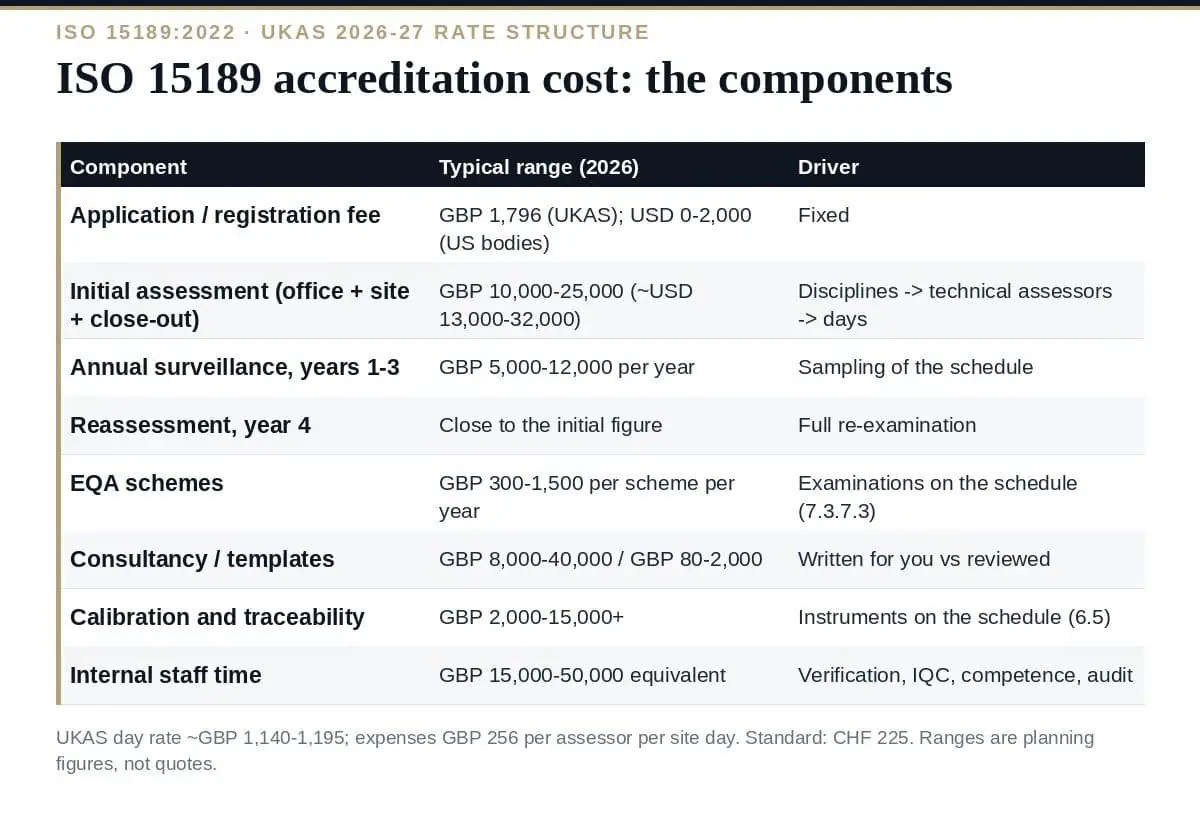
UKAS, the UK national accreditation body, publishes its 2026-27 rate structure — £1,796 to apply, roughly £1,140 to £1,195 per assessment day, a flat £256 per assessor per site day in expenses — and a four-year cycle of initial assessment, three surveillances and a reassessment; the US bodies quote case by case. This guide reconstructs the ISO 15189 accreditation cost line by line from those published figures, sets out the costs that sit around the accreditation invoice — external quality assessment, consultants, calibration, staff time — and explains why the number of disciplines on the schedule, not the number of staff, is the variable to manage.
Free gap assessment
Are you ready for the 2026 edition of ISO 9001?
Score yourself against the new edition, free, including the risk and opportunity split and the clause 10 renumbering that breaks converted checklists.
Run the free ISO 9001 gap assessment → or View premium report sample
Laboratories are accredited to ISO 15189, not certified: an accreditation body operating under ISO/IEC 17011 assesses competence to perform named examinations on named sample types and grants a schedule that lists them. The price follows the schedule. A laboratory with five disciplines and two hundred examinations on its schedule buys more technical assessor time than a single-discipline laboratory with twice the headcount, which is why A2LA, the College of American Pathologists’ ISO 15189 programme and other bodies quote after seeing the application rather than publishing a tariff.
UKAS is the exception: it publishes worked indicative costings for testing and calibration laboratories, and although it publishes no medical-laboratory case study, the rate structure is the same. Our guide to ISO 15189 covers what the schedule of accreditation contains.
| Component | Who invoices it | Typical range (2026) | What drives it |
|---|---|---|---|
| Application or registration fee | Accreditation body | £1,796 at UKAS; US bodies from $0 to about $2,000 | Fixed |
| Optional pre-assessment | Accreditation body | £4,700 to £7,300 at UKAS rates (3.5 to 5.5 days) | Whether you want gaps found before the initial assessment |
| Initial assessment: document review, site visit, close-out | Accreditation body | £10,000 to £25,000 (roughly $13,000 to $32,000) for a multi-discipline medical laboratory | Disciplines on the schedule → technical assessors → site and office days |
| Annual surveillance, years 1 to 3 | Accreditation body | £5,000 to £12,000 per year | Sampling of the schedule; usually one lead plus one or two technical assessors |
| Reassessment, year 4 | Accreditation body | Close to the initial assessment figure | Full re-examination of the schedule |
| External quality assessment (EQA) schemes | EQA providers | £300 to £1,500 per scheme per year, many schemes | Clause 7.3.7.3 requires participation across the examinations on the schedule |
| Consultancy or gap analysis | Consultancy | £8,000 to £40,000 | Writing the system versus reviewing it |
| Documentation templates | Template vendor | £80 to £2,000 | A pack against drafting from scratch |
| Equipment calibration and traceability | Calibration providers | £2,000 to £15,000+ | Clause 6.5; pipettes, balances, thermometers, centrifuges, analysers |
| Internal staff time | Your payroll | £15,000 to £50,000 equivalent | Method verification, IQC design, competence records, internal audit, management review |
| ISO 15189:2022 standard | ISO | CHF 225 (about $280) | Fixed; 62 pages |
The accreditation-body rows are anchored to UKAS’s published 2026-27 rates and its testing-laboratory case studies, scaled for the assessor count a medical laboratory typically needs; the others are labelled typical ranges from published consultancy estimates and project experience. None is a quote. Anyone who gives one figure without asking how many disciplines are on the schedule is guessing.
UKAS’s indicative costings show the mechanism. For its larger-scope testing laboratory — four chemistry and microbiology disciplines — the initial assessment is 2.5 office days, 8 site days split across a lead assessor and three technical assessors at two days each, one close-out day and £2,048 of flat expenses: £15,790.50 in total. Surveillance is 2 office days, 4.5 site days and 0.75 close-out days, £8,837.50 a year. Reassessment in year 4 is £15,740. Three rules follow for a medical laboratory.
The transition to the 2022 edition gives a sense of scale: UKAS reported in December 2025 that moving 560 medical laboratories to ISO 15189:2022 took 850 assessment days — about 1.5 assessment days per laboratory on top of normal surveillance.
In the United States, ISO 15189 accreditation is offered by the College of American Pathologists through its ISO 15189 programme and by A2LA, among others, alongside — not instead of — the CLIA certificate a clinical laboratory needs to operate. Neither publishes a tariff; both price from the scope after an application. A2LA states that its cost varies with the size of the organisation, the size of the scope and readiness, and offers a written estimate.
Budget the same structure as UKAS — a fixed fee, assessor days at a daily rate, travel — and expect the day rate to be higher than the UK figure. Because CLIA inspection continues in parallel, ISO 15189 in the US is an addition to a compliance budget, not a replacement for one.
For comparison, the same arithmetic for a testing laboratory is worked through in our guide to ISO 17025 accreditation cost; the day rates are identical and the difference is the number of disciplines.
How much does ISO 15189 accreditation cost?
For a multi-discipline medical laboratory, plan on £10,000 to £25,000 (about $13,000 to $32,000) for the initial assessment, £5,000 to £12,000 a year in surveillance, a reassessment in year 4 close to the initial figure, plus EQA, calibration, consultancy and staff time. The number of disciplines on the schedule is the main driver.
Why does UKAS publish prices when US bodies do not?
UKAS publishes its rate structure and indicative case studies; A2LA and CAP quote from the application because the price depends on scope and readiness. The structure — fixed fee, assessor days, expenses — is the same everywhere.
Is ISO 15189 accreditation cheaper than ISO 17025?
Not per day — the rates are the same. Medical laboratories tend to cost more because they carry more disciplines and more examinations on the schedule, and because point-of-care testing is now inside scope.
Do we still need CLIA in the US?
Yes. CLIA certification is the legal requirement to test human specimens in the US; ISO 15189 accreditation is voluntary and additional.
What does the standard itself cost?
ISO 15189:2022 is CHF 225 from ISO for the 62-page PDF and ePub bundle, about $280.
Budget ISO 15189 accreditation cost from the schedule: count the disciplines, assume a technical assessor for each, add the office and close-out days the published UKAS structure shows, and price surveillance and the year-4 reassessment as a four-year commitment. Then add the costs the invoice does not carry — EQA per scheme, calibration per instrument, verification per method — because those are where a medical laboratory’s real spend sits.
The Method Verification and Validation Procedure, the Internal Quality Control Procedure, the Competence Matrix and Authorisation Register and the ISO 15189 Internal Audit Checklist are in the ISO 15189 Toolkit, or start with the free templates.

October 11, 2026
October 11, 2026
October 11, 2026
October 11, 2026
October 11, 2026

