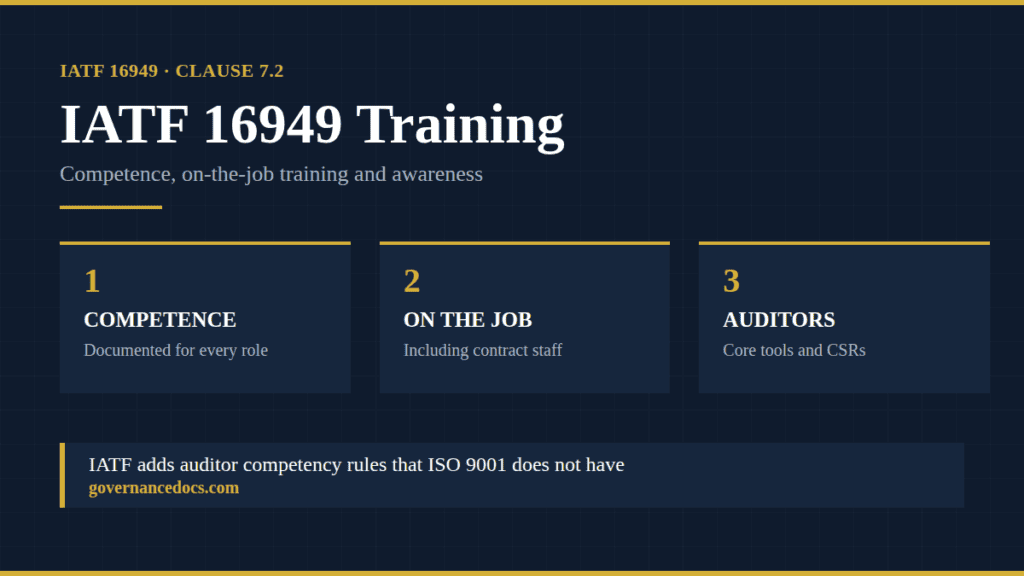
IATF 16949 training is about proving competence, not counting course hours. An auditor will pick a person on the shop floor, ask what they do, and then ask you to show why they are qualified to do it.
This guide sets out the IATF 16949 training requirements in the 2016 edition: competence, awareness and on-the-job training. It covers internal auditor qualification, a sample training matrix and the records auditors usually sample.
IATF 16949:2016 is still the current edition, built on ISO 9001:2015. The IATF plans a second edition for mid-2027, so the clause numbers below are the ones you are audited against today.
Free gap assessment
Where do you stand on the automotive supplemental requirements?
Score only what IATF adds to ISO 9001, free, including customer-specific requirements, product safety and the core tools.
IATF 16949 adds to ISO 9001 rather than replacing it. ISO 9001 clause 7.2 asks you to determine the competence each role needs and to make sure people are competent through education, training or experience.
Where people fall short, you act, for example by training, mentoring or reassigning them. You then evaluate whether the action worked and keep documented information as evidence of competence.
ISO 9001 clause 7.3 covers awareness. People must know the quality policy, the relevant objectives, how they contribute and what happens when work does not conform.
IATF 16949 training and competence clauses, one by one
IATF 16949 adds four competence clauses under 7.2 and two awareness clauses under 7.3. Two of them have been revised by the IATF’s IATF 16949 Sanctioned Interpretations, so check the current text rather than an old copy.
7.2.1 Competence – supplemental
You need a documented process for identifying training needs, including awareness, and for achieving competence. It covers everyone whose work affects conformity to product and process requirements.
People doing specific assigned tasks must be qualified as required, with attention to customer requirements. Sanctioned Interpretation 22, effective November 2021, added prevention content. Training and awareness must cover topics such as recognizing the signs of pending equipment failure and attempted cyber-attacks.
7.2.2 Competence – on-the-job training
Clause 7.2.2 requires on-the-job training, including customer requirements training, for anyone with new or modified responsibilities affecting conformity. That includes quality, internal, regulatory and legislative requirements.
It explicitly covers contract and agency personnel. The level of detail should match the person’s education and the complexity of the task. Anyone whose work can affect quality must be told the consequences of not meeting customer requirements.
7.2.3 Internal auditor competency
You need a documented process to verify that internal auditors are competent, taking into account your own requirements and any customer-specific requirements. You must keep a list of qualified internal auditors.
Sanctioned Interpretation 4, effective September 2020, separates three auditor types. Quality management system, manufacturing process and product auditors must all show at least:
understanding of the automotive process approach to auditing, including risk-based thinking;
understanding of applicable customer-specific requirements;
understanding of the ISO 9001 and IATF 16949 requirements in the audit scope;
understanding of the applicable core tool requirements in the audit scope;
understanding of how to plan, conduct, report and close out audit findings.
Manufacturing process auditors also need technical understanding of the processes they audit, including PFMEA and control plan. Product auditors need to understand product requirements and use the right measuring and test equipment.
If your own staff deliver the auditor training, you must keep documented evidence of the trainer’s competence. Auditors must also maintain their competence over time, through a minimum number of audits per year that you define and by keeping up with internal and external changes.
7.2.4 Second-party auditor competency
If you audit your suppliers, you must show that those second-party auditors are competent. They must meet any customer-specific qualification requirements and show core competencies similar to internal auditors, including the manufacturing process being audited and its PFMEA and control plan.
7.3.1 Awareness and 7.3.2 employee motivation
Clause 7.3.1 requires documented information showing that all employees understand their impact on product quality. That includes customer requirements and the risks a nonconforming product creates for the customer.
Clause 7.3.2 requires a documented process to motivate employees to achieve quality objectives, make continual improvements and support innovation. It includes promoting quality and technological awareness across the organization.
What IATF 16949 awareness training should cover
IATF 16949 awareness training is the session every employee attends, including office staff and temporary workers. Keep it short, practical and tied to your own products. A good session covers:
the quality policy and the objectives that apply to the person’s area;
who your customers are and what a defect costs them, using real examples;
the special characteristics on the products they handle, and how they are marked;
how to stop and escalate when something looks wrong;
early signs of equipment failure and how to report them;
cyber security basics, such as suspicious emails and USB devices;
how their work links to complaints, scrap and rework figures.
Our guide to special characteristics in IATF 16949 explains how those characteristics are identified and controlled, which makes good material for this session.
Qualifying internal auditors for IATF 16949 competence
The standard does not require an external certificate for internal auditors. It requires you to define the competence, verify it and keep the evidence. Some customers do set their own auditor training rules, so check your customer-specific requirements first.
A practical qualification route looks like this:
Write the competence criteria for each auditor type, using the five minimum items above.
Train candidates on IATF 16949, ISO 9001, the core tools and your customers’ requirements.
Record the trainer’s competence if the training is delivered in-house.
Have each candidate shadow audits, then lead audits under supervision.
Assess the candidate against the criteria and record the decision.
Add qualified auditors to the approved list, with the audit types they may perform.
Track the audits each auditor completes and refresh their knowledge when requirements change.
Core tools knowledge is often the gap. Our guide to the IATF 16949 core tools summarizes APQP, PPAP, FMEA, MSA and SPC. Auditors who run layered process audits also need to understand the process they are checking.
A sample IATF 16949 training matrix
A training matrix links each role to the IATF 16949 training it needs, the clause it supports and the evidence you keep. The refresh intervals below are examples only; IATF 16949 lets you set your own.
Role
Training
Clause
Example refresh
Evidence
All employees
Quality awareness, customer impact, cyber basics
7.3.1, 7.2.1
Annually and at induction
Attendance sheet, induction checklist
Operators
Work instructions, special characteristics, reaction plans
7.2.2
On any new or changed task
On-the-job training record, sign-off by trainer
Agency and contract staff
Same as operators for their tasks
7.2.2
Before starting work
On-the-job training record
Internal QMS auditors
IATF 16949, ISO 9001, CSRs, core tools, audit method
7.2.3
When requirements change
Competency file, approved auditor list
Process and product auditors
Above plus PFMEA, control plan, measuring equipment
7.2.3
When requirements change
Competency file, audits completed
Supplier auditors
Customer qualification rules, core tools, process audit
7.2.4
As customers require
Qualification records
Team leaders
Problem solving, containment, escalation
7.2.1
Annually
Training records, effectiveness check
Training records auditors sample
Expect the auditor to trace a person from the floor back to your IATF 16949 training records. Make sure you can show:
the training needs analysis for the role;
the person’s competency or skill matrix entry;
on-the-job training sign-offs for current tasks;
evidence that training was effective, such as observed performance or test results;
the approved internal auditor list and each auditor’s competency file;
Do internal auditors need an external IATF 16949 training certificate?
Not under the standard itself. Clause 7.2.3 requires a documented process to verify competence against defined minimum items. Some customers add their own training rules, so check your customer-specific requirements.
Does on-the-job training apply to temporary workers?
Yes. Clause 7.2.2 explicitly includes contract and agency personnel. Train and record them before they start any task that affects conformity.
How often should IATF 16949 awareness training be repeated?
The standard sets no fixed interval. Set one in your training process, often at induction and annually, and add sessions when customers, products or risks change.
What is the difference between competence and awareness?
Competence means a person can do the task correctly, shown by education, training or experience. Awareness means they understand why it matters, including the customer impact of a defect.
Our IATF 16949 Toolkit provides 250+ editable templates for an automotive QMS — including a Competence Matrix, an On the Job Training record and a Training Needs Identification form — for $99.
When a standard changes, know first
One email a month: edition changes, new deadlines, and what they mean for documentation you already have. No sales sequence.