CART

Key Takeaways
Free gap assessment
How much of ECC-2:2024 is actually in place?
Score all 28 subdomains, free, plus the other NCA control sets that apply alongside the ECC.
Run the free NCA ECC gap assessment → or View premium report sample
In today’s increasingly digital world, NCA ECC cybersecurity compliance has become a critical requirement for Saudi firms aiming to protect their data and operations from the ever-growing threat of cyberattacks. The National Cybersecurity Authority (NCA) in Saudi Arabia has established the Essential Cybersecurity Controls (ECC) framework to help organizations build robust cybersecurity defenses in line with international best practices while addressing the unique challenges faced by businesses in the Kingdom. This article explores the importance of NCA ECC cybersecurity compliance, the key elements of the framework, and practical steps for Saudi businesses to achieve and maintain compliance.
—
The Saudi National Cybersecurity Authority (NCA) was created to enhance the nation’s cybersecurity posture. One of its flagship initiatives is the Essential Cybersecurity Controls (ECC), a comprehensive set of standards and guidelines applying to all government agencies and the private sector. The focus on NCA ECC cybersecurity is essential as it guides organizations on securing their critical information infrastructure and maintaining trust with customers and partners.
Why is this compliance especially vital for Saudi firms? Saudi Arabia is undergoing rapid digital transformation across all sectors, from finance to energy, healthcare to retail. This increased digitization has expanded the attack surface for cybercriminals, making it imperative for businesses to adopt protective measures. Additionally, with the Saudi Vision 2030 initiative emphasizing technology-driven growth, cybersecurity is no longer optional but a cornerstone of sustainable development and international cooperation.
—
The framework outlined by the NCA is designed to be both prescriptive and flexible, ensuring it applies across various industries and organizational sizes. Here are the essential elements of the NCA ECC cybersecurity framework:
One of the fundamental tenets of the NCA ECC is establishing a strong governance structure. Organizations are required to develop cybersecurity policies aligned with business objectives, designate responsible personnel, and conduct regular risk assessments. This proactive approach helps identify vulnerabilities before they can be exploited.
Free ISO 27001 risk assessment
Which of your risks sit above your appetite line?
Set your own risk criteria, pick from 61 information security risk scenarios, rate likelihood and impact, and decide how to treat each one. You get a heat map, a process score and the findings an auditor would raise, free.
Run the free risk assessment → or View premium report sample
Proper management of who can access what information is crucial. ECC mandates that firms implement strict controls such as multi-factor authentication (MFA), role-based access controls (RBAC), and secure password policies. These measures reduce the risk of unauthorized access and insider threats.
Identifying and classifying assets—including hardware, software, and data—is necessary for effective cybersecurity. ECC requires firms to maintain accurate inventories and ensure that all assets are securely configured and regularly updated to defend against known vulnerabilities.
Securing the network perimeter and internal communication channels is another central element. This includes implementing firewalls, intrusion detection and prevention systems (IDPS), and encrypting data in transit. Monitoring network traffic for suspicious activity is also critical.
No cybersecurity system is foolproof. ECC compliance entails having a well-defined incident response plan that includes procedures for detecting, reporting, and mitigating incidents. This ensures minimal disruption and quick recovery after an attack.
Human error remains one of the biggest cybersecurity risks. The NCA stresses continuous training and awareness programs to educate employees about phishing attacks, social engineering, and other threats.
Ongoing evaluation of cybersecurity controls and transparent reporting to the NCA help maintain compliance. Firms may undergo audits to verify adherence and identify areas for improvement.
—
Saudi Arabia’s economy relies heavily on sectors such as energy, finance, healthcare, and telecom, all of which involve critical infrastructure. Cyberattacks on these sectors could have catastrophic consequences, not just for individual companies but for national security and economic stability. The ECC framework provides a common set of safeguards to protect such vital assets.
The NCA ECC is not merely advisory; it is mandatory for many organizations, especially those deemed critical or classified under the Saudi Cybersecurity Framework. Non-compliance can lead to severe penalties, including fines, suspension of operations, or legal action.
Clients and partners are increasingly demanding proof of cybersecurity maturity before engaging in business. Compliance with NCA ECC standards boosts a company’s reputation, assuring stakeholders that data privacy and security are prioritized. Moreover, it facilitates international business by aligning with global cybersecurity norms.
Cybersecurity breaches often result in significant financial costs—not only in remediation but also in lost business opportunities and reputational damage. By complying with ECC controls, Saudi firms position themselves to better prevent attacks and reduce the fallout when breaches occur.
—
Meeting NCA ECC cybersecurity requirements may seem daunting, but Saudi businesses can take a structured approach to compliance:
Evaluate current cybersecurity practices against ECC requirements. This assessment highlights strengths and weaknesses to inform action plans. Many specialized consultants and firms offer gap analysis services tailored for the Saudi market.
Building on the gap analysis, leadership must endorse a strategic plan that defines goals, resource allocation, governance frameworks, and timelines for addressing deficiencies.
Depending on identified gaps, firms may need to deploy firewalls, endpoint protection platforms, data encryption solutions, identity and access management tools, and network monitoring systems.
Document formal cybersecurity policies aligned with ECC guidance and conduct ongoing employee training to enhance awareness and adherence.
Define roles and responsibilities, communication protocols, and recovery processes to ensure readiness for potential cybersecurity events.
Cybersecurity is not a onetime project. Establish mechanisms for ongoing monitoring of controls, conducting internal audits, and preparing for external NCA compliance inspections.
—
There is a global shortage of skilled cybersecurity professionals, and Saudi Arabia is no exception. Companies should invest in upskilling current employees, partnering with educational institutions, and considering outsourcing certain security functions to specialized providers.
Navigating detailed regulatory requirements can be overwhelming. Engaging with experienced consultants and using automated compliance management tools can simplify adherence.
Some firms worry that strict cybersecurity controls may slow down innovation. However, integrating cybersecurity into business processes via a risk-based approach ensures smooth operations without sacrificing protection.
—
As cyber threats evolve, so will the regulatory landscape in Saudi Arabia. The NCA is expected to continuously update its ECC framework to address new technologies such as cloud computing, artificial intelligence, and Internet of Things (IoT). Saudi firms that adopt a forward-looking cybersecurity posture now will be better prepared for future requirements and disruptions.
The government is also fostering increased collaboration between public and private sectors to share threat intelligence and develop national resilience. Participating actively in such initiatives can provide companies with valuable insights and support.
—
For Saudi firms, NCA ECC cybersecurity compliance is no longer a choice but a vital aspect of modern business operations. It underpins national security, regulatory adherence, customer confidence, and operational resilience. While the journey to full compliance may require investment and effort, the protection and competitive advantages gained far outweigh the costs.
By understanding the NCA ECC framework’s core elements, committing to comprehensive cybersecurity strategies, and fostering a culture of security awareness, Saudi businesses can confidently navigate the digital era and contribute to a safer cyber ecosystem for the entire Kingdom.
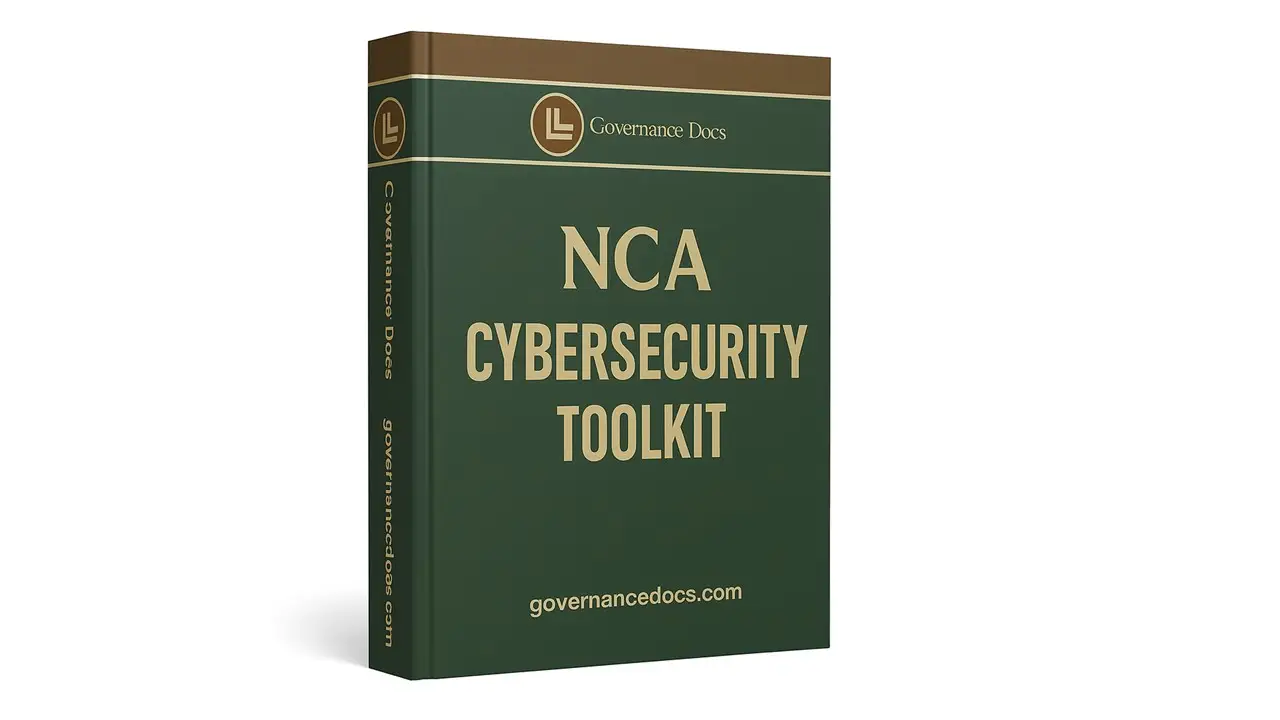
Skip the blank page. Download auditor-written, fully editable NCA Cybersecurity documentation templates and adapt them to your organization in minutes.
Further reading: For authoritative reference, see Saudi Arabia’s National Cybersecurity Authority.
The Personal Data Protection Law points controllers to the NCA controls as their security baseline, and adds its own obligations on consent, rights, records and breach notification to SDAIA: see our guide to the Saudi PDPL.
The ECC are mandatory for Saudi government organisations and their subsidiaries, and for organisations owning or operating critical national infrastructure. The National Cybersecurity Authority also strongly encourages all other organisations in the Kingdom to adopt them as a baseline, and many private-sector entities implement them because government contracts and regulated counterparties increasingly require it.
The current edition, ECC 2-2024, has four main domains — cybersecurity governance, cybersecurity defense, cybersecurity resilience, and third-party and cloud computing cybersecurity — broken into 28 subdomains and 109 individual controls. The earlier ECC-1:2018 edition had a fifth domain for industrial control systems; that domain was deleted and its controls moved to the OTCC. Confirm which edition your regulator or contracting authority expects before you begin a gap assessment.
They overlap substantially but serve different purposes. ISO 27001 is a voluntary, certifiable management system driven by risk; the ECC is a mandatory control baseline with prescribed controls and national oversight. An existing ISO 27001 ISMS gives you most of the governance, risk and documentation machinery, which makes ECC compliance faster — but the ECC controls must still be evidenced individually.
Through self-assessment against the controls, reported to the NCA, supported by evidence and subject to review. This is not a certification scheme with a certificate at the end; it is a regulatory compliance obligation. Practically, that means the quality and traceability of your evidence matters more than any document set, because you are demonstrating control operation rather than earning a badge.
Yes — there are seven sets in all. Alongside the ECC the NCA publishes control sets for cloud computing, critical systems, operational technology, data, telework and social media accounts. Our guide to the NCA cybersecurity controls sets out all seven and their current editions. The ECC is the baseline every in-scope entity starts from; the others apply according to what you operate. Establish which apply to you at the outset, because retrofitting a second framework into a completed programme is considerably more expensive.
If you are ready to move from reading to implementing, the NCA Cybersecurity Toolkit gives you every policy, procedure and record template mapped to the standard — auditor-written, fully editable and ready to download from $99. Not sure it is the right fit? Our Which ISO Toolkit Do I Need? buyer’s guide compares options by goal and industry.
A consultant can be invaluable for complex or high-risk programmes, but they typically charge $150–$400 per hour and take days to weeks to engage. A documentation toolkit delivers 80–90% of the same NCA ECC documentation instantly, for a one-time $99–$199 — and many teams buy the toolkit first, then use a consultant only for a final gap review or audit preparation. See our full toolkit vs. consultant comparison.


October 19, 2026
October 18, 2026
October 18, 2026

October 15, 2026

October 15, 2026

