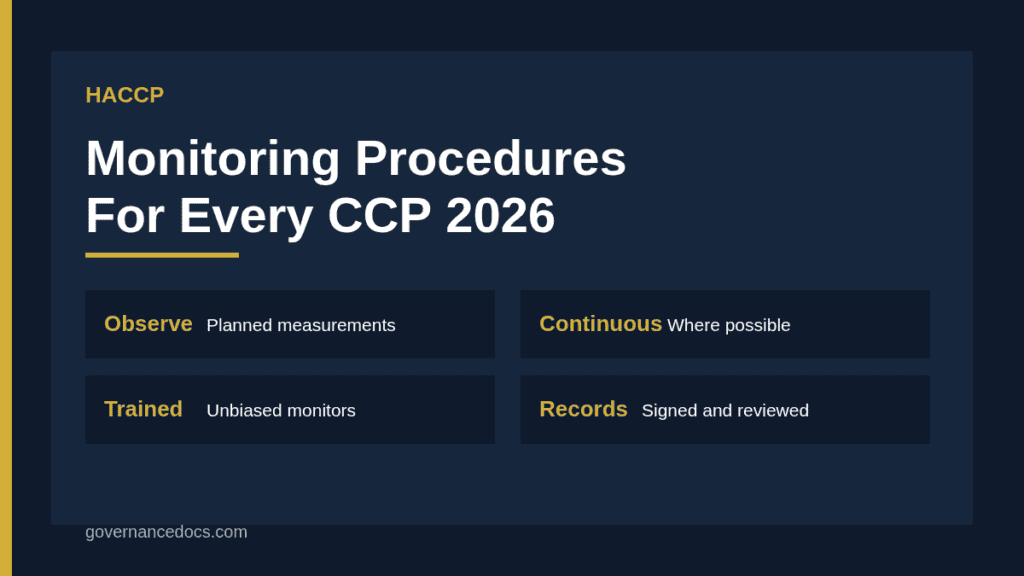
HACCP monitoring procedures are the planned observations or measurements that tell you whether a critical control point is under control right now, not after a problem has reached the customer. Principle 4 of the HACCP system covers monitoring, and it links the critical limits you set to the corrective actions you take when they are missed. A monitoring procedure that is vague, too infrequent or performed by untrained staff is one of the most common weaknesses found in food safety audits.
This guide explains what the U.S. National Advisory Committee on Microbiological Criteria for Foods guidelines say about monitoring and record keeping, and how to turn them into procedures that work on the production floor. It follows our guides to the HACCP principles, critical limits and the HACCP plan.
Free gap assessment
Would your HACCP plan survive an inspection?
Score the whole of the Codex text, free - the good hygiene practices as well as the seven principles, with the US and EU overlays on top.
The guidelines, as presented by the U.S. Food and Drug Administration, describe monitoring as a planned sequence of observations or measurements to assess whether a critical control point is under control, and to produce an accurate record for future use in verification. It serves three purposes: it tracks the operation so you can see a trend toward a limit, it detects when a critical limit is exceeded, and it creates written documentation for verification.
Purpose
Example
Track the operation
Noticing a cooking temperature drifting down before it hits the limit
Detect loss of control
A reading below the critical limit triggers a corrective action
Provide records
Signed temperature charts used in verification and audits
Continuous or batch monitoring
The guidelines say monitoring should ideally be continuous, which is possible with many physical and chemical methods, for example continuous temperature recording during thermal processing. Where continuous monitoring is not feasible, you must set a frequency and procedure reliable enough to show that the critical control point is under control, and the guidelines note that statistically designed data collection or sampling systems often help.
In practice, choose continuous monitoring with alarms for high-risk points such as cooking, pasteurisation and cold storage. For batch checks, base the frequency on the process: how quickly can a deviation develop, and how much product would be affected between checks? A check every four hours means that up to four hours of product could be at risk when a problem is found.
Choose fast, direct measurements
The guidance prefers rapid physical and chemical measurements, such as time, temperature, pH and moisture, over microbiological testing for monitoring, because microbiological tests are seldom effective for monitoring due to the time they take. Results must be available quickly enough for you to act before product ships. Use calibrated instruments, and record the calibration checks.
Who should carry out HACCP monitoring procedures
Monitoring is typically done by line personnel, supervisors, maintenance staff or quality staff. The guidelines say monitors must understand the importance of the task, be unbiased in reporting and be trained in the specific technique. Give them the authority to stop the line, since a monitor who must first find a manager to approve a stop will delay action. Document training and competence, and refresh it when procedures change. Include your HACCP team in reviewing who is assigned.
Writing a monitoring procedure
Each critical control point needs a procedure that answers five questions. Put them in a single-page work instruction that sits near the equipment.
What is measured or observed, and the critical limit.
How it is measured, with the instrument or method.
When and how often, or that it is continuous.
Who performs it and who backs them up.
Where and how results are recorded, and what to do on a deviation.
The last item ties directly to HACCP corrective action. Monitors should know exactly what to do, whom to notify and how to hold affected product.
Records and review
Principle 7 covers record keeping. The guidance recommends that monitoring records be dated and signed or initialled by the person doing the monitoring, and reviewed by quality assurance personnel, with a monthly review suggested. It also suggests a comprehensive system verification each year. Records the guidelines list include the hazard analysis summary, the HACCP plan summary table, validated flow diagrams, supporting documents and operational records such as monitoring data sheets, deviation and corrective action logs and training records.
Record actual values, not just ticks, so you can see trends.
Record the time and the person, and do not pre-fill entries.
Store records where they can be retrieved for audits.
Have a reviewer sign off within a set time, and follow up on gaps.
Also check that every critical control point has HACCP monitoring procedures that match the current plan. When the plan changes, update the procedures, forms and training on the same day, so the floor never works from an outdated sheet.
Linking monitoring to verification
Monitoring shows day-to-day control. Verification checks that the whole system works. Calibrating instruments, reviewing records, observing monitors at work and testing product all belong to verification. Our guide to HACCP validation versus verification explains the difference.
Setting the frequency of HACCP monitoring procedures
Frequency is the design choice that most affects risk. Start from the process: how fast can a hazard develop if a control fails, and how much product passes between checks? A temperature that can fall out of range within minutes needs continuous recording or checks every few minutes. A slower change, such as a chilled store warming overnight, may need a check at set times and an alarm. Record the reasoning in the plan so an auditor can see why a frequency was chosen. If experience shows that deviations occur between checks, increase the frequency or move to continuous measurement. Reviewing HACCP monitoring procedures after every deviation keeps the design honest.
Using technology for critical control point monitoring
Data loggers, wireless sensors and alarms can remove much of the manual burden and improve reliability. They record every reading, alert staff immediately and produce trend charts for review. Technology does not remove the need for procedures: someone must respond to alarms, check that sensors are working and calibrate them. Validate automated systems, keep them under change control and have a manual fallback for outages. When you rely on electronic records, make sure that access is controlled, entries cannot be altered without a trace and backups exist.
Training monitors
Training should be practical. Show monitors how to use the instrument, what a normal reading looks like, what a deviation means for food safety and what to do next. Assess competence by observing them, not only by asking questions. Refresh training after procedure changes, new equipment or a deviation, and record each session. Explain why the task matters. Monitors who understand that a missed reading could make a consumer ill are more likely to take the job seriously and report problems honestly.
Handling missed or late checks
Plan for the day a check is missed. The procedure should say what to do: treat product produced since the last good check as potentially affected, hold it, evaluate it and record the decision. Do not fill in a record after the event to hide the gap. Review missed checks at the monthly record review, and look for causes such as staffing, workload or unclear instructions. If misses are common, redesign the task or add automated alarms.
A hypothetical example
A hypothetical sauce producer sets its cooking step as a critical control point with a critical limit of a minimum core temperature held for a set time. It installs a data logger with an alarm and asks the operator to check the display at the start of each batch and initial a record. The supervisor reviews logger charts daily and signs, and the quality manager reviews all records monthly. When the alarm sounds during one batch, the operator stops the line, holds the batch and calls the supervisor, following the corrective action procedure. Monthly review shows the same kettle triggers most alarms, and maintenance replaces its probe. The example is invented for illustration.
Common findings on HACCP monitoring procedures
Frequency set without reference to how quickly deviations develop.
Monitors untrained or lacking authority to act.
Records filled in at the end of the shift or pre-completed.
Instruments not calibrated.
No record review, or review long after the event.
Monitoring procedures that do not say what to do on a deviation.
To avoid building CCP monitoring sheets, work instructions and record review forms from scratch, the HACCP Toolkit provides documents you can adapt. Have your food safety lead check them against your regulations and customers’ standards.
HACCP monitoring procedures FAQ
What is the purpose of monitoring a CCP?
To track the operation, detect a loss of control and produce records for verification.
Must monitoring be continuous?
The guidance says it should ideally be continuous where methods allow. Otherwise, set a frequency reliable enough to show control.
Why avoid microbiological tests for monitoring?
Results take too long to act on. Rapid measures such as time, temperature and pH are preferred.
Who reviews monitoring records?
Quality personnel, with monthly review suggested by the guidelines. Records should be signed by the monitor.
What happens when a limit is exceeded?
The corrective action procedure applies: stop, control the product, correct the cause and record it.