CART
Key Takeaways
Free gap assessment
Could you demonstrate GDPR compliance today?
Score yourself against what a supervisory authority actually asks for, free — the records, not the policy.
Run the free GDPR gap assessment → or View premium report sample
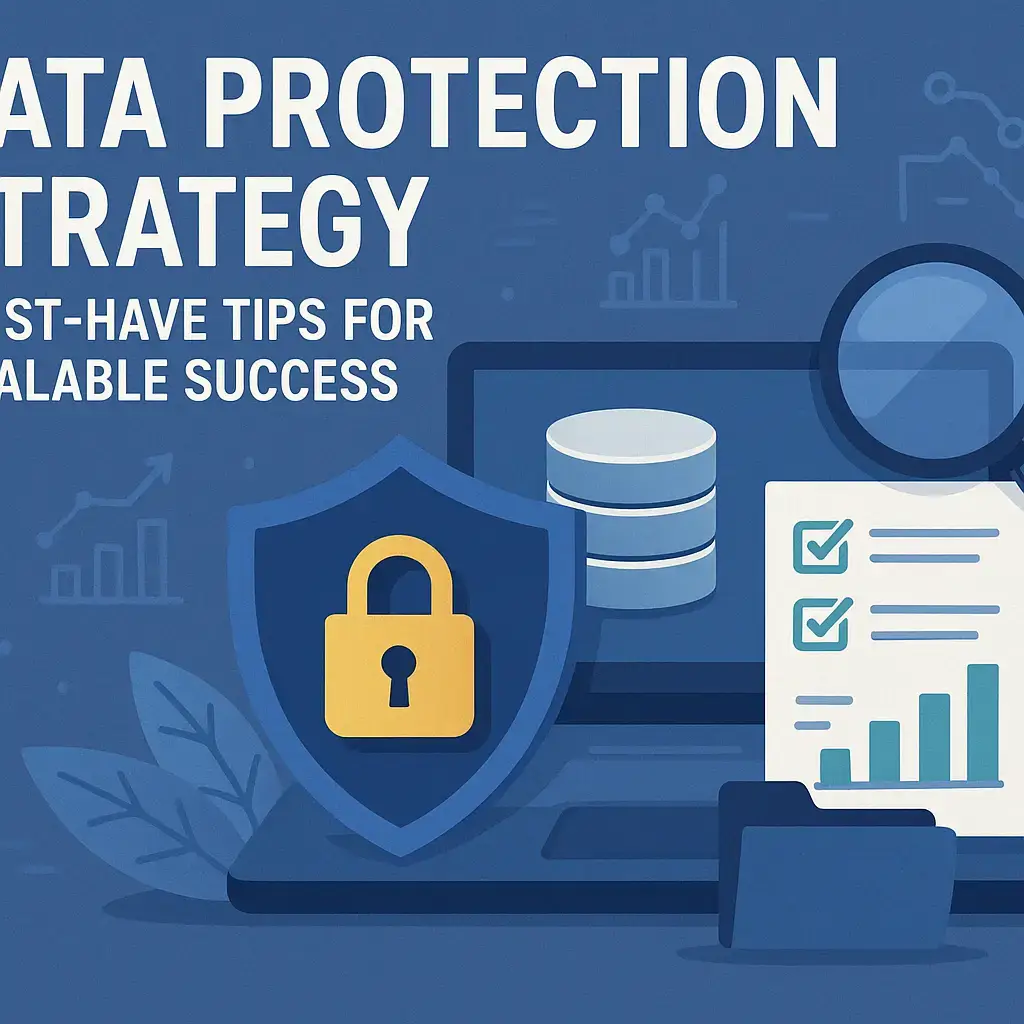
In today’s digital landscape, a solid data protection strategy is no longer just a luxury for large corporations; it is a critical necessity for organizations of all sizes. With cyber threats evolving rapidly and data breaches becoming increasingly common, having an effective approach to safeguarding sensitive information is vital. However, developing a data protection strategy that can scale alongside your business growth presents unique challenges. This article explores essential tips and best practices to build a data protection strategy that not only shields your organization but also supports scalable success.
Before diving into actionable tips, it is crucial to understand why a data protection strategy is indispensable. Companies today rely heavily on data—from customer information and intellectual property to financial records and operational metrics. Losing this data or having it compromised can lead to significant financial losses, reputational damage, and legal consequences.
Moreover, data privacy regulations such as the General Data Protection Regulation (GDPR), California Consumer Privacy Act (CCPA), and other regional laws impose strict requirements on businesses to handle data responsibly. Non-compliance can result in hefty fines and sanctions. Therefore, establishing an effective data protection strategy ensures you’re prepared to meet these mandates while maintaining trust with customers and partners.
To achieve scalable success, your data protection strategy should include several critical components. These elements work together to create a comprehensive shield around your data assets.
Begin with a thorough assessment of the data your organization collects, stores, and processes. Identify sensitive data, including personally identifiable information (PII), financial details, intellectual property, and any other critical assets. Once identified, classify data based on its sensitivity level and business impact, allowing you to prioritize protection efforts effectively.
Controlling who can access data is fundamental. Implement role-based access control (RBAC), ensuring employees and systems have only the permissions necessary for their functions. Advanced identity management solutions, such as multi-factor authentication (MFA), further fortify access controls by requiring multiple forms of verification before granting entry.
Encryption transforms readable data into an unreadable format, protecting it both at rest and in transit. Use strong encryption protocols for databases, backups, and communication channels. Additionally, data masking techniques can be employed to obscure sensitive information during development or when exposed to third parties, reducing the risk of accidental leaks.
Unforeseen incidents like ransomware attacks, system failures, or natural disasters can lead to data loss. Regularly backing up data and having a tested disaster recovery plan are crucial to minimizing downtime and restoring operations quickly. Ensure backups are stored securely and offsite to prevent simultaneous compromise.
Achieving scalability means your data protection approach can effectively support evolving data volumes, business processes, and technology environments without compromising security or efficiency. Here are must-have tips that can help you design a scalable data protection strategy:
Not all data requires the same protection level. Conduct continuous risk assessments and prioritize resources based on the potential impact of data loss or breaches. This selective focus ensures effective allocation of security investments and reduces unnecessary complexity.
Free privacy risk assessment
Which privacy risks would hurt the people whose data you hold?
List your personal data and processing, pick from 38 privacy risk scenarios, rate them for the people concerned and for you, and plan treatment with ISO 27701 controls. You get a heat map, a process score and the findings an auditor would raise, free.
Run the free privacy risk assessment → or View premium report sample
Manual processes are hard to scale and prone to errors. Integrate automation tools for activities like data classification, access monitoring, threat detection, and incident response. Artificial Intelligence (AI) and Machine Learning (ML) can also identify unusual patterns, helping detect breaches sooner.
Data protection is not solely a technological challenge; it’s also about people. Develop clear, concise policies detailing data handling, access rules, and breach reporting protocols. Regularly conduct training and awareness sessions to empower employees to recognize threats such as phishing attacks and improper data usage.
The traditional perimeter-based security is insufficient in today’s decentralized world with cloud computing and remote work. The Zero Trust model operates under the principle “never trust, always verify,” continuously validating every user and device whether inside or outside the network before granting access.
As many organizations embrace cloud infrastructure for scalability and flexibility, integrating cloud-native security tools can facilitate consistent protection without hindering agility. These tools offer features like automated compliance checks, encryption, and identity management tailored for dynamic environments.
Maintain ongoing vigilance by scheduling regular audits of your data protection practices. Compliance checks ensure adherence to evolving regulations, help identify vulnerabilities, and provide recommendations for continuous improvement.
Security should support—not obstruct—business goals. Engage stakeholders across departments to align data protection measures with operational needs and growth plans. This collaboration fosters buy-in, optimizes workflows, and balances protection with usability.
Scaling data protection is not without hurdles. Recognizing and addressing common obstacles early can smooth your path to success.
Rapid growth often leads to data sprawl—data scattered across multiple locations, devices, and cloud services. This fragmentation complicates management and protection efforts. Centralizing visibility through unified dashboards and employing data discovery tools can help regain control.
Skilled cybersecurity professionals are in high demand. Leveraging security-as-a-service models or managed security service providers (MSSPs) can supplement internal teams and provide access to specialized expertise.
Excessively stringent security may frustrate users and reduce productivity. Strive for a user-centric design in your strategy, integrating security measures seamlessly into daily workflows while maintaining robust protection.
Consider a rapidly expanding e-commerce company that experienced exponential growth in customer data and transaction volumes. Initially relying on basic security protocols, the company faced challenges managing data across on-premise servers and multiple cloud platforms.
By implementing a comprehensive data protection strategy based on the principles outlined above, the company achieved:
– Automated data classification, reducing manual errors and focusing protection on high-risk assets.
– A Zero Trust access framework combined with MFA, limiting unauthorized access from internal and remote users.
– Cloud-native encryption and backup solutions that automatically scaled with data growth.
– Regular employee training programs, increasing awareness and reducing phishing-related incidents significantly.
– Proactive risk assessments enabling rapid adjustment of security postures aligned with business growth.
As a result, the company not only improved its resilience against cyber threats but also fostered customer trust and compliance with international regulations, supporting continued expansion without compromising security.
Designing a data protection strategy that supports scalable success requires a thoughtful blend of technology, processes, and people. By focusing on risk management, embracing automation, fostering a security-first culture, and aligning protection with business objectives, organizations can safeguard their valuable data assets regardless of size or industry.
In an era where data is a core asset and threat landscapes evolve constantly, scalable and adaptive data protection is a critical enabler of sustainable growth and competitive advantage. Start implementing these must-have tips today to future-proof your data security and propel your organization towards resilient success.
Skip the blank page. Download auditor-written, fully editable Data Protection documentation templates and adapt them to your organization in minutes.
Further reading: For authoritative guidance, see ISO’s standards catalogue.
Information security protects any information asset from compromise. Data protection is narrower and legally driven: it governs how personal data may be collected, used, shared, retained and deleted, and it gives rights to the people the data describes. A system can be perfectly secure and still unlawful — encrypted data collected without a lawful basis is a data protection failure, not a security one.
Under the GDPR a DPO is mandatory in three cases: you are a public authority, your core activities require large-scale regular and systematic monitoring of individuals, or your core activities involve large-scale processing of special-category or criminal-offence data. Outside those, appointing one is optional — but if you do, the role must be independent, resourced and free from conflicting duties.
Only as long as the purpose you collected it for requires, plus any period a law obliges you to keep it. There is no universal number. The practical answer is a retention schedule: every data category, its purpose, its retention period, the legal basis for that period, and the deletion method. Without one, “storage limitation” is an aspiration rather than a control.
Not automatically, but it changes the assessment. Strong encryption with keys the attacker did not obtain can mean the breach is unlikely to result in a risk to individuals, which can remove the duty to notify them — the obligation to record the incident internally remains, and regulator notification still depends on the risk assessment. Document the reasoning; do not assume encryption alone closes the question.
ISO 27001 gives you the management system — risk assessment, control selection, internal audit, management review — that a data protection programme otherwise has to invent. It does not make you compliant with any privacy law, because it does not address lawful basis, transparency or individual rights. Most organisations pair it with ISO 27701 for the privacy-specific requirements.
If you are ready to move from reading to implementing, the GDPR Documentation Toolkit gives you every policy, procedure and record template mapped to the standard — auditor-written, fully editable and ready to download from $99. Not sure it is the right fit? Our Which ISO Toolkit Do I Need? buyer’s guide compares options by goal and industry.
A consultant can be invaluable for complex or high-risk programmes, but they typically charge $150–$400 per hour and take days to weeks to engage. A documentation toolkit delivers 80–90% of the same data protection documentation instantly, for a one-time $99–$199 — and many teams buy the toolkit first, then use a consultant only for a final gap review or audit preparation. See our full toolkit vs. consultant comparison.

October 22, 2026
October 22, 2026
October 22, 2026
October 22, 2026
October 22, 2026

