

Cyber Security Policy Template: The Practical 2026 CSF Guide
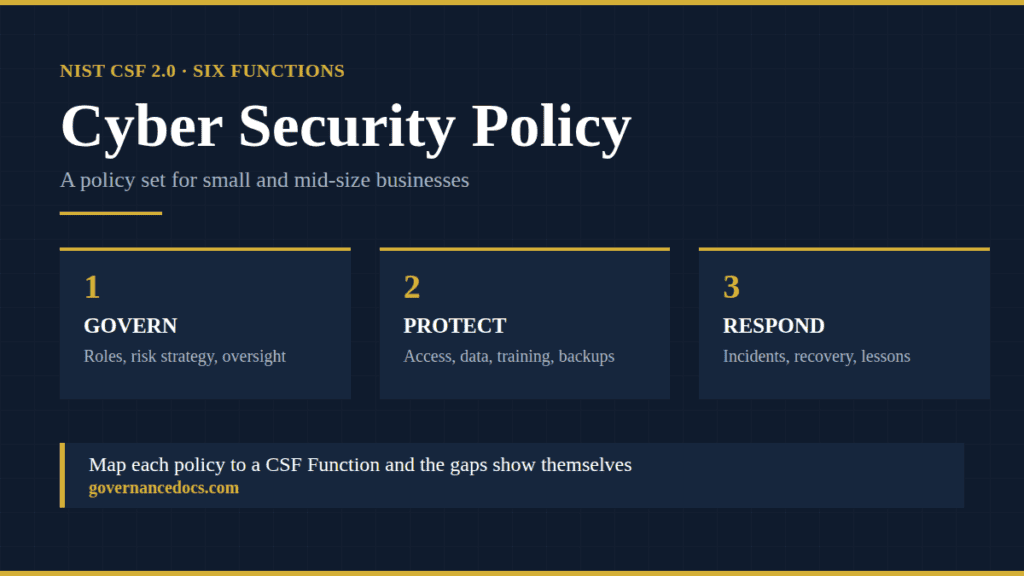
A cyber security policy template built on the NIST Cybersecurity Framework (CSF) 2.0 gives a small or mid-sized business a policy set that follows how security work is actually organized: govern it, know what you have, protect it, spot trouble, respond and recover. You do not need ISO 27001 or a certificate to use it.
This guide lays out a ten-policy set mapped to the six CSF Functions, gives cyber security policy examples you can adapt, and ends with a template skeleton every policy in the set can share.
Why build a cyber security policy template around NIST CSF 2.0
NIST published CSF 2.0 on 26 February 2024. Its Core has six Functions (Govern, Identify, Protect, Detect, Respond, Recover), 22 Categories and 106 Subcategories. Each Subcategory is an outcome, such as “Backups of data are created, protected, maintained, and tested” (PR.DS-11), not a prescribed control.
That makes it a practical skeleton for policy. The Framework asks for policy directly in the Govern Function: GV.PO-01 calls for a policy for managing cybersecurity risks that is established, communicated and enforced, and GV.PO-02 for that policy to be reviewed and updated.
Two caveats. There is no CSF certification, so nobody issues a certificate for following it. And CSF does not dictate document names or how many policies you need; it describes outcomes and leaves the method to you. The NIST Cybersecurity Framework page links to the full CSF 2.0 document and NIST’s quick-start guides.
CSF 2.0 is written for organizations of all sizes and sectors, not only US critical infrastructure. If you later need certification, the same policies map across; our comparison of information security frameworks shows how CSF lines up with ISO 27001 and SOC 2.
The policy set at a glance: security policy templates by Function
For most businesses, this cyber security policy template set runs to ten documents across the six Functions. Smaller firms can merge them into one document; see the sizing section below.
| Function | Policy | CSF 2.0 Categories | Typical owner |
|---|---|---|---|
| Govern | 1. Cybersecurity policy (master) | GV.OC, GV.RM, GV.RR, GV.PO, GV.OV | CEO or security lead |
| Govern | 2. Supplier security policy | GV.SC | Procurement with security |
| Identify | 3. Asset management policy | ID.AM | IT manager |
| Identify | 4. Risk and vulnerability management policy | ID.RA, ID.IM | Security lead |
| Protect | 5. Access control and authentication policy | PR.AA | IT manager |
| Protect | 6. Data protection and backup policy | PR.DS | IT manager and data owners |
| Protect | 7. Secure configuration and patching policy | PR.PS, PR.IR | IT operations |
| Protect | 8. Acceptable use and awareness policy | PR.AT | HR with security |
| Detect | 9. Logging and monitoring policy | DE.CM, DE.AE | IT operations |
| Respond and Recover | 10. Incident response and recovery policy | RS.MA, RS.AN, RS.CO, RS.MI, RC.RP, RC.CO | Security lead |
Every one of the 22 Categories has a home. That is the test to apply to any set of security policy templates: if a Category has no owner document, nobody owns the outcome.
Free ISO 27001 risk assessment
Which of your risks sit above your appetite line?
Set your own risk criteria, pick from 61 information security risk scenarios, rate likelihood and impact, and decide how to treat each one. You get a heat map, a process score and the findings an auditor would raise, free.
Run the free risk assessment → or View premium report sample
Cyber security policy examples by Function
Below are cyber security policy examples: sample clauses for each policy. Each clause drops into the cyber security policy template skeleton further down. Replace bracketed values with your own and delete anything you cannot actually do. A policy that promises more than you deliver becomes an audit finding or, worse, a liability after an incident.
Govern: cybersecurity policy and supplier security
- Accountability: “[Company] manages cybersecurity risk as part of business risk. The [CEO] is accountable for cybersecurity. The [Security Lead] runs the program and reports to leadership [quarterly].” (GV.RR, GV.OV)
- Review: “This policy and all supporting policies are reviewed at least annually and after significant change to the business, its technology or the threats it faces.” (GV.PO-02)
- Suppliers: “Suppliers with access to [Company] systems or Confidential data are risk-assessed before contract, have security requirements written into the contract, and are reviewed [annually].” (GV.SC-05, GV.SC-06, GV.SC-07)
Identify: assets, risk and vulnerabilities
- Inventory: “IT maintains inventories of hardware, software, cloud services and data stores. Devices not in the inventory are not connected to the corporate network.” (ID.AM-01, ID.AM-02)
- Risk assessment: “A cybersecurity risk assessment is performed at least annually and before major changes. Each risk is recorded with an owner and a treatment decision.” (ID.RA)
- Vulnerabilities: “Internet-facing systems are scanned at least [monthly]. Findings are recorded with a remediation due date based on severity.” (ID.RA-01)
Protect: access, data, configuration and people
- Access: “Every user has a unique account. Multi-factor authentication is required for email, remote access, cloud administration and any system holding Confidential data. Access is reviewed [quarterly] and removed on the user’s last working day.” (PR.AA-01, PR.AA-03, PR.AA-05)
- Backup: “Critical data is backed up [daily], with at least one copy offline or immutable. Restores are tested [quarterly] and the results recorded.” (PR.DS-11)
- Patching: “Systems are built from approved secure configurations. Critical security patches are applied within [14] days of release and others within [30] days.” (PR.PS-01, PR.PS-02)
- Awareness: “All staff complete security awareness training at onboarding and [annually], including how to report phishing. Administrators and developers receive role-specific training.” (PR.AT-01, PR.AT-02)
Detect: logging and monitoring
- Logging: “Security-relevant logs from [identity provider, firewalls, endpoints and cloud platforms] are collected centrally and retained for [12 months].” (PR.PS-04)
- Review: “Alerts are reviewed [each business day]. Anything that may indicate an incident is escalated under the incident response policy.” (DE.CM, DE.AE)
Respond and Recover: incidents
- Reporting: “Anyone who suspects an incident reports it immediately to [contact]. The [Incident Lead] triages, categorizes and prioritizes each report.” (RS.MA-02, RS.MA-03)
- Communication: “The incident response plan names who notifies customers, insurers, law enforcement and regulators. Legal counsel confirms any notification obligations and deadlines.” (RS.CO)
- Recovery: “Backups are checked for integrity before restoration. Recovery ends only when the [Incident Lead] declares it complete against defined criteria.” (RC.RP-03, RC.RP-06)
Cyber security policy template skeleton
Use one layout for all ten policies so staff and auditors always know where to look. This security policy template skeleton works for each document in the set:
| Section | What to write | Example wording |
|---|---|---|
| 1. Document control | Owner, approver, version, approval and review dates | “Owner: IT Manager. Approved by: CEO, [date]. Version 1.1. Next review: [date].” |
| 2. Purpose | One or two sentences on why the policy exists | “This policy sets the rules for granting, reviewing and removing access to [Company] systems.” |
| 3. Scope | People, systems, locations and any exclusions | “Applies to all staff, contractors and service accounts, and to all company-managed and cloud systems.” |
| 4. CSF outcomes addressed | The CSF 2.0 Category and Subcategory IDs this policy answers | “PR.AA-01, PR.AA-03, PR.AA-05.” |
| 5. Policy statements | Numbered, testable rules using “must” | “5.1 Multi-factor authentication must be used for all remote access.” |
| 6. Roles and responsibilities | Who approves, operates and checks | “The IT Manager approves privileged access. Line managers confirm their team’s access in quarterly reviews.” |
| 7. Exceptions | How exceptions are requested, approved and expire | “Exceptions are approved by the Security Lead for up to [6] months and recorded in the exceptions log.” |
| 8. Enforcement | Consequences of breaching the policy | “Violations may result in disciplinary action, up to and including termination.” |
| 9. Records and evidence | What proves the policy operates, and how long it is kept | “Quarterly access review sign-offs, retained for [3] years.” |
| 10. Related documents | Procedures, standards and forms underneath | “Access request procedure; joiners, movers and leavers checklist.” |
Keep section 4. Mapping each policy to CSF identifiers lets you show a customer questionnaire or gap assessment exactly which outcomes you cover. Use CSF 2.0 identifiers such as PR.AA-05; older CSF 1.1 codes such as PR.AC-4 belong to a Category that was withdrawn in 2.0.
Sizing your cybersecurity policy template set
A 15-person firm does not need ten separate documents. As a rule of thumb:
| Organization | Typical approach | Documents |
|---|---|---|
| Very small (roughly under 25 staff) | One combined cybersecurity policy template with a section per Function | 1 policy plus an incident response plan |
| Small to mid-sized | Master policy plus separate access, backup and incident policies | 4 to 6 |
| Larger, or selling to regulated customers | The full ten-policy set with procedures underneath | 10 plus procedures |
Whatever the size, the content of the cyber security policy template is the same; only the packaging changes. Our NIST CSF policy templates guide shows how a full library of cybersecurity policy templates covers all 106 outcomes. If a regulation or customer contract requires a written information security program, our WISP template guide explains how it fits around these policies.
Rolling out the policy set in six steps
- Pick the size that fits you from the table above, and list the documents you will keep.
- Fill in the master cybersecurity policy first. Every other policy inherits its roles, review cycle and exception process.
- Complete the remaining policies with the shared skeleton, mapping each one to CSF 2.0 Categories.
- Check that each of the 22 Categories has an owning document, then get management approval and record it.
- Publish the set, train staff on what changed, and collect acknowledgements.
- Start collecting the evidence each policy names, so the first review has records to look at.
Step four is the quality gate. If you finish your cyber security policy template work and a Category is still unowned, fix that before approval rather than after an assessor finds it.
Mistakes that make a cyber security policy template fail
- Copied wholesale. Text lifted from a government or enterprise policy that mentions “the agency” or controls you do not run.
- Promises you cannot keep. “All patches within 48 hours” when the real figure is a month.
- No owner or review date. Nobody updates a policy nobody owns.
- Procedure inside policy. Step-by-step tool instructions mean every tool change needs management re-approval.
- Old identifiers. CSF 1.1 references in a document that claims CSF 2.0 alignment.
- No evidence. The policy says access is reviewed quarterly, but no review is recorded.
Cyber security policy template FAQ
Is NIST CSF only for US companies?
No. CSF 2.0 is designed for organizations of any size, sector or country. It is voluntary and free to use.
How many cybersecurity policies does a small business need?
CSF sets no number. One well-structured cyber security policy template can cover all six Functions for a very small company, provided each Category has clear rules and an owner. Split documents out as the team and customer demands grow.
Can we get certified against NIST CSF?
No. There is no CSF certification scheme. You can self-assess or have a third party assess you against a target profile. If customers want a certificate, ISO 27001 is the usual route, and it starts from a top-level ISO 27001 information security policy.
What is the difference between a cyber security policy and an IT policy?
A cyber security policy sets risk rules for protecting systems and data. IT policies also cover operational matters such as hardware purchasing, change scheduling and service levels. Our guide to building an IT policy manual covers that wider library.
Our NIST CSF Toolkit provides 164 editable templates covering all 106 CSF 2.0 Subcategories — including a Cybersecurity Policy, a Data Security Policy and an Incident Response Policy — for $99.
Related guide: Vulnerability Management Policy Template
When a standard changes, know first
One email a month: edition changes, new deadlines, and what they mean for documentation you already have. No sales sequence.

Governance Docs
Governance Docs LLC
Recent Posts
November 27, 2026

November 27, 2026

November 26, 2026

November 26, 2026

November 26, 2026