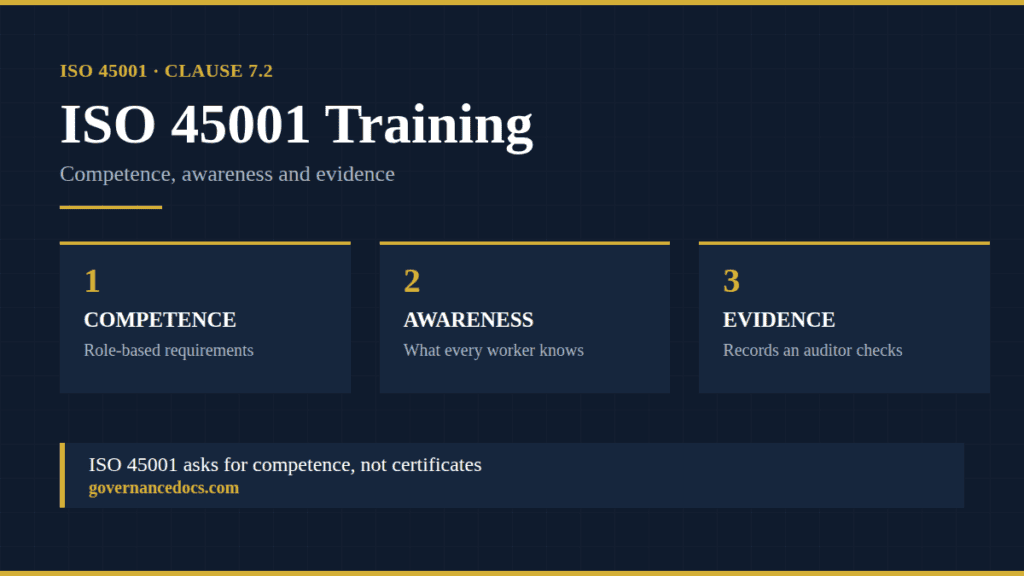
ISO 45001 training is not one course you send people on. It is the competence and awareness the standard expects every worker to have, backed by records that show how you decided what each role needs.
Certification auditors do not ask for training certificates. They ask workers questions, then check whether your records explain the answers. This guide covers what ISO 45001:2018 actually requires, the main types of training, a training matrix you can copy and how auditors test competence.
Free gap assessment
Could you prove workers take part in safety decisions?
Score every clause of ISO 45001, free, including the consultation and participation evidence that fails more audits than any other requirement.
Four parts of the standard drive training. None of them names a course, a provider or a number of hours.
Clause
What it requires
Evidence auditors look for
5.4 Consultation and participation of workers
Provide the mechanisms, time, training and resources for consultation and participation. Non-managerial workers participate in determining competence requirements, training needs, training and evaluating training.
Safety committee minutes or worker input on the training plan
7.2 Competence
Determine the competence needed by workers who affect or can affect OH&S performance, ensure they are competent through education, training or experience, act to close gaps, evaluate whether those actions worked, and keep records.
Competence requirements per role, training records, effectiveness checks
7.3 Awareness
Make workers aware of the OH&S policy and objectives, their contribution, the consequences of not conforming, relevant incidents, the hazards and risks that affect them, and their ability to remove themselves from imminent and serious danger.
Induction content, toolbox talks, answers given in worker interviews
8.1 Operational planning and control
Control the hazards identified in planning. In the hierarchy of controls at 8.1.2, training sits with administrative controls, below elimination, substitution and engineering controls.
Task training linked to the risk assessment and to safe work procedures
Clause 7.2 also brings in documented information. You must retain documented information as evidence of competence, so competence records are mandatory records.
There is no ISO 45001 training certificate requirement
The standard does not require any worker to hold a certificate. Competence can come from education, training or experience, and you decide which mix each role needs.
A certificate is still useful evidence. It is just not the requirement. A forklift driver with a card but no idea of the site traffic plan is not competent for your site. An experienced supervisor with no certificate may be, if you can show how you assessed it.
Most organizations need four layers. The lengths below are typical ranges, not requirements.
Type
Who needs it
Typical length
What it should produce
Awareness
Every worker, including new starters and contractors on site
A short induction session, then refreshers
Workers who can explain the policy, their hazards and how to report
Role-based OHS training
Anyone whose task is controlled by a procedure or permit
Varies by task
Competence in the controls for that task
Internal auditor
Staff who will audit the OH&S management system
One to three days
Auditors who can plan, sample, and write findings against the clauses
Lead auditor
Certification body auditors, consultants, some program managers
About four to five days with an exam
A course certificate that supports auditor certification
Awareness and OHS training by role
Awareness covers the 7.3 list. Role-based OHS training covers the controls in your risk assessment: permits, lockout, working at height, chemical handling, driving and so on.
Legal requirements sit on top of the standard. In the US, OSHA explains on its OSHA training requirements page that workers must receive the safety training its standards define. Treat those as legal requirements under clause 6.1.3 and feed them into your training matrix.
ISO 45001 internal auditor training
ISO 45001 internal auditor training does not have to be a certified course. The standard asks you to show that your auditors are competent and objective, not that they passed a particular exam.
A good course covers the clause structure, audit planning, sampling, interviewing workers, and writing a nonconformity. Pair it with a few supervised audits before anyone audits alone.
Lead auditor training
Lead auditor courses are for people who audit other organizations or lead audit programs. Courses certified by CQI and IRCA are widely offered, and Exemplar Global certifies training providers whose courses support its ISO 45001 auditor certification.
A matrix turns 7.2 into something an auditor can sample. Start from the roles in your organization chart, not from the courses you already run. This example is a starting point.
Add one column for triggers. A new process, a serious incident or a change in law should prompt training outside the normal cycle.
Training records that hold up
A record that survives an audit shows who was trained, on what, when, by whom and how competence was confirmed. Record the content version too, so you can show what people were taught before and after a procedure changed.
The confirmation field is the one most often left blank. Pick one method per training type and use it every time:
Awareness: a short quiz, or a few questions asked during site walks.
Task training: observed performance against the safe work procedure, signed off by a competent supervisor.
Internal auditors: review of their first audit reports by an experienced auditor.
Top management: evidence in management review minutes that OH&S results were discussed and acted on.
How auditors check ISO 45001 competence
Auditors test ISO 45001 competence by working backward from the shop floor. Expect these checks.
Worker interviews. They ask a worker what the main hazards of the job are, how to report a near miss and whether they can stop work they consider dangerous.
Matrix against records. They pick names from the matrix and ask for the matching records.
Link to risk. They check that task training covers the controls in the risk assessment.
Effectiveness. Clause 7.2 requires you to evaluate whether training worked. A signed attendance sheet alone rarely proves that.
Worker participation. They look for evidence that workers helped decide what training is needed.
Define the competence each role needs, using the risk assessment and legal register.
Ask workers and their representatives what is missing, as clause 5.4 expects.
Compare current people against the requirements and record the gaps.
Close gaps with training, mentoring, supervised practice or recruitment.
Evaluate effectiveness through observation, quizzes, audit findings or incident trends.
Keep records and set refresh triggers in the matrix.
Training is one workstream in our ten-step ISO 45001 implementation plan. ISO 45001 is also being revised, with a new edition expected in 2027. Our ISO 45001 revision guide tracks what is reported to change. Until then, certification remains against ISO 45001:2018.
ISO 45001 training FAQ
Is ISO 45001 training mandatory?
The standard requires competence and awareness, not a particular course. In practice almost every organization uses some ISO 45001 training to get there, because it is the easiest way to show the gap was closed.
Do internal auditors need a certified course?
No. You need evidence that each auditor is competent and objective. A short course plus supervised audits is common and acceptable.
How often should ISO 45001 training be refreshed?
The standard sets no frequency. Set one per role in your matrix, usually annual awareness refreshers, and add triggers for incidents, new equipment and changes in law.
Can ISO 45001 training be delivered online?
Yes, for awareness and theory. Practical task competence usually needs supervised practice or observation on site before it counts as evidence.
Our ISO 45001 Toolkit provides 50+ editable templates for an ISO 45001:2018 management system — including the Procedure for Competence, Training and Awareness, a Training Matrix and a Training Needs Analysis Form — for $99.
When a standard changes, know first
One email a month: edition changes, new deadlines, and what they mean for documentation you already have. No sales sequence.