

FedRAMP for AI: The Essential 2026 Guide for AI Agents
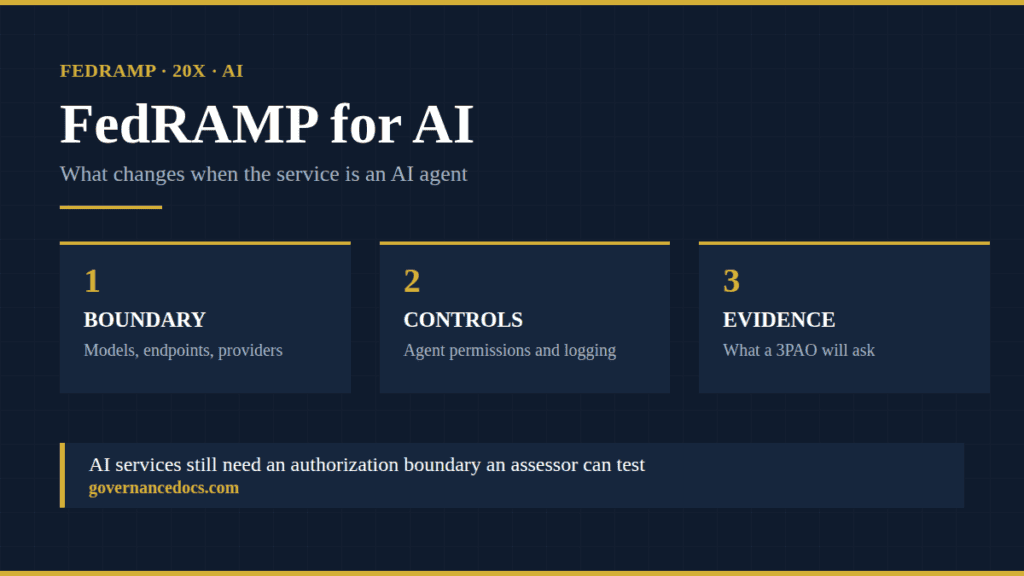
FedRAMP for AI works the same way as FedRAMP for any other cloud service. There is no separate AI baseline, no AI-only path and no AI-specific Key Security Indicator.
What changes is what sits inside your boundary, how data moves through it, and how you prove an agent cannot do more than it should.
This guide is for providers selling AI services and AI agents to US federal agencies in 2026. It covers the 2026 rules, the closed AI prioritization initiative, the OMB memos agencies add, and the questions you should expect.
A note on terms. Since the Consolidated Rules took effect on 4 July 2026, FedRAMP calls its decision a FedRAMP Certification. Many agencies and contracts still say “authorization”. For the background, see our guide to FedRAMP authorization and what FedRAMP 20x changed.
Free gap assessment
Are you working to the 2026 FedRAMP rules or the old ones?
Score the Key Security Indicators and the CR26 obligations, free, including the Security Decision Record that replaced the SSP.
Run the free FedRAMP gap assessment → or View premium report sample
What FedRAMP for AI means in 2026
FedRAMP certifies cloud service offerings, not models. An AI service that handles federal customer data goes through FedRAMP like any other SaaS, PaaS or IaaS product.
The 2026 rules give you two paths. The Rev5 path uses NIST SP 800-53 Rev 5 control lists set per certification class. The FedRAMP 20x path, now generally available, uses Key Security Indicators (KSIs) that FedRAMP maps to those same controls.
Neither path treats FedRAMP for AI as a special case. We read the published Key Security Indicators in November 2026: ten themes, from Change Management to Supply Chain Risk, and no indicator mentions models, machine learning or agents. Your AI features are assessed through the general rules.
| Path | Control basis | Core submission | Good fit when |
|---|---|---|---|
| Rev5 | NIST SP 800-53 Rev 5 control lists per class (B, C, D) | Certification Package Overview and Security Decision Record, human-readable and JSON | You already hold or are building a Rev5 package |
| FedRAMP 20x | Key Security Indicators mapped to SP 800-53 controls; Class A is 20x only | The same two artifacts, with KSI evidence validated largely by automation | Your AI service is cloud-native and can produce evidence from code and telemetry |
Watch the dates on the FedRAMP deadlines page. New Rev5 applications must follow the 2026 rules from 1 January 2027, and every grace period ends on 1 February 2028.
FedRAMP AI prioritization: what it was, and what is left
In August 2025 FedRAMP opened an AI prioritization initiative. It covered cloud services that give federal workers access to conversational AI engines designed for routine, repeated use.
To be prioritized, a service had to meet all five criteria on the FedRAMP AI prioritization page:
- Enterprise features such as single sign-on, SCIM provisioning, role-based access control and real-time analytics.
- Data separation, so that model information from training on customer data does not leave the customer environment without customer authorization.
- Demand from at least five CFO Act agencies, or a specific recommendation from the CIO Council.
- Availability for government use through the GSA Multiple Award Schedule.
- The ability to meet FedRAMP 20x requirements within two months of acceptance.
FedRAMP lists three prioritized services: ChatGPT Enterprise and API Platform, Gemini for Government, and Perplexity Enterprise Pro for Government. All three received FedRAMP Certification in early 2026.
The initiative was completed in April 2026 and is closed to new entrants. So FedRAMP AI prioritization is not a route for a new AI vendor today. Apply through the normal Rev5 or 20x path.
The criteria still show what FedRAMP treated as table stakes for enterprise AI: identity integration, automated provisioning, role-based access and no training on customer data without consent.
Free AI risk assessment
Which of your AI systems could harm people, or you?
List your AI systems, models and data, pick from 54 AI risk scenarios, including the attacks on AI described in ISO 27090, rate them for the people affected and for you, and plan treatment with ISO 42001 Annex A controls. You get a heat map, a process score and the findings an auditor would raise, free.
Run the free AI risk assessment → or View premium report sample
The OMB memos that sit on top of FedRAMP
FedRAMP answers the security question. Agencies also apply OMB policy on AI use and AI buying, and those duties reach you through the contract rather than the certification package.
- M-25-21, “Accelerating Federal Use of AI through Innovation, Governance, and Public Trust” (3 April 2025), governs how agencies use AI, including minimum risk practices for high-impact AI.
- M-25-22, “Driving Efficient Acquisition of Artificial Intelligence in Government” (3 April 2025), governs how agencies buy AI. It applies to contracts from solicitations issued 180 days or more after issuance, and to options exercised after that point.
- M-26-04, “Increasing Public Trust in Artificial Intelligence Through Unbiased AI Principles” (11 December 2025), adds contract requirements for large language models that agencies procure.
One M-25-22 clause matters most to AI providers. Agencies must ensure contracts permanently prohibit using non-public agency inputs and outputs to further train publicly or commercially available AI algorithms, absent explicit agency consent. Read the M-25-22 memo for the full list.
None of these memos is a FedRAMP requirement. But your assessor and the agency contracting officer will ask overlapping questions, so document the answers once and reuse them.
FedRAMP for AI agents: what changes
People search for FedRAMP for AI agents more than any other AI angle, and for good reason. A chat assistant reads and answers. An agent calls tools, holds credentials and changes things. That moves the risk from content to actions.
The boundary includes the model endpoint
The Minimum Assessment Scope rule MAS-CSO-IIR defines the offering as every information resource likely to handle federal customer data, or likely to affect its confidentiality, integrity or availability.
Prompts, retrieved documents, tool outputs and agent memory are all federal customer data. So the inference endpoint, vector store, orchestration layer and tool connectors are in scope.
MAS-CSO-FLO requires you to identify and explain the information flows for every resource in the offering. For an agent, draw the full loop: prompt, retrieval, model call, tool call, result, response and logs. Our authorization boundary guide walks through the steps.
Third-party model providers
If you call a model hosted by someone else, it is a third-party information resource. MAS-CSO-TPR requires you to document four things for each one: general usage and configuration, justification for use, mitigation measures, and compensating controls that reduce the potential impact to federal customer data.
Check whether the model provider holds its own FedRAMP Certification, and at which class. Keep its data-retention and training terms with your package, because the agency will test them against M-25-22.
Agent identities and permissions
An agent acts through non-user accounts: service principals, API keys and OAuth tokens. KSI-IAM-SNU requires secure authentication for non-user accounts and services, reviewed on an ongoing basis.
KSI-IAM-JIT expects a least-privileged, just-in-time authorization model covering user and non-user accounts. In practice, give each agent its own identity and scope its tool permissions to the task.
A human approval step for high-impact actions, such as deleting records or sending external messages, is good practice rather than a FedRAMP rule. Our post on AI agent security and least privilege covers the design patterns.
Prompt injection and tool misuse
FedRAMP has no prompt-injection control. Assessors map the risk to existing SP 800-53 controls instead: information input validation (SI-10), information flow enforcement (AC-4) and least privilege (AC-6).
Document your input filters, tool allow-lists and output checks as the implementation of those controls. Keep test results that show an injected instruction did not trigger a tool call.
Logging what the agent did
KSI-MLA-LET requires a list of the information resources and event types you log, monitor and audit. For an agent, add prompts (or hashes where content is sensitive), tool calls with parameters, the identity used, the model version and the outcome.
Send those events to your SIEM (KSI-MLA-OSM) and review them (KSI-MLA-RVL).
Model and prompt changes
A new model version, a changed system prompt or a new tool is a change to the offering. Run it through change management (the CM family and the KSI-CMT theme), then decide whether it is a significant change under FedRAMP’s significant change rules.
The question table for FedRAMP for AI
Use this table as a fill-in skeleton for FedRAMP for AI reviews. Each row is a question we expect from a 3PAO or agency reviewer, based on the rules above. The last column names the NIST SP 800-53 family most assessors will file it under.
| Question an agency/3PAO will ask | What to document | Control family |
|---|---|---|
| Which components touch federal data, including the model endpoint and vector store? | Inventory and boundary diagram per MAS-CSO-IIR | CM (CM-8), PL |
| Where does a prompt go, end to end? | Data flow diagram per MAS-CSO-FLO, including retrieval and tool calls | AC (AC-4), SC |
| Who hosts the model, and is it FedRAMP Certified? | MAS-CSO-TPR record: usage, justification, mitigations, compensating controls | SA (SA-9), SR |
| Can agency data be used to train or tune a model? | Contract terms, retention settings, tenant isolation evidence | SA, SC |
| What identity does the agent use, and what can it do? | Non-user account register, scopes, approval rules | IA, AC (AC-6) |
| How do you stop prompt injection from triggering actions? | Input filtering, tool allow-list, output validation, test results | SI (SI-10), AC |
| What is logged for each agent action? | Event type list, sample log, retention, review cadence | AU |
| How are model or prompt changes approved? | Change records, test evidence, significant change assessment | CM (CM-3) |
| How do you detect and respond to AI misuse? | Incident runbook with AI scenarios, exercise record | IR |
| How do you assess AI-specific risk? | Risk assessment covering model, data and agent risks | RA |
Rows four and six go beyond what FedRAMP’s rules spell out. Treat them as good practice that reflects M-25-22 and the way assessors apply SI and AC controls to AI.
A practical sequence for FedRAMP 20x or Rev5
- Choose the path. FedRAMP 20x suits cloud-native AI services that can validate KSIs automatically; Rev5 suits teams with an existing Rev5 package.
- Draw the boundary around the full agent loop, including the model endpoint, retrieval and tool connectors.
- Write a MAS-CSO-TPR record for each third-party model or AI API.
- Register every agent identity as a non-user account with scoped permissions.
- Extend your logged event types to cover prompts, tool calls and model versions.
- Add AI scenarios to your risk assessment and incident response plan. Our generative AI risk assessment guide has a worked example.
- Map each AI control to its SP 800-53 family and, on 20x, to the KSI it supports.
- Prepare the Certification Package Overview and Security Decision Record in human-readable and JSON form.
For the full indicator list, see our guide to FedRAMP 20x Key Security Indicators.
Where NIST is heading on AI controls
NIST is building SP 800-53 control overlays for AI systems, with single-agent and multi-agent use cases on its list. In October 2026 the project was renamed Control Overlays for Super Intelligence Systems (COSIS).
When we checked in November 2026, NIST had published no agent overlay draft, so there is nothing for FedRAMP to adopt yet. Until then, FedRAMP for AI means mapping AI risks to the existing families, as the table above does.
FedRAMP for AI FAQ
Is there a separate FedRAMP baseline for AI?
No. FedRAMP for AI uses the Rev5 or FedRAMP 20x path under the same Consolidated Rules for 2026. No Key Security Indicator names AI, models or agents, so your AI features are assessed through the general controls.
Can I still apply through FedRAMP AI prioritization?
No. FedRAMP completed the initiative in April 2026 and closed it to new entrants. New AI providers apply through the normal Rev5 or 20x path.
Does my model provider need its own FedRAMP Certification?
The rules do not say every third-party resource must be certified. MAS-CSO-TPR requires you to document its usage, justification, mitigations and compensating controls. A certified provider makes that record easier to defend; an uncertified one puts more weight on your compensating controls.
Is FedRAMP 20x faster for AI services?
FedRAMP 20x replaces long control narratives with Key Security Indicators validated largely by automation. Whether that is faster for you depends on how much evidence your platform can generate automatically.
Our FedRAMP Toolkit provides 54 editable templates for the FedRAMP Consolidated Rules for 2026 — including the Certification Package Overview, Security Decision Record, Key Security Indicators Register and Minimum Assessment Scope Record — for $99.
When a standard changes, know first
One email a month: edition changes, new deadlines, and what they mean for documentation you already have. No sales sequence.

Governance Docs
Governance Docs LLC
Recent Posts

November 26, 2026

November 26, 2026

November 26, 2026

November 26, 2026
November 26, 2026