

Internal Audit Outsourcing: The Practical 2026 Guide to 3 Models
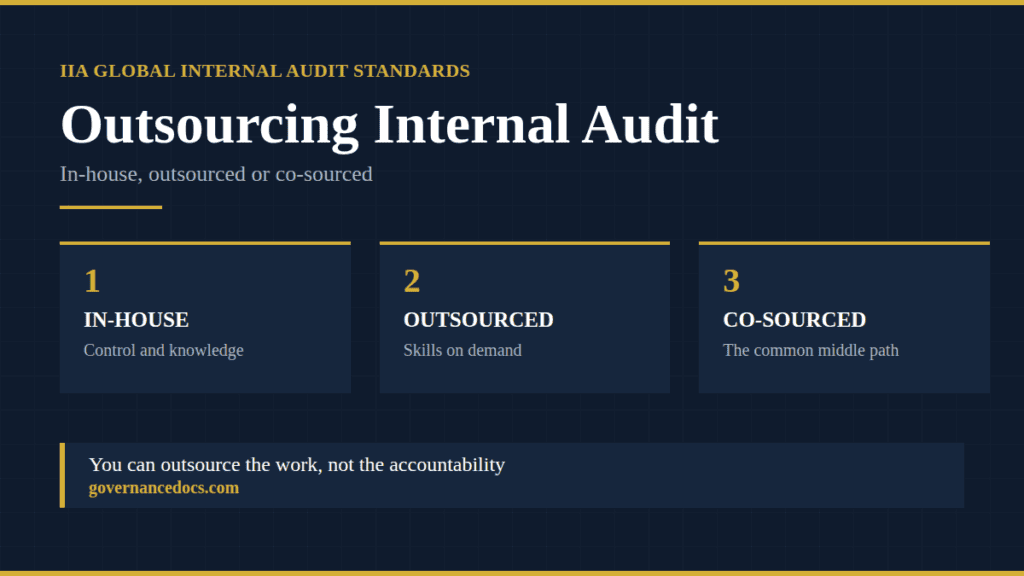
Internal audit outsourcing means contracting some or all of your internal audit services to an independent external provider instead of employing every auditor yourself. The IIA’s Global Internal Audit Standards recognize two forms: full outsourcing of the whole function, and partial outsourcing, which they also call cosourcing.
The internal audit outsourcing decision is not only about cost. It decides who holds the methodology, who keeps the knowledge, and how you show an assessor that the function still conforms. This guide compares the three models, sets out what the Standards require whichever you pick, and gives you a scoping checklist for the contract.
In-house, outsourced or co-sourced internal audit
Most functions end up in one of three models. The table summarizes the trade-offs.
| Model | How it works | Main advantages | Main drawbacks |
|---|---|---|---|
| In-house | Employed staff perform all internal audit services | Deep business knowledge; continuity; full control of priorities | Hard to cover specialist areas; fixed headcount cost; key-person risk |
| Fully outsourced | An external provider performs the whole function, often including the chief audit executive role | Fast start; access to a wide skills bench; scalable | Knowledge leaves with the provider; less day-to-day presence; dependence on one firm |
| Co-sourced | An in-house team, led by an employed chief audit executive, buys in specific skills or engagements | Specialists on demand; in-house ownership of methodology and relationships | Two methodologies to align; coordination effort; quality varies by engagement |
When an in-house function fits
An in-house team suits organizations with steady audit demand, a stable risk profile and enough volume to keep auditors busy year round. It also suits sectors where regulators expect a visible, permanent function.
When outsourced internal audit fits
Outsourced internal audit suits smaller organizations that need assurance but cannot justify a full team, and companies building a function from scratch. A newly listed company facing an exchange deadline is a typical case.
When co-sourced internal audit fits
A co-sourced internal audit model suits functions that are sound on core financial and operational work but lack depth in IT, cybersecurity, data analytics or a regulated topic. Standard 3.1 of the Standards says the chief audit executive should consider contracting an independent external provider when the function collectively lacks the competencies to perform requested services.
What the Standards require whatever the model
The Global Internal Audit Standards took effect on 9 January 2025. They state that they apply whether an organization employs internal auditors directly, contracts them through an external service provider, or both. Our guide to the Global Internal Audit Standards covers the full structure.
There is no single standard on external providers. The requirements are spread across several standards. These are the ones that matter for an internal audit outsourcing decision.
The board and the chief audit executive stay accountable
The chief audit executive is responsible for conformance with the Standards, whether employed by the organization or contracted through a provider. The board keeps its responsibility to support and oversee the function in all cases.
In a fully outsourced model, the provider may supply the person in the chief audit executive role. The board still approves the internal audit charter, the plan and the budget. Standard 10.1 says an adequate budget should still be approved by the board whether the function is insourced or outsourced.
Independence and objectivity
Standard 7.1 requires the chief audit executive to confirm the function’s organizational independence to the board at least annually, with reporting lines set out in the charter. Outsourcing does not change that. Where a chief audit executive also runs areas that need auditing, the same standard points to an objective external provider reporting to the board as one way to obtain assurance.
Standard 2.2 presumes objectivity is impaired if an auditor provides assurance on an activity they were responsible for within the previous 12 months. Ask whether any proposed provider staff ran the process they would now audit.
Resources, methodology and evidence
Standard 8.2 expects the chief audit executive and the board to discuss resourcing options, including outsourcing. Standard 9.3 lists managing external service providers, when used, among the documented methodologies a function needs.
Standard 10.2 says to weigh the cost effectiveness and flexibility of staffing approaches, such as hiring versus contracting. Its examples of evidence include provider contracts and the résumés of auditors the provider assigns.
Quality assurance applies to the provider’s work too
Standard 8.4 requires an external quality assessment at least once every five years by a qualified, independent assessor or team, with at least one person holding an active CIA designation. The assessor reviews the whole function, including work done by contracted auditors. Contracted work has to conform just as in-house work does.
Internal audit outsourcing and SOX: the external auditor limit
For SEC issuers, one restriction is fixed in law. Section 10A(g) of the Securities Exchange Act, added by Section 201 of the Sarbanes-Oxley Act, makes it unlawful for a registered public accounting firm to provide internal audit outsourcing services to an audit client contemporaneously with the audit.
In plain terms, the firm that audits your financial statements cannot also be your outsourced internal audit provider. A different firm can.
Stock exchange rules add to this.
Section 303A.07(c) of the NYSE Listed Company Manual requires each listed company to have an internal audit function, which may be outsourced to a third party other than the company’s independent auditor. In November 2026 the SEC instituted proceedings on an NYSE proposal to extend the time newly listed companies have to set up that function from one year to five years. Until the SEC decides, the one-year period applies.
Your external auditor may still rely on internal audit work for ICFR testing, subject to its own standards. Agree early which controls the provider will test and how the evidence will be documented, so the work can be reused.
How to scope and contract internal audit services
Treat an internal audit outsourcing contract as an extension of your charter. A vague engagement letter is the most common source of later disputes.
Questions to ask a provider
- Will you conform to the Global Internal Audit Standards, and can you show your last external quality assessment?
- Which named people will do the work, and what are their qualifications and relevant industry experience?
- Have any of them designed, operated or advised on the processes in scope in the last 12 months?
- Do you provide any other services to us, or to our external auditor, that could create a conflict?
- Whose methodology, working papers and finding rating scale will be used?
- Who owns the working papers, and how long are they retained?
- How will you handle confidential and personal information, and where will it be stored?
Service levels worth writing down
- Delivery of the agreed risk-based internal audit plan, with a change process for new engagements
- Timelines from fieldwork end to draft report and to final report
- Attendance at audit committee meetings and the format of periodic reports
- Staff continuity, with notice and handover rules if named auditors change
- Escalation routes for significant findings between scheduled reports
Quality assurance and knowledge transfer
Require supervision and review evidence on every engagement, not just a signed report. Ask for findings rated on your own internal audit findings rating scale so results stay comparable year to year.
Build knowledge transfer into the contract. Useful terms include shadowing for in-house staff, handover of risk and control matrices and audit programs, and an exit plan that returns all working papers in usable form.
Red flags in an outsourced internal audit relationship
- The provider also audits your financial statements, or offers to as a package.
- Reports arrive with generic findings that could apply to any client.
- Named senior staff appear at the pitch and then disappear from fieldwork.
- The provider resists sharing working papers or methodology.
- Nobody in-house can explain the audit plan or the basis for the overall opinion.
- The provider audits controls it helped design without disclosing it.
What drives the cost of internal audit outsourcing
Internal audit outsourcing pricing varies widely, and published rate cards rarely reflect a real engagement. These are the factors that move a quote:
- Number of engagements and total hours in the plan
- Specialist content, such as IT, cybersecurity, data analytics or regulatory topics
- Seniority mix, including whether the provider supplies the chief audit executive
- Locations and travel, and whether fieldwork is on site or remote
- Quality of your existing documentation, since weak records add hours
- Reporting load, such as audit committee attendance and SOX coordination
A narrowly scoped engagement is easier to price than an open-ended retainer. For example, Governance Docs offers a fixed-scope ISO 27001 or ISO 42001 internal audit for $2,750, which is a management-system audit under clause 9.2 rather than a full IIA internal audit function. See our ISO 27001 internal audit guide for how that type of audit works.
Internal audit outsourcing FAQ
Can a small company outsource its whole internal audit function?
Yes. The Standards apply to outsourced functions in the same way as in-house ones. The board still needs to approve the charter, plan and budget, and someone, employed or contracted, must perform the chief audit executive role.
Is co-sourced internal audit better than full outsourcing?
It depends on what you already have. Co-sourcing keeps the methodology, relationships and knowledge in-house and buys in specialist skills. Full outsourcing is faster to start but makes knowledge transfer and exit planning more important.
Can our external auditor perform our internal audit?
Not if you are an SEC issuer and the firm audits your financial statements. The Exchange Act lists internal audit outsourcing services among the services a registered firm cannot provide to an audit client contemporaneously with the audit.
Does outsourcing remove the need for an external quality assessment?
No. Standard 8.4 requires an external quality assessment at least once every five years, and it covers the function as a whole, including contracted work.
Our Internal Audit Toolkit provides 87 editable templates for running a function under the IIA’s Global Internal Audit Standards — including the internal audit charter, a resourcing, co-sourcing and talent plan, and engagement working papers — for $99.
When a standard changes, know first
One email a month: edition changes, new deadlines, and what they mean for documentation you already have. No sales sequence.

Governance Docs
Governance Docs LLC
Recent Posts

November 26, 2026

November 26, 2026

November 26, 2026

November 26, 2026
November 26, 2026