CART

The Global Internal Audit Standards are the IIA’s rulebook for internal auditing, and since 9 January 2025 they are the edition every internal audit function claiming conformance is measured against. They replaced the 2017 International Professional Practices Framework (IPPF) standards, and the change is not a renumbering exercise. The board now has written duties, the function needs a strategy and a performance methodology, and a new class of mandatory requirement, the Topical Requirements, sits alongside the core text.
This guide covers the structure, the changes from 2017, and a transition sequence that will stand up at your next quality assessment.
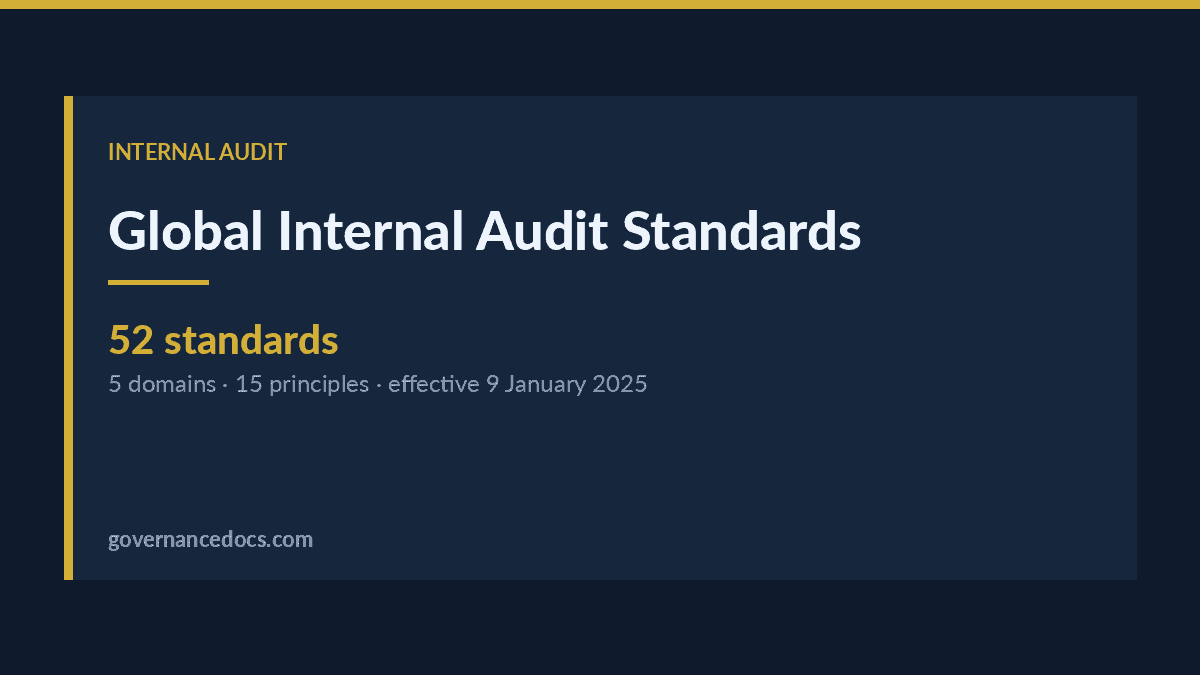
The IIA issued the Global Internal Audit Standards on 9 January 2024 and gave functions a year to prepare: they took effect on 9 January 2025. The full text is free to read on the IIA website.
The Global Internal Audit Standards apply to anyone providing internal audit services, whether that is an in-house team, an outsourced provider, or a co-sourced mix. The chief audit executive (CAE) is accountable for the function’s conformance overall, but individual auditors are also responsible for the requirements that apply to their own work.
Within the IPPF, the Global Internal Audit Standards share the mandatory tier with the Topical Requirements. Global Guidance remains supplemental.
The Global Internal Audit Standards are organised as 5 domains, 15 principles and 52 standards. Each standard is written in three layers: Requirements (the “must” statements), Considerations for Implementation (how to apply them), and Examples of Evidence of Conformance (what an assessor might look for). Standard 11.2 is the one exception, with no evidence-examples section.
The 2017 framework split its standards into Attribute (1000 series) and Performance (2000 series) standards, with the Core Principles, the Definition and the Code of Ethics as separate mandatory elements. The Global Internal Audit Standards fold all of that into one principle-based structure. Several requirements are genuinely new rather than reorganised.
Each of the nine Domain III standards carries a set of Essential Conditions: things the board and senior management are expected to do so that internal audit can work. Examples include approving the charter and plan, establishing a direct reporting line, and authorising the CAE’s appointment and removal. The CAE must walk the board and senior management through Domain III. If they decline a condition, the CAE has to explain the consequences with examples, and where all parties agree a condition is not needed, record why and what compensates for it.
The function now needs its own strategy with a vision, strategic objectives and supporting initiatives, aligned to what the organisation and the board expect, and reviewed periodically with the board and senior management.
The CAE must set performance objectives informed by the board and senior management, build a methodology to measure progress, seek their feedback, and act on what it shows through an action plan. Under 8.3, the board approves those objectives at least annually.
Technology is a standalone requirement. The CAE must keep the function’s tools under regular evaluation, train auditors when new tools arrive, work with IT and information security on implementation, and tell the board and senior management where technology gaps are holding the function back.
Topical Requirements set a minimum baseline for auditing specific risk subjects; four have been issued so far. The external quality assessment cadence stays at least once every five years, but Standard 8.4 now requires at least one assessor on the team to hold an active Certified Internal Auditor designation.
| Area | 2017 IPPF | 2024 Global Internal Audit Standards |
|---|---|---|
| Structure | Attribute and Performance standards plus separate Core Principles, Definition and Code of Ethics | 5 domains, 15 principles, 52 standards in one document |
| Board duties | Requirements addressed to the CAE | Essential Conditions on all nine Domain III standards |
| Strategy | No standalone strategy standard | Standard 9.2: vision, objectives, initiatives |
| Performance | Covered through internal assessments | Standard 12.2: objectives, methodology, feedback, action plan |
| Technology | Considered under due professional care | Standard 10.3: a dedicated resource requirement |
| Plan coverage | Risk-based plan, annual risk assessment | Standard 9.4 also names IT governance, fraud risk and compliance and ethics programs |
| Topic baselines | None | Mandatory Topical Requirements for assurance work |
| External assessment | Every five years, qualified independent assessor | Same cadence, plus an active CIA on the team and results sent straight to the board |
The effective date has passed, so any unfinished transition is already overdue. A practical sequence:
Reading the “must” statements in the Global Internal Audit Standards closely turns up obligations that are easy to miss inside a long standard:
Each needs a field on a form or a paragraph in a procedure.
They were issued on 9 January 2024 and became effective on 9 January 2025. From that date the 2024 edition replaced the 2017 IPPF standards as the basis for conformance.
Yes. The IIA publishes the full text for public access on its complete Standards page. Some supporting tools and templates from the IIA are member resources, but the requirements themselves are open.
No. Individuals can hold IIA certifications such as the CIA, but a function is not certified to the Global Internal Audit Standards. Its conformance is evaluated through internal assessments and an external quality assessment at least once every five years, which can be a full external assessment or a self-assessment with independent validation.
The requirements apply regardless of size, but the Considerations for Implementation allow the approach to be scaled. A one-person function will need outside help to run its quality program, because nobody inside the team is independent of the work being assessed.
Conformance with the Global Internal Audit Standards is ultimately shown through documents: a charter the board approved, a strategy, a risk assessment with the board’s input visible in it, engagement records that carry the required fields, and a quality program that tests all of it.
Once the structure is clear, three practical guides follow from it: how to rate internal audit findings under Standard 14.3, and how to audit the two Topical Requirements already in force, the Cybersecurity Topical Requirement and the Third-Party Topical Requirement.
Our Internal Audit Toolkit provides 87 editable templates (60 Word, 27 Excel) built on all 52 standards and every item of the four issued Topical Requirements. For a transition, start with the 2017 IPPF to 2024 Standards Transition Gap Assessment, the Standards Conformance Register and the Roles and Essential Conditions RACI, then work through the Internal Audit Charter, Internal Audit Strategy and Performance Objectives and KPI Dashboard. It is $99, and every document is yours to adapt to your function.

October 11, 2026
October 11, 2026
October 11, 2026
October 11, 2026
October 11, 2026

