

Website Privacy Policy Template 2026: Essential GDPR + US Guide
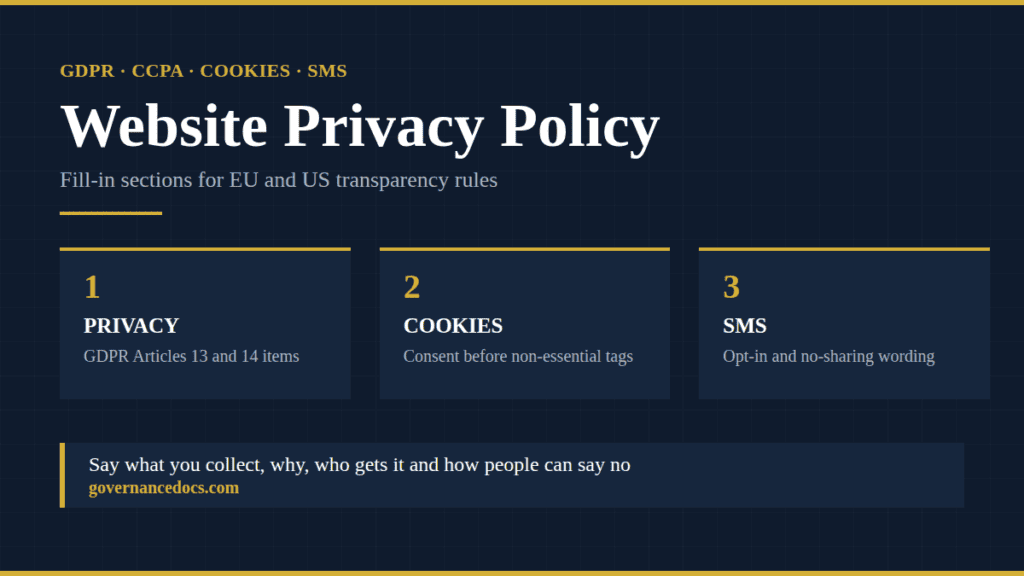
A website privacy policy template is only useful if it matches what your site actually does: the forms, the cookies, the analytics, the text messages and the vendors behind them. Copy-paste policies fail audits because they describe a different business.
This guide gives you a section-by-section website privacy policy template with example wording that covers GDPR transparency rules and the main US requirements, plus a cookie policy section, an SMS privacy section and a GDPR checklist. It is practical guidance, not legal advice, so have counsel review the final text.
Free gap assessment
Could you demonstrate GDPR compliance today?
Score yourself against what a supervisory authority actually asks for, free — the records, not the policy.
Run the free GDPR gap assessment → or View premium report sample
Which laws shape a website privacy policy template?
Most small and mid-sized sites need to satisfy several rule sets at once. The table shows which part of your policy each one drives.
| Rule set | Applies when | What it adds to your policy |
|---|---|---|
| GDPR Articles 13 and 14 | You process personal data of people in the EU in scope of the GDPR | A fixed list of transparency items (identity, purposes, legal basis, retention, rights and more) |
| CCPA as amended by the CPRA | You are a for-profit business meeting the statute’s thresholds and collect California residents’ personal information | A notice at collection, a privacy policy describing rights, updated at least once every 12 months |
| CalOPPA (Cal. Bus. & Prof. Code 22575) | You operate a commercial website or online service that collects personally identifiable information from California residents | Categories collected and shared, effective date, how changes are notified, Do Not Track response |
| ePrivacy Directive Art. 5(3) | You store or read cookies or similar technologies on EU users’ devices | A cookie policy and prior consent for non-essential cookies |
| CTIA guidance and carrier 10DLC registration | You send business text messages to US mobile numbers | An accessible privacy policy and a statement that mobile opt-in data is not shared for marketing |
For UK-specific wording and the privacy notice rules behind it, see our UK GDPR privacy notice guide.
Website privacy policy template: section by section
Fill in this website privacy policy template in order. Keep the language plain: GDPR Article 12 requires information that is concise, transparent, intelligible and easily accessible, in clear and plain language.
| Section | What to write | Example wording |
|---|---|---|
| 1. Who we are | Legal name, address, contact; EU representative and DPO if you have them | “[Company Ltd], [address], is the controller of your personal data. Contact us at [[email protected]].” |
| 2. Data we collect | Categories, by source | “When you fill in our contact form we collect your name, email address and message. Our site also collects your IP address and device information through cookies.” |
| 3. Why we use it and our legal basis | Purpose and legal basis per activity | “We use your contact details to answer your enquiry (legitimate interests: responding to people who contact us).” |
| 4. Who we share it with | Recipients or categories | “We use service providers for hosting, email delivery and payments. They process data only on our instructions.” |
| 5. International transfers | Countries and safeguards | “Some providers are in the United States. Where required, we rely on an adequacy decision or the European Commission’s Standard Contractual Clauses.” |
| 6. How long we keep it | Period or criteria per category | “Enquiries are deleted [24] months after our last contact with you.” |
| 7. Your rights | Access, rectification, erasure, restriction, objection, portability, consent withdrawal, complaint | “You can ask for a copy of your data or ask us to correct or delete it by emailing [address]. You may also complain to your data protection authority.” |
| 8. California rights | Notice at collection items, Do Not Sell or Share, Do Not Track | “We do not sell or share personal information as those terms are defined under California law.” |
| 9. Cookies | Summary and link to cookie policy | “We use strictly necessary cookies and, with your consent, analytics cookies. See our Cookie Policy.” |
| 10. Text messages | SMS program data use | See the SMS section below |
| 11. Children | Whether the site is aimed at children | “Our site is not directed to children under [13/16] and we do not knowingly collect their data.” |
| 12. Security | Measures at a high level | “We protect data with encryption in transit, access controls and regular reviews of our providers.” |
| 13. Changes and effective date | How you notify changes | “Effective [date]. We will post changes here and notify registered users of material changes by email.” |
Free privacy risk assessment
Which privacy risks would hurt the people whose data you hold?
List your personal data and processing, pick from 38 privacy risk scenarios, rate them for the people concerned and for you, and plan treatment with ISO 27701 controls. You get a heat map, a process score and the findings an auditor would raise, free.
Run the free privacy risk assessment → or View premium report sample
GDPR privacy policy template checklist
Use this table to check any privacy policy template GDPR reviewers will read against Article 13 (data collected from the person) and Article 14 (data obtained from elsewhere). The right-hand column points to the matching section of the website privacy policy template above.
| Required item | Article | Template section |
|---|---|---|
| Controller identity and contact; representative | 13(1)(a), 14(1)(a) | 1 |
| DPO contact details, where applicable | 13(1)(b), 14(1)(b) | 1 |
| Purposes and legal basis | 13(1)(c), 14(1)(c) | 3 |
| Legitimate interests pursued | 13(1)(d), 14(2)(b) | 3 |
| Categories of personal data | 14(1)(d) | 2 |
| Recipients or categories of recipients | 13(1)(e), 14(1)(e) | 4 |
| Third-country transfers and safeguards | 13(1)(f), 14(1)(f) | 5 |
| Retention period or criteria | 13(2)(a), 14(2)(a) | 6 |
| Data subject rights | 13(2)(b), 14(2)(c) | 7 |
| Right to withdraw consent | 13(2)(c), 14(2)(d) | 7 |
| Right to complain to a supervisory authority | 13(2)(d), 14(2)(e) | 7 |
| Whether providing data is required, and consequences | 13(2)(e) | 2 or 3 |
| Source of the data | 14(2)(f) | 2 |
| Automated decision-making, including profiling | 13(2)(f), 14(2)(g) | 3 |
Timing matters too. Under Article 13 the information is due when you collect the data. Under Article 14(3) it is due within a reasonable period and at the latest within one month, or earlier at first contact or first disclosure to another recipient.
US additions: CCPA/CPRA and CalOPPA
The California Attorney General’s CCPA guidance explains that a notice at collection must be given at or before the point of collection. Under Civil Code 1798.100 it covers the categories of personal information collected (including sensitive personal information), the purposes, whether the information is sold or shared, and how long each category is kept or the criteria used to decide. Link to your full privacy policy from it, and add a “Do Not Sell or Share My Personal Information” link if you sell or share.
CalOPPA is older and broader: it reaches any operator of a commercial website that collects personally identifiable information from California residents, regardless of size. Your policy must list the categories collected and the categories of third parties you share with, describe any process for reviewing and correcting data, explain how you notify material changes, state its effective date, and disclose how you respond to Do Not Track signals and whether other parties may track users across sites.
Several other US states now have comprehensive privacy laws with their own notice rules. Our CCPA compliance guide covers the California program in depth, and the CCPA-CPRA Compliance Toolkit adds 60+ templates, including notice at collection and opt-out notice templates.
Website cookie policy template
Article 5(3) of the ePrivacy Directive requires consent before you store or access information on a user’s device, unless it is strictly necessary to transmit a communication or to provide a service the user explicitly asked for. Analytics, advertising and most social media cookies need prior consent; pre-ticked boxes do not count. The UK equivalent sits in PECR.
The European Commission’s Digital Omnibus proposal of November 2025 would change parts of these rules, but it was still in negotiation in November 2026. Write your website cookie policy template against the current Article 5(3) as implemented in each member state.
| Category | Consent needed? | Example wording |
|---|---|---|
| Strictly necessary | No | “These cookies keep you logged in and remember your cart. The site cannot work without them.” |
| Preferences | Usually yes | “These remember choices such as language and region.” |
| Analytics | Yes in the EU | “With your consent, [tool] tells us which pages are visited. Data is kept for [14] months.” |
| Marketing | Yes | “With your consent, [provider] uses cookies to show you our ads on other sites.” |
Add a cookie list (name, provider, purpose, duration) and tell users how to change their choice at any time, for example through a “Cookie settings” link in the footer. Our guide to cookie consent covers banner design and consent records.
SMS privacy policy template
If you text customers in the US, your privacy policy is part of the approval process. Section 5.2.1 of the CTIA Messaging Principles and Best Practices (May 2023) says message senders should maintain and conspicuously display a privacy policy that explains how they collect, use and share consumer information, referenced from the opt-in call to action.
Messaging providers go further during A2P 10DLC campaign registration. Twilio, for example, says it can reject a campaign when the privacy policy suggests mobile opt-in data may be shared with third parties, affiliates or lead generators, and expects a statement that mobile information will not be shared with third parties or affiliates for marketing or promotional purposes.
Sample SMS privacy policy template wording:
- “We collect your mobile number and opt-in records when you sign up for [program name] text messages.”
- “No mobile information will be shared with third parties or affiliates for marketing or promotional purposes. Text messaging opt-in data and consent are excluded from all other sharing described in this policy.”
- “We share your number only with service providers that deliver our messages on our behalf.”
- “Reply STOP to opt out or HELP for help. Message frequency varies. Message and data rates may apply.”
Common mistakes in privacy policy templates
These are the gaps that show up most often when a finished website privacy policy template is reviewed.
- Listing every legal basis “just in case”. Each purpose needs one basis you can justify.
- “As long as necessary” with no criteria. GDPR asks for the period or the criteria used to set it.
- Forgetting embedded tools. Chat widgets, video embeds and booking forms collect data too.
- No effective date or version. CalOPPA requires an effective date, and you need versions to prove what users saw.
- Never reviewing it. The CCPA requires the California rights information to be updated at least once every 12 months.
Website privacy policy template FAQ
Do I need a privacy policy if my site only has a contact form?
Yes, in most cases. A contact form collects names and email addresses, which triggers GDPR transparency duties for EU visitors and CalOPPA for commercial sites collecting that data from California residents. A short website privacy policy template filled in for that one form is enough for many small sites.
Can one policy cover both GDPR and US laws?
Yes. Most organizations use one policy with a general section plus a jurisdiction section for California and other states. Keep the core facts identical across sections so they never contradict each other.
Should the cookie policy be a separate page?
It can be either. A separate page is easier to keep current because cookie lists change often; link to it from the privacy policy and from your consent banner.
How often should I update my website privacy policy?
Whenever you add a tool, vendor or purpose, and at least once a year. Update the effective date and keep the previous version on file.
Our GDPR Toolkit provides 100+ editable templates, including a website privacy policy, example privacy notices for website enquiries and online purchases, and a privacy notice procedure, for $99.
When a standard changes, know first
One email a month: edition changes, new deadlines, and what they mean for documentation you already have. No sales sequence.

Governance Docs
Governance Docs LLC
Recent Posts
November 25, 2026
November 25, 2026
November 25, 2026

November 25, 2026
November 25, 2026