

Information Security Policy Template: The Complete 2026 Guide
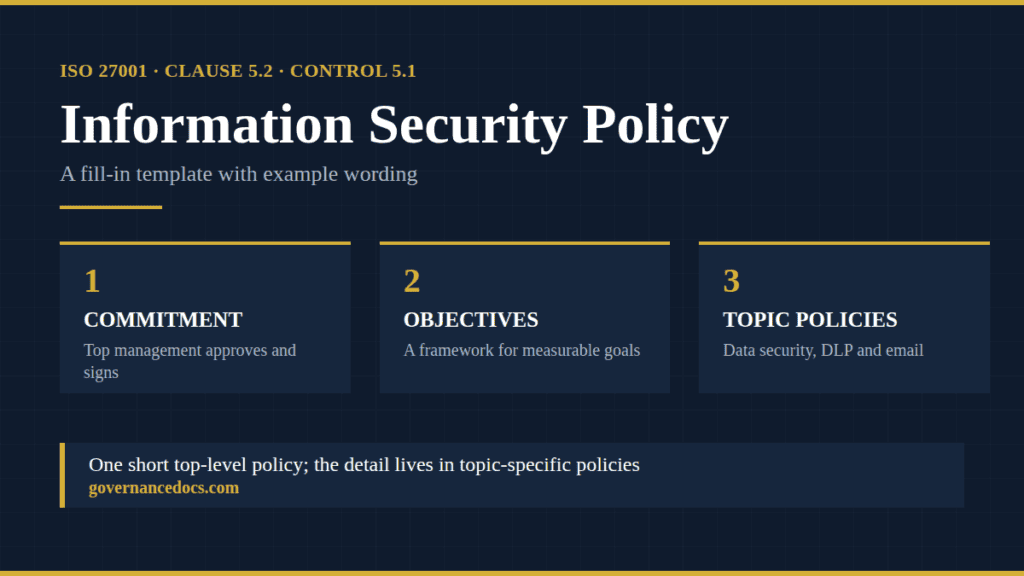
An information security policy template gives you the document an ISO 27001 auditor usually reads first: the top-level statement of what your organization protects, why, and who answers for it. It is short by design. The detail lives in topic-specific policies that sit underneath it.
This guide covers what clause 5.2 and Annex A control 5.1 of ISO/IEC 27001:2022 expect, a 12-section fill-in template with example wording, and starter templates for the three topic-specific policies buyers ask about most: data security, data loss prevention and email security.
What an information security policy is, and what it is not
Think of it as the constitution of your information security management system (ISMS). It states intent, sets direction, assigns ownership and commits management.
ISO/IEC 27001:2022 separates two layers. Clause 5.2 requires one information security policy, established by top management. Annex A control 5.1 extends the requirement to topic-specific policies, such as access control or backup, which are approved, published, communicated, acknowledged and reviewed in the same way.
Many policy findings come from mixing those layers. A document that combines management commitments with password rules is hard to approve and goes stale fast. Keep the top-level policy to a few pages and push operational rules down a level.
If you are building the IT department’s operational rulebook rather than the ISMS policy, see our guide to the IT department policy library. If you are not pursuing ISO 27001 at all, a policy set organized by the NIST CSF 2.0 Functions may fit better.
What ISO 27001 requires in the information security policy
Clause 5.2 sets four content requirements. In plain terms, the policy must:
- Be appropriate to the purpose of the organization.
- Include information security objectives, or provide the framework for setting them. The objectives themselves are planned under clause 6.2.
- Include a commitment to satisfy applicable requirements related to information security, such as legal, regulatory and contractual obligations.
- Include a commitment to continual improvement of the ISMS.
The same clause says the policy must be available as documented information, communicated within the organization, and available to interested parties as appropriate. Whatever information security policy template you start from, check it against these points.
Annex A 5.1 adds that the policy and each topic-specific policy are approved by management, published, communicated to and acknowledged by relevant personnel and interested parties, and reviewed at planned intervals and when significant changes occur. The policy is one of the required documents; our list of ISO 27001 mandatory documents covers the rest of the set.
The ISO/IEC 27001:2022 page on iso.org lists the current edition and its 2024 amendment, which added climate-change wording to clause 4.
Information security policy template: 12 sections to fill in
Copy this information security policy template into your own document. Replace bracketed text, delete what does not apply, and keep each section short. The example wording is written for a 50-person software company; adapt scope and roles to yours.
| Section | What to write | Example wording |
|---|---|---|
| 1. Document control | Title, version, owner, approver, approval date, next review date, classification | “Version 2.0. Owner: Information Security Manager. Approved by the CEO on [date]. Next review: [date]. Classification: Internal.” |
| 2. Purpose | Why the policy exists, in two or three sentences | “This policy sets [Company]’s direction for protecting the confidentiality, integrity and availability of information, and records management’s commitment to the ISMS.” |
| 3. Scope | People, locations, systems and information covered; match your ISMS scope statement word for word | “It applies to all employees, contractors and third parties who access [Company] information, and to the production platform, corporate IT and offices listed in the ISMS scope [ref].” |
| 4. Requirements | Legal, regulatory and contractual obligations at headline level (clause 5.2 c) | “[Company] will meet applicable information security requirements, including data protection law and customer contracts, as recorded in the legal and contractual requirements register [ref].” |
| 5. Principles | Four to six principles that guide decisions | “Access is granted on least privilege. Information is classified and handled by classification. Security is assessed before new systems or suppliers go live.” |
| 6. Objectives | The objectives, or the framework for setting them (clause 5.2 b) | “Measurable security objectives are set each year by the ISMS steering group and tracked in the objectives register [ref].” |
| 7. Risk management | Link to the risk methodology and who may accept residual risk | “Risks are assessed and treated under the risk methodology [ref]. Residual risks rated [High] or above require acceptance by the CEO.” |
| 8. Roles and responsibilities | Top management, ISMS owner, asset owners, managers, all users | “The CEO is accountable for the ISMS. The Information Security Manager runs it day to day. Asset owners classify and protect their assets. All users report suspected incidents immediately.” |
| 9. Topic-specific policies | The supporting policies and where they are published | “This policy is supported by the topic-specific policies in Appendix A, each approved by [role] and published on [intranet location].” |
| 10. Compliance and exceptions | Monitoring, the exception process and the disciplinary link | “Exceptions are requested in writing, risk-assessed, time-limited and approved by the Information Security Manager. Breaches may lead to action under the disciplinary procedure.” |
| 11. Continual improvement | The clause 5.2 d commitment and how it is met | “Management commits to continual improvement of the ISMS through internal audit, management review and corrective action.” |
| 12. Review and communication | Review cycle, how staff acknowledge it, how interested parties get it | “Reviewed at least annually and after significant change. Acknowledged by all staff at onboarding and after each major revision. Available to customers and auditors on request.” |
Example management statement
Most information security policy template layouts open with a short signed statement. Wording you can adapt:
“[Company] treats information as a business-critical asset. We protect the confidentiality, integrity and availability of the information we hold for our customers, our people and ourselves. We will meet the legal, regulatory and contractual requirements that apply to us, set measurable security objectives each year, and continually improve our information security management system. Everyone who works with our information shares responsibility for protecting it.” Signed: [Name], Chief Executive Officer, [date].
Topic-specific policies under the information security policy template
Annex A 5.1 leaves the list of topic-specific policies to you. ISO/IEC 27002 gives examples such as access control, backup, cryptography and information transfer; your risk assessment and Statement of Applicability decide the rest. Our ISO 27001 policy templates guide maps the full set. The table shows a typical first set.
Free ISO 27001 risk assessment
Which of your risks sit above your appetite line?
Set your own risk criteria, pick from 61 information security risk scenarios, rate likelihood and impact, and decide how to treat each one. You get a heat map, a process score and the findings an auditor would raise, free.
Run the free risk assessment → or View premium report sample
| Topic-specific policy | Main Annex A controls | What it adds |
|---|---|---|
| Data security policy | 5.12, 5.13, 5.33, 8.10, 8.11 | Classification, labeling, records protection, deletion and masking rules |
| Data loss prevention policy | 8.12 | Where leakage controls apply, what they block, how alerts are handled |
| Email security policy | 5.14, 8.7 | Rules for sending, receiving and forwarding information by email |
| Acceptable use policy | 5.10 | What users may and may not do with company systems and information |
| Access control policy | 5.15 to 5.18 | How access is requested, approved, reviewed and removed |
| Backup policy | 8.13 | What is backed up, how often, and how restores are tested |
The three most requested get starter templates below. Each reuses the information security policy template layout above: document control, purpose, scope, rules, roles, exceptions, review.
Data security policy template
A data security policy turns your classification scheme into handling rules. Most organizations write their data security policies around the levels set in their data classification scheme. Sample clauses for a data security policy template:
- Scope: “This policy covers all [Company] data in any format, including customer data, personal data, source code and financial records.”
- Classification: “The data owner classifies data as Public, Internal, Confidential or Restricted when it is created or received.”
- Handling: “Confidential and Restricted data is stored only in the approved systems listed in the data handling standard and is encrypted at rest and in transit.”
- Retention and deletion: “Data is kept for the period in the retention schedule and then securely deleted. Deletion of Restricted data is logged.”
Data loss prevention policy template
Control 8.12 asks you to apply data leakage prevention measures to the systems, networks and devices that handle sensitive information. A data loss prevention policy template should say where those measures apply and what happens when they trigger. Our ISO 27001 data leakage prevention guide covers the control itself in depth.
- Channels: “Leakage controls apply to corporate email, approved cloud storage, removable media on managed devices and web uploads from managed devices.”
- Rules: “Transfers of Restricted data to unapproved destinations are blocked. Transfers of Confidential data trigger a user warning and are logged.”
- Alert handling: “The security team triages high-severity alerts within [one business day] and records the outcome.”
- Employee privacy: “Monitoring is limited to what is needed to protect information, is disclosed to staff in this policy, and follows applicable employment and privacy law.”
Email security policy template
ISO/IEC 27001:2022 has no separate email control. Email falls under 5.14, information transfer, which covers rules, procedures or agreements for all types of transfer, whether electronic, physical or verbal. An email security policy template covers the email part of that, plus malware protection under 8.7.
- “Business email is sent only from [Company] accounts. Automatic forwarding to personal or external accounts is disabled.”
- “Confidential information sent outside [Company] is encrypted using [approved method] or shared through an approved link with access controls.”
- “Requests to change payment or bank details received by email are verified by calling a known number before any action is taken.”
- “Suspicious messages are reported with the Report Phishing button and are not forwarded to colleagues.”
- “Inbound email is scanned for malware and spoofing. SPF, DKIM and DMARC are configured for every domain that sends email.”
Common mistakes when filling in an infosec policy template
Search for an infosec security policy template and you will find plenty of free documents. Audit problems are rarely about wording; they are about evidence and fit:
- No approval record. The policy is unsigned, or nothing shows that top management approved it.
- Scope mismatch. The policy scope differs from the ISMS scope statement.
- No objectives. The policy neither states objectives nor points to a framework for setting them.
- No acknowledgement trail. Staff have never confirmed they read it.
- Review overdue. The next review date has passed with no record of a review.
- Template residue. Another company’s name, roles that do not exist, or systems you do not run.
- Old control numbers. The transition to the 2022 edition ended on 31 October 2025, so 2013-style references such as A.5.1.1 are now an easy finding.
Free information security policy templates are a reasonable starting point if you check each of those seven points before approval.
Information security policy template FAQ
How long should an information security policy be?
ISO 27001 sets no length. In practice two to four pages works well for the top-level policy, because management can genuinely read and approve it. Operational detail belongs in topic-specific policies and procedures.
Who has to approve the information security policy?
Clause 5.2 assigns the policy to top management, and Annex A 5.1 requires management approval. In most companies that means the CEO, managing director or board. Keep a record of the approval, such as a signed copy or meeting minutes.
Can we combine all our policies into one document?
Yes. The standard does not require separate files. Small organizations often keep the top-level policy and a few topic-specific sections in one manual. Each section still needs an owner, approval and a review date, so follow the information security policy template structure for each one.
Is an information security policy enough for ISO 27001 certification?
No. It is one of several required documents, alongside the ISMS scope, risk assessment and treatment records, the Statement of Applicability and objectives. Auditors also want evidence the system operates, such as internal audit and management review records.
Our ISO 27001 Toolkit provides 165 editable templates for building and certifying an ISMS — including an Information Security Policy, a Data Loss Prevention (DLP) Policy and an Email Usage Policy — for $99.
When a standard changes, know first
One email a month: edition changes, new deadlines, and what they mean for documentation you already have. No sales sequence.

Governance Docs
Governance Docs LLC
Recent Posts
November 27, 2026
November 27, 2026

November 26, 2026
November 26, 2026

November 26, 2026