

The IT governance documents an organization needs fall into six sets: direction and oversight, service management, data governance, records management, project governance, and the evidence that proves they work. Most teams discover the gaps during an audit or a customer questionnaire, not before. This checklist shows what to have, and which framework each document comes from.
No single standard hands you the full list. COBIT 2019 tells you what governance should achieve, ITIL and ISO/IEC 20000-1 describe service management, DAMA-DMBOK covers data, ISO 15489 covers records, and project governance comes from your own project management method. The IT governance documents you need are the union of those, trimmed to your size and risk.
The IT governance documents checklist, by framework
Use the table as a gap check. For each row, ask whether the document exists, is approved by the right owner, and was reviewed in the last twelve months. Each framework links to the toolkit that supplies the editable templates.
| Documents you need | Source framework | Type | Our toolkit |
|---|---|---|---|
| Governance charter, decision rights, IT policy set, performance measures | COBIT 2019 (ISACA): a governance and management framework for enterprise IT | Voluntary framework, assessable but not a certified management system | COBIT 2019 |
| Service catalogue, change, incident, problem and request procedures, practice guides | ITIL (Version 5, PeopleCert): service management practices | Voluntary guidance, people are certified, organizations are not | ITIL 5 Service Management |
| Service management plan, service catalogue, SLAs, supplier agreements, internal audit and management review records | ISO/IEC 20000-1:2018 service management system requirements | Certifiable by an accredited body | ISO/IEC 20000 IT Service Management |
| Data governance policy, roles and decision rights, standards, data quality and metadata documents | DAMA-DMBOK knowledge areas | Voluntary body of knowledge, not certifiable | Data Governance (DMBOK) |
| Records management policy, retention schedule, classification scheme, metadata and disposition records | ISO 15489-1:2016 records management principles | Guidance, not certifiable | ISO 15489 Records Management |
| Project governance: charters, business cases, stage gates, risk and issue logs, closure reports | Project management practice, run through a PMO | Your own policy, no certification of the organization | Project Management (PMO) |
Only ISO/IEC 20000-1 leads to an organizational certificate. The rest are frameworks or guidance, so there is no certificate to chase. That changes what “done” means: for ISO/IEC 20000-1 an accredited body decides, and for the others you decide, and your auditors or customers judge.
Document set 1: governance charter and policies (COBIT 2019)
Start at the top. A governance charter states who decides what about IT: who sets direction, who approves investment, who accepts risk, and who reports to the board. If you cannot point to this document, every other document lacks an owner.
COBIT 2019 separates governance (evaluate, direct, monitor) from management (plan, build, run, monitor). It organizes its governance and management objectives into five domains, and 40 objectives in total. You do not need a document for each one. Pick the objectives that matter to your strategy and write down who owns them, what the process is, and how you measure it.
The core COBIT-derived set:
- IT governance charter and committee terms of reference
- IT policy set (acceptable use, access, change, supplier, and so on)
- Roles and responsibilities matrix for governance and management
- Performance measures and a reporting calendar
- Assessment records, if you rate process capability
ISACA has announced COBIT 7 to succeed COBIT 2019 and has said little about its structure, so treat any claim about what changes as unverified until the publication is out. Your charter and decision rights will survive a framework revision. The ISACA COBIT page is where to check status. For the layered logic behind this tier, see our post on the IT governance framework.
Document set 2: service management documents (ITIL 5 and ISO/IEC 20000-1)
This is where the largest share of day-to-day IT governance documents lives. The same operational documents serve both ITIL and ISO/IEC 20000-1, which is why it pays to write them once.
The checklist:
- Service catalogue: every service you deliver, its owner, its users and its hours.
- Service level agreements: measurable targets agreed with customers, plus supporting agreements with suppliers.
- Change procedure: how changes are requested, assessed, approved and recorded.
- Incident procedure: logging, categorization, prioritization, escalation and closure.
- Problem procedure: root cause analysis and known error records.
- Service request procedure and a continual improvement register.
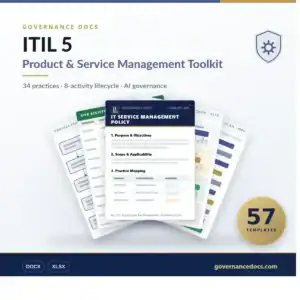
ITIL describes these as practices, and ITIL (Version 5) organizes work around an eight-activity product and service lifecycle: Discover, Design, Acquire, Build, Transition, Operate, Deliver and Support. Those activities are not a cycle you walk through in order. ITIL is guidance, so it will not tell you which documents an auditor will ask for. The ITIL 5 Service Management toolkit turns the practices into procedures, runbooks and registers you can edit.
ISO/IEC 20000-1:2018 is different: it has requirements, and a certification body audits against them. It expects a documented service management plan, a service catalogue, service level agreements and controlled records, among other things. We list them clause by clause in ISO 20000 mandatory documents and records. The ISO/IEC 20000 toolkit maps its templates to that requirement set.
If you are still deciding which of the two to follow, the existing comparisons of COBIT versus ITIL and ISO 20000 versus ITIL cover that choice. This post assumes you will use both where they fit.
Document set 3: data governance documents (DMBOK)
IT governance documents often stop at systems. Data needs its own set, because the people who decide what data means and who may use it are rarely the people who run the servers.
A DMBOK-based program normally produces:
- Data governance policy: the principles and authority behind every data decision.
- Roles and decision rights: a council, data owners, data stewards and custodians, with named people.
- Data standards: naming, definitions, formats and reference data rules.
- Data quality rules and an issue process
- Metadata and glossary documents
- Measures: adoption, quality and issue resolution.
DAMA-DMBOK describes the knowledge areas behind these. It is a body of knowledge, so it gives you structure but no pass or fail. Our post on the data governance framework explains the layers and the build order, and the Data Governance (DMBOK) toolkit provides the policy, role and standard templates.
Document set 4: records management and the retention schedule (ISO 15489)
The retention schedule is the document most IT teams assume someone else owns. It states how long each class of record is kept, what triggers the clock, and what happens at the end. ISO 15489-1 calls this a disposition authority.
The ISO 15489 set usually includes:
- Records management policy
- Business classification scheme
- Retention schedule with the legal or business basis for each period
- Metadata requirements for records
- Disposition and legal hold records
One rule matters here: retention periods come from your legal and business obligations, not from a template. Any example period in a toolkit is a starting point you must confirm against the laws that apply to you. ISO 15489-1:2016 is guidance, so there is no certificate, but regulators and litigants will ask to see the schedule and proof that you followed it. Our guide to building a records retention schedule walks through the fields and approvals, and the ISO 15489 Records Management toolkit supplies the templates.
Document set 5: project governance (PMO)
Governance fails quietly in projects: money is approved without a business case, and nobody reviews it at the end. Project governance documents fix that by setting the checkpoints.
- Project governance policy and the PMO’s terms of reference
- Business case and project charter templates
- Stage gate or phase review criteria
- Risk, issue and change logs
- Status reports, closure report and lessons learned
This set connects to the rest. A project that changes a production system must follow the change procedure. A project that creates a dataset needs a data owner. A project that creates records needs a classification. The Project Management (PMO) toolkit provides the project-level templates.
How to run a gap check on your IT governance documents
Work through the checklist in this order and stop to fix what you find.
- List what exists. Include documents held in tools and wikis. A procedure that lives in a ticketing system still counts, if it is controlled.
- Check ownership. Every document needs a named role as owner, not a department.
- Check dates and review cycles. A policy nobody has reviewed in years is a finding.
- Check that people follow it. A document that contradicts practice is worse than none, because it records your own failure.
- Cross-reference. The incident procedure should name the data owner roles, and the retention schedule should cover incident records.
Leave out what does not apply. A 40-person company does not need a full governance committee structure for every COBIT objective. It needs a short charter, a handful of policies and procedures that match how it actually works.
Which IT governance documents to write first
If you are starting from little, a sensible order is: charter and policies first, then incident and change procedures, then the data governance policy and roles, then the retention schedule, then project governance. That follows your risk. Outages and unauthorized changes hurt first, data and records questions arrive with the next customer or regulator, and project controls improve spending.
Then decide whether you want a certificate. If customers ask for ISO/IEC 20000-1, build the full service management system. If not, ITIL practices and COBIT-aligned policies may be enough. Either way, the documents support your position; an accredited body, not a template, decides certification.
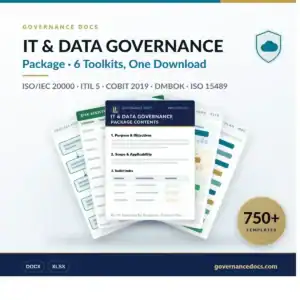
All six toolkits above are in the IT & Data Governance Package: 6 toolkits for $299, one purchase with a separate download per toolkit. Licensed for internal use by one organization, and consultants serving clients need the Consultant Package.

IT governance documents FAQ
How many IT governance documents does a small organization need?
There is no required number. Start with a charter, a core policy set, incident, change and problem procedures, a data governance policy with named roles, and a retention schedule. Add more as your risk and customer demands grow.
Are IT governance documents required by law?
Not as a category. Specific laws and contracts may require specific documents, such as retention periods or security policies. COBIT, ITIL and DMBOK are voluntary, and ISO/IEC 20000-1 is only required if you choose certification or a customer demands it.
Do I need ITIL and ISO/IEC 20000-1 documents both?
Usually one set of procedures serves both. ISO/IEC 20000-1 adds management system requirements such as a service management plan, internal audit and management review. Many organizations write operational procedures once and add the management system layer only if they pursue certification.
Who should own the data governance documents?
A data governance council or equivalent body sets policy, while data owners and stewards from the business own the rules for their data. IT is usually a custodian, not the owner.
Can I copy a retention schedule from another organization?
No. Retention periods depend on the laws, contracts and business needs that apply to you. Use an example to structure the schedule, then confirm every period with legal counsel.

Recent Posts
November 18, 2026
November 18, 2026
November 18, 2026
November 18, 2026

November 18, 2026