

A privacy compliance program that runs one law at a time will collapse under its own paperwork. If you handle personal data of EU residents, UK customers, Californians, Indian users and Saudi patients, you do not need six programs. You need one program, one data map and one set of evidence, mapped to each legal regime.
This guide helps you decide which of eight frameworks apply to you, how they overlap, and what order to build them in. It is a decision aid, not legal advice. Your counsel decides what applies to your processing.
Start by separating laws from management frameworks
The first mistake in a privacy compliance program is treating everything as the same kind of thing. Six of the eight frameworks below are laws: GDPR, UK GDPR, CCPA/CPRA, HIPAA, India’s DPDP Act and Saudi Arabia’s PDPL. You do not choose them. Your customers, your data subjects and your sector choose them for you.
The other two are management frameworks. ISO/IEC 27701 is a certifiable standard for a privacy information management system. The NIST Privacy Framework is voluntary guidance and cannot be certified. You choose these, and they are where your single program lives.
Documents support compliance. They do not make anyone compliant, and an ISO certificate is decided by an accredited body after an audit. Neither a toolkit nor a certificate proves that you comply with a law.
The eight frameworks at a glance
| Framework | What it is | Who it applies to | Type | Our toolkit |
|---|---|---|---|---|
| GDPR | EU data protection regulation | Organizations processing personal data in the EU context, including some outside the EU that target EU residents | Law, no certification | GDPR & Data Protection |
| UK GDPR | UK retained regime, amended by the Data (Use and Access) Act 2025 | Organizations processing personal data of people in the UK | Law, no certification | UK GDPR (DUAA 2025) |
| ISO/IEC 27701 | Privacy information management system standard | Any controller or processor that wants a certifiable privacy system, usually driven by customer demand | Voluntary, certifiable | ISO/IEC 27701 Privacy Information Management |
| NIST Privacy Framework | Risk-based privacy framework with Functions, Categories and Subcategories | Any organization, especially US teams that want risk language rather than a standard to audit against | Voluntary guidance, not certifiable | NIST Privacy Framework |
| CCPA / CPRA | California consumer privacy law | Businesses that meet the statute’s thresholds and handle California residents’ data | Law, no certification | CCPA / CPRA |
| HIPAA | US health information privacy, security and breach rules | Covered entities and their business associates | Law, no certification | HIPAA |
| India DPDP Act | India’s digital personal data protection law and its 2025 Rules | Organizations processing digital personal data in India, or offering goods or services to people in India | Law, no certification | India DPDP Act |
| Saudi PDPL | Saudi personal data protection law, regulated by SDAIA | Organizations processing personal data of individuals in Saudi Arabia | Law, no certification | Saudi PDPL (SDAIA) |
Which frameworks apply to you
Work down these questions in order to scope your privacy compliance program. They take an afternoon, not a project.
- Where are your data subjects? One EU customer is enough to put GDPR on the list if you target the EU market. The same logic applies to the UK, India and Saudi Arabia. Where your servers sit matters far less than where your people are.
- Do you handle health information as a covered entity or business associate? If yes, HIPAA applies on top of everything else. If you only collect wellness data from consumers, ask counsel whether HIPAA reaches you at all.
- Do you do business with California residents at scale? Check the statute’s thresholds with counsel before assuming either way.
- Do customers ask for evidence? Procurement questionnaires that ask for a “privacy management system” point toward ISO/IEC 27701. Questionnaires that ask how you manage privacy risk point toward the NIST Privacy Framework.
Be honest about voluntary versus mandatory. A law you fail to meet creates liability. A standard you skip creates, at worst, a lost deal.
Why one privacy compliance program beats six
Strip the legal vocabulary away and the six laws ask for the same operational building blocks. You need to know what personal data you hold and why. You need a way to tell people what you do with it, honor their requests, assess risk before launching something new, control your vendors, and respond when something goes wrong.
That is one data map, one notice library, one request process, one risk assessment method, one vendor process and one incident process. The differences are in the details: legal bases, clocks, thresholds and regulator contacts. Keep those details in a jurisdiction layer on top of the shared core, not in six copies of everything.
Free privacy risk assessment
Which privacy risks would hurt the people whose data you hold?
List your personal data and processing, pick from 38 privacy risk scenarios, rate them for the people concerned and for you, and plan treatment with ISO 27701 controls. You get a heat map, a process score and the findings an auditor would raise, free.
Run the free privacy risk assessment → or View premium report sample
A short example of where the layer matters:
- Lawful basis. GDPR requires a lawful basis before processing. The CCPA lets processing proceed by default with notice, subject to opt-out rights. Our CCPA vs GDPR comparison goes through the consequences.
- Consent in Saudi Arabia. The PDPL treats consent as the default basis, and it has no adequacy list for transfers. Every transfer needs its own exemption and safeguard, so a Saudi transfer record looks different from an EU one.
- Health data. HIPAA applies by role and by data type, not by where the data subject lives. See GDPR vs HIPAA for the practical split.
Choosing a backbone: ISO/IEC 27701 or the NIST Privacy Framework
Your privacy compliance program needs a spine, a management structure that holds the shared core. Two options fit, and the right one depends on who is asking you for assurance.
When ISO/IEC 27701 is the better backbone
Choose it when customers, partners or regulators in your market value a certificate. It is a management system, so it brings the habits auditors expect: scope, roles, a risk process, internal audit, management review and corrective action. Its controls map naturally to the GDPR duties, which our ISO 27701 vs GDPR mapping walks through. The ISO/IEC 27701 toolkit supplies the management system documents.
A certificate describes your management system within a defined scope at the time of the audit. It does not prove compliance with any law. Treat it as evidence of discipline, and keep your legal register separate.
When the NIST Privacy Framework is the better backbone
Choose it when nobody will audit you and you want a way to reason about privacy risk and prioritize work. It is voluntary, it has no certification scheme, and it organizes outcomes rather than prescribing a management system. NIST describes it as a voluntary tool for managing privacy risk; version 1.0 is available and version 1.1 is still an initial public draft on NIST’s Privacy Framework page. If you adopt it, state which version you are aligned to. The NIST Privacy Framework toolkit is built for this use.
Using both
Some organizations use the NIST framework to set a target profile and priorities, and ISO/IEC 27701 to run and evidence the system. That works, but it doubles the overhead. Pick one backbone unless a specific customer demand justifies the second.
The order to implement them in
Sequence matters more than speed in a privacy compliance program. This order avoids rework.
- Build the data map first. Every framework depends on it. Our GDPR data mapping guide shows how to capture sources, systems, recipients and retention without drowning in detail.
- Add your home-jurisdiction law. The law with the most customers, the strictest regulator or the largest exposure goes first. For many organizations that is GDPR, and the GDPR toolkit gives you the core policies, records and request procedures.
- Stand up the backbone. Set scope, roles, the risk method and the review cycle. Everything else plugs into this.
- Layer the other laws as deltas. For each additional law, ask what is different, not what is required from scratch. UK GDPR differs in lawful bases, rights timelines, automated decision-making and transfers. CCPA/CPRA adds notices at collection, opt-out and sensitive information handling. DPDP and PDPL each bring their own consent, breach and registration mechanics.
- Add HIPAA where it applies. HIPAA has its own privacy, security and breach rules and its own business associate agreements. Treat it as a parallel track that reuses your risk process and vendor controls.
- Test, then certify if you are going to. Audit the whole privacy compliance program internally first. Internal audit and management review come before any external audit.
Dates and clocks to confirm before you commit
Breach and request clocks differ by regime, and you should record them in a single register rather than in people’s heads. A few confirmed examples:
- GDPR requires notifying the supervisory authority of a breach within 72 hours of becoming aware of it, where feasible.
- Saudi PDPL breach notification to SDAIA is also 72 hours, through the National Data Governance Platform, per our Saudi PDPL toolkit research. Confirm the current SDAIA guidance before you rely on it.
- India’s DPDP Rules were notified on 13 November 2025. Part of the Rules took effect immediately, the Consent Manager provisions take effect on 13 November 2026, and the main obligations (notice, security safeguards, breach intimation, retention, children’s data and data principal rights) take effect on 13 May 2027. Our DPDP Rules 2025 post sets out the schedule. The DPDP Act toolkit follows it.
Do not copy penalty figures into your policies. Amounts are adjusted or amended over time. Cite the legal provision and link to the regulator.
Common mistakes in a multi-law privacy compliance program
- Building to the strictest law and calling it done. The strictest law on one point is not the strictest on all of them. Saudi consent defaults and California opt-out mechanics both diverge from GDPR.
- Copying the EU notice everywhere. A notice written for GDPR will miss California’s disclosures and the other regimes’ specific content.
- Letting the certificate stand in for the law. The standard is a system. The law is a duty. Keep a legal register.
- Ignoring the vendor layer. Processor agreements, HIPAA business associate agreements and transfer safeguards all depend on the same vendor inventory. Keep one inventory.
- Treating the privacy program as a security project. Security is one input. Purpose, transparency, retention and rights are privacy questions that security controls do not answer.
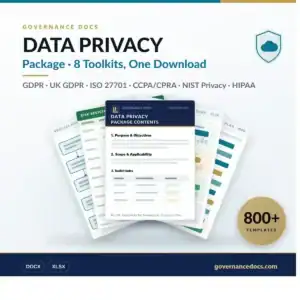
The Data Privacy Package covers all eight frameworks in this guide: 8 toolkits for $349. It is one purchase with a separate download per toolkit, licensed for internal use by one organization. Consultants serving clients need the Consultant Package.
Privacy compliance program FAQ
Do I need ISO/IEC 27701 to comply with GDPR?
No. GDPR is a law, and no certificate is required to comply with it. ISO/IEC 27701 is a voluntary way to organize and evidence your privacy management. A certificate does not prove GDPR compliance, because a regulator examines your actual processing.
Can the NIST Privacy Framework replace a legal compliance program?
No. It is voluntary guidance for managing privacy risk and it does not map one-to-one to any statute. Use it to organize your work, and track your legal obligations in a separate register.
Should I start with GDPR or with the law of my home market?
Start with the law that carries the most exposure for your actual data subjects. For many organizations that is GDPR, but a US healthcare provider may start with HIPAA, and a business selling mostly to Californians may start with the CCPA.
How many documents does a multi-law program really need?
Fewer than you expect, if the core is shared. One data map, one request procedure, one risk assessment method and one vendor process serve all regimes, with short jurisdiction supplements on top.
Does buying templates make us compliant?
No. Templates give you a structured starting point. Compliance depends on adapting them to your real processing, running the procedures, and keeping evidence. Have counsel review the legal positions before you adopt them.

Recent Posts
November 18, 2026

November 18, 2026

November 18, 2026

November 18, 2026

November 18, 2026