

ISO 14001 Certificate Validity: The Complete 2026 Guide
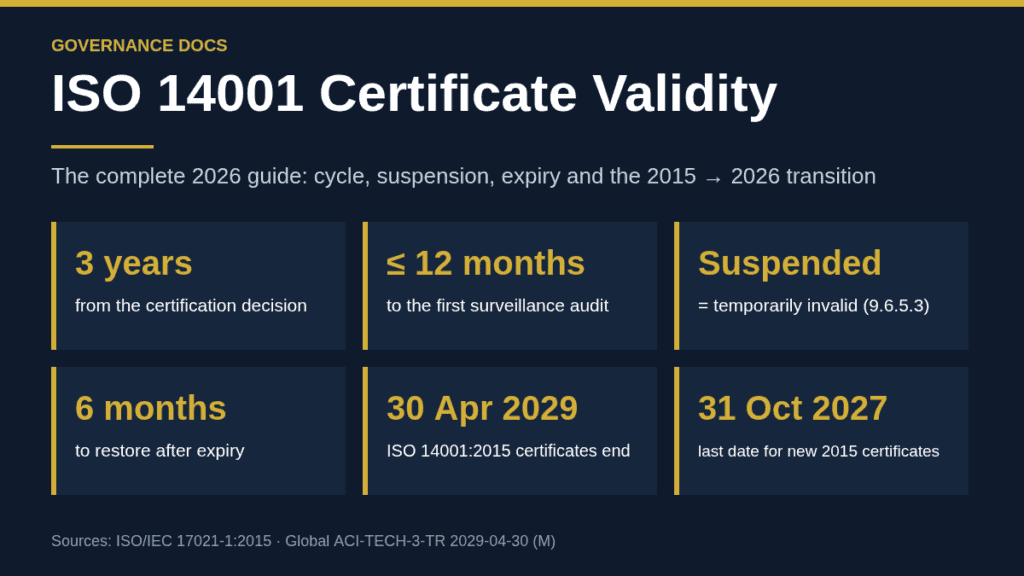
ISO 14001 certificate validity runs for three years from the certification decision, but only while two annual surveillance audits happen on time, nothing triggers a suspension, and your certification body keeps its own accreditation. In 2026 there is a fourth condition: every certificate issued against ISO 14001:2015 stops being valid on 30 April 2029, whatever expiry date is printed on it. This guide walks through each rule, cites the clause it comes from, and shows how to plan your next audits so the certificate never lapses.
If you are still working toward your first certificate, start with our ISO 14001 certification guide. This post is for organizations that already hold one, and for buyers checking a supplier’s.
Free gap assessment
Are you ready for the 2026 edition of ISO 14001?
Score every clause of the new edition, free, including the aspects, life cycle and compliance evaluation work that carries most of the findings.
Run the free ISO 14001 gap assessment → or View premium report sample
How ISO 14001 Certificate Validity Works: The Three-Year Cycle
ISO 14001 does not set certificate rules itself. They come from ISO/IEC 17021-1:2015, the standard every accredited certification body must follow. Clause 9.1.3.2 fixes the shape of the cycle: a two-stage initial audit, surveillance audits in the first and second years after the certification decision, and a recertification audit in the third year before the certificate expires. The first cycle starts on the date of the certification decision, not the date of your stage 2 audit. Later cycles start on the recertification decision.
Clause 9.1.3.3 adds two timing rules that matter more than most people realize. Surveillance must happen at least once every calendar year (except in a recertification year), and the first surveillance audit must fall no more than 12 months after the certification decision date. Miss that window and your certification body has grounds to suspend.
| Point in the cycle | Audit | What it means for ISO 14001 certificate validity |
|---|---|---|
| Day 0 | Certification decision after stage 1 and stage 2 | Certificate issued; three-year clock starts |
| Within 12 months of the decision | Surveillance audit 1 | Late or refused audit is a suspension trigger (9.6.5.2) |
| Next calendar year | Surveillance audit 2 | Same rule: at least once per calendar year |
| Year 3, before expiry | Recertification audit | Major nonconformities must be corrected before expiry (9.6.3.2.2) |
| Recertification decision | New certificate | New expiry can be based on the old expiry date (9.6.3.2.3) |
For ISO 14001 certificate validity, the printed expiry date is therefore a ceiling, not a guarantee. The certificate is valid up to that date only if the surveillance programme between issue and expiry is completed.
What Keeps an ISO 14001 Certificate Valid Between Audits
Surveillance is where ISO 14001 certificate validity is most often lost. Under 17021-1 clause 9.6.2, surveillance must include on-site auditing, but it is not a full-system audit every year. Your certification body samples the system, follows up earlier findings, checks complaints, reviews changes, and confirms that the system is still delivering its intended results. Our ISO 14001 surveillance audit guide covers what auditors look at in detail.
Four things keep ISO 14001 certificate validity intact between audits:
- Audit dates held. Postponing a surveillance visit past the calendar-year or 12-month limit is the most common avoidable cause of suspension.
- Findings closed on time. ISO/IEC 17021-1 sets a hard deadline for major nonconformities only at recertification (before expiry). During surveillance, the deadline is whatever your certification body’s documented procedure says. Many bodies use 90 days for a major finding, but that number is their rule, not the standard’s, so read your certification agreement.
- Honest use of the certificate and marks. Clause 8.3.4 requires your contract to stop you claiming certification for sites or activities outside scope, or implying that your products are certified.
- Changes reported. A new site, a major process change, or a significant environmental incident can prompt a special or short-notice audit under clause 9.6.4.
Suspension, Withdrawal and Scope Reduction
Clause 9.6.5.2 gives examples of when a certification body shall suspend: the client has failed to meet certification requirements, the client does not allow surveillance or recertification audits at the required frequencies, or the client has asked for a voluntary suspension. During suspension, clause 9.6.5.3 says the certification is temporarily invalid. That matters commercially, because ISO 14001 certificate validity is about status, not dates. A supplier whose certificate is suspended cannot honestly say it holds a valid ISO 14001 certificate, even though the expiry date has not passed.
If the issue is resolved, the certification body restores the certificate. If not, clause 9.6.5.4 requires withdrawal or a reduction in scope. The note to that clause says suspension would not exceed six months in most cases, which is a useful planning figure but not a fixed limit.
| Status | Is the certificate valid? | Typical cause | Way back |
|---|---|---|---|
| Active | Yes | Audits on schedule, findings closed | Not needed |
| Suspended | No, temporarily (9.6.5.3) | Missed surveillance, unresolved major finding, voluntary request | Resolve the cause; often a follow-up or short-notice audit |
| Scope reduced | Yes, for the remaining scope only | Part of the system no longer conforms | Scope extension audit later (9.6.4.1) |
| Withdrawn | No | Suspension not resolved | Start again as a new client |
| Expired | No | Recertification not completed before expiry | Restore within 6 months (9.6.3.2.5), otherwise at least a stage 2 |
What Happens at the ISO 14001 Certificate Expiry Date
The recertification audit has to be planned so the certification body can decide before the expiry date (9.6.3.1.1). When recertification is completed in time, the new certificate’s expiry can be based on the existing expiry date, so you do not lose the months between the audit and the old expiry (9.6.3.2.3). The issue date on the new certificate must be on or after the recertification decision.
If the date passes first, ISO 14001 certificate validity ends and you have a gap. Clause 9.6.3.2.5 lets the certification body restore certification within six months of expiry, provided the outstanding recertification activities are completed. After six months, at least a stage 2 audit is required. Even when restored, the effective date on the certificate is on or after the recertification decision, so the gap stays visible. The note to clause 8.2.2 allows the original certification date to remain on the certificate after a lapse, but only if the current cycle dates and the previous expiry are also shown. Our ISO 14001 recertification audit guide explains how to time year 3 so this never happens.
ISO 14001 Certificate Validity and the 2026 Transition
ISO 14001:2026 was published in April 2026 and replaced ISO 14001:2015 including its 2024 climate amendment. Global ACI, the body that took over the IAF’s role, issued the mandatory transition requirements as Global ACI-TECH-3-TR 2029-04-30 (M) on 4 September 2026. The document notes that there are about 700,000 accredited ISO 14001 certificates worldwide, and it sets a three-year transition. You can read it in full in the Global ACI ISO 14001:2026 transition requirements.
| Date | Milestone (Global ACI-TECH-3-TR 2029-04-30) | What it means for you |
|---|---|---|
| 31 Oct 2026 | Accreditation bodies ready to assess the 2026 edition | Your certification body can now apply to transition |
| 31 Jan 2027 | Certification bodies submit transition declarations; bodies not transitioning must tell their clients in writing | If your body says it will not transition, plan a transfer now |
| 30 Apr 2027 | Accreditation bodies complete transition decisions | Your body can issue accredited ISO 14001:2026 certificates only after its own transition |
| 31 Oct 2027 | No new or initial certifications to ISO 14001:2015 | First-time applicants must certify to 2026 |
| 30 Apr 2029 | ISO 14001:2015 certifications no longer valid | Any 2015 certificate is invalid from this point, whatever its printed expiry |
The transition audit can run alongside a surveillance audit, a recertification audit, or as a separate special audit. It must cover the changed requirements, changes in your context, and any other changes your system needs. The changes Global ACI lists include the new clause 6.3 “Planning of changes”, new sub-clauses under clause 9.3 management review, and updated wording for documented information. The certification body may run the transition audit remotely under Global ACI-TECH-3-003 (formerly IAF MD 4) if it can show the objectives are met. Whether extra audit time is needed is marked “Possibly”: the body must justify any increase based on how much your system has changed.
Two clauses in the transition document directly affect ISO 14001 certificate validity. First, a certification body does not have to reissue existing 2015 certificates with an earlier expiry date, but it may shorten the printed validity to avoid confusion. Second, under section 6.4, if you decide not to transition, you can still be audited against the 2015 edition, but your certificate will expire at the end of the transition period. If its current expiry is later than 30 April 2029, it will not last the full cycle.
A practical way to plan is to look at when your current cycle ends:
- Cycle expires in 2027 or 2028: make the recertification audit your transition audit, once your certification body has transitioned. That avoids a separate visit.
- Cycle expires after 30 April 2029: transition at a surveillance audit in 2027 or 2028. If you wait for recertification, the 2015 certificate will lapse first.
- First certification planned for late 2027: stage 1 and stage 2 must be to the 2026 edition if the certification decision is after 31 October 2027, so build the 2026 system from the start.
Our ISO 14001:2026 transition guide covers the clause-by-clause changes.
How to Check ISO 14001 Certificate Validity
Whether you are checking your own certificate or a supplier’s, clause 8.2.2 lists what every accredited certificate must show. Read these fields first:
- the certified organization’s name and the location of each certified site;
- the effective date, which cannot be before the certification decision;
- the expiry date or recertification due date;
- a unique identification code;
- the standard and its edition, for example ISO 14001:2015 or ISO 14001:2026;
- the scope of activities, products and services at each site;
- the name, address and mark of the certification body.
The edition field now matters for ISO 14001 certificate validity. A certificate showing ISO 14001:2015 with an expiry date after 30 April 2029 will still lose validity on that date unless the holder transitions.
The certificate alone cannot tell you whether it is suspended, so confirm its status. Clause 8.1.2 obliges the certification body to tell you the status of a given certification on request. You can also search the IAF CertSearch database by company name or certificate number. If a certificate does not appear there, ask the certification body directly rather than assuming it is fake. Also check that the body’s accreditation covers environmental management systems, because an unaccredited certificate does not fall under any of the rules above.
Changing Certification Body Without Losing Validity
Transfers follow Global ACI-TECH-3-002 (M), formerly IAF MD 2, issued July 2026. Three clauses decide whether your ISO 14001 certificate validity survives the move:
- 2.1.2: only valid accredited certification can be transferred. A certificate known to be suspended cannot be accepted.
- 2.1.3: if your current body has stopped trading or lost its accreditation, the transfer must be completed within six months or by the certificate’s expiry, whichever is sooner.
- 2.3.4: if the pre-transfer review finds no problems, your existing cycle continues and the new body plans the remaining audits. If it treats you as a new client, a new cycle starts with its certification decision.
The transition adds a reason to move. If your certification body tells you by 31 January 2027 that it will not transition to ISO 14001:2026, transfer while the certificate is still valid and unsuspended. Waiting until late 2028 leaves little room if the new body asks for extra audit work. Our ISO 9001 certificate validity guide applies the same transfer rules to quality certificates, which helps if you hold both.
Keeping Your Evidence Ready for Every Audit
When ISO 14001 certificate validity is lost, it is rarely because the environmental management system is bad. It is lost because audit dates slip, a major finding stays open, or nobody notices that the next audit needs to be the transition audit. Three habits prevent most problems:
- Keep an audit calendar that shows the certification decision date, the 12-month limit for the first surveillance, each calendar-year surveillance, and the expiry date, with 30 April 2029 marked if you still hold a 2015 certificate.
- Run internal audits and management reviews against ISO 14001:2026 before your transition audit, including the new planning-of-changes requirement in clause 6.3.
- Track every nonconformity in one register with its owner, root cause and closure evidence, so nothing reaches the certification body’s deadline unresolved.
FAQ: ISO 14001 Certificate Validity
How long is an ISO 14001 certificate valid?
Three years from the certification decision, as long as surveillance audits take place at least once a calendar year, with the first within 12 months of the decision, and the certificate is not suspended or withdrawn. A recertification audit in year 3 starts the next cycle.
Is my ISO 14001:2015 certificate still valid in 2026?
Yes, as long as it is in date and not suspended. Under the Global ACI transition requirements, all ISO 14001:2015 certifications stop being valid on 30 April 2029, so you need a transition audit to ISO 14001:2026 before then.
What happens if my ISO 14001 certificate expires?
You are not certified from the expiry date. Your certification body can restore the certificate within six months if the outstanding recertification activities are completed. After six months, at least a stage 2 audit is needed, and the gap stays on the record.
Can a supplier’s ISO 14001 certificate be valid if it is suspended?
No. ISO/IEC 17021-1 clause 9.6.5.3 says certification is temporarily invalid during suspension, even if the printed expiry date has not passed. Ask the certification body to confirm the current status.
Does the ISO 14001:2026 transition audit add audit days?
Possibly. The Global ACI transition document requires the certification body to decide whether extra time is needed, based on how much your system has changed and whether the transition is done during a scheduled audit or a separate special audit. Ask for the justification in your quote.
Our ISO 14001 Toolkit gives you 67 editable templates aligned to ISO 14001:2026, including the registers, internal audit, management review and nonconformity records your certification body will sample at every surveillance and transition audit. It is $99 and downloads instantly.
Sources: ISO/IEC 17021-1:2015 clauses 8 and 9, as reproduced by IAS (Section 9); Global ACI-TECH-3-TR 2029-04-30 (M), Transition Requirements for ISO 14001:2026, v1.0, 4 September 2026; Global ACI-TECH-3-002 (M), transfer of accredited certification, v1.0, 10 July 2026.

Governance Docs
Governance Docs LLC
Recent Posts
November 17, 2026
November 16, 2026
November 15, 2026
November 14, 2026
November 13, 2026