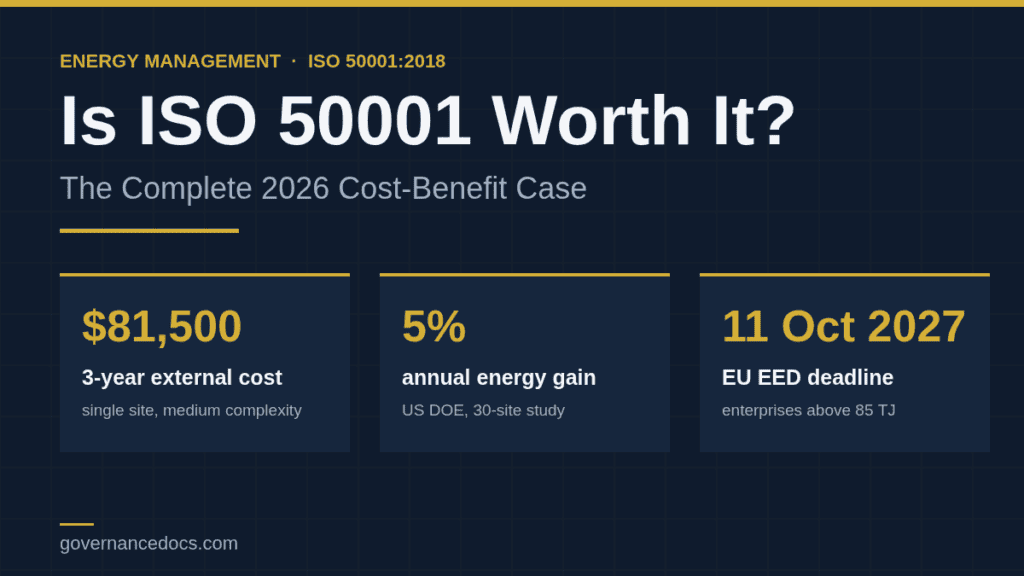
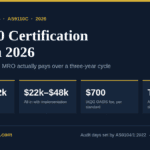
Is ISO 50001 worth it? For a site with a real energy bill, usually yes — but the business case rests on energy savings and regulatory deadlines, not on the certificate itself. ISO 50001 is the only management system standard that pays for itself out of operating cost, which makes the arithmetic unusually honest. It is also the only one with a hard EU deadline attached: enterprises above 85 TJ of annual energy use must have a certified energy management system in place by 11 October 2027.
Is ISO 50001 worth it at your energy volume? That is the question this cost-benefit case answers, run against ISO 50001:2018 and 2026 market rates.
Is ISO 50001 Worth It? The Short Answer
Three conditions decide it. Meet two of them and ISO 50001 is worth it:
Your annual energy spend is above roughly $500,000. Below that, the percentage savings are real but the absolute numbers struggle to cover audit fees.
You are in scope of a mandate. The EU Energy Efficiency Directive, UK ESOS and a growing list of customer contracts now name ISO 50001 directly.
Your energy data is poor. Counter-intuitively, bad metering is an argument for certification — the standard forces the sub-metering and baselining that surface the savings.
Is ISO 50001 worth it on one condition alone? Rarely. It is not worth it if your energy cost is a rounding error on the P&L, if you lease space and cannot touch the plant, or if nobody will own the data after the certificate arrives.
What ISO 50001 Certification Actually Costs
Before answering is ISO 50001 worth it, price it properly. Audit fees are the small half.
Certification bodies charge by auditor day, typically US$1,200–$2,500, and scope the audit on energy-system complexity rather than headcount. For a single site of medium complexity, expect the figures below — treat them as typical ranges and confirm with quotes.
Cost line
Low complexity
Medium complexity
High complexity
Stage 1 + stage 2 initial audit
$3,600–$10,000
$6,000–$17,500
$9,600–$35,000
Surveillance audit (each, years 2–3)
$1,200–$3,750
$2,400–$6,250
$3,600–$12,500
Certification body, full three-year cycle
$8,000–$23,000
$13,000–$39,000
$21,000–$78,000
Energy review (clause 6.3)
$3,000–$8,000
$8,000–$20,000
$20,000–$60,000
Sub-metering and data collection
$5,000–$20,000
$20,000–$80,000
$80,000–$300,000+
Baselines, EnPIs and data plan
$2,000–$6,000
$6,000–$15,000
$15,000–$40,000
Documentation and training
$3,500–$10,000
$9,000–$22,000
$20,000–$55,000
Internal time, year one
40–80 staff days
80–160 staff days
160–400 staff days
Sub-metering is the line that settles “is ISO 50001 worth it” on cost alone. It is also the line most likely to be an investment you needed anyway — you cannot manage energy you do not measure, certificate or no certificate. Our full ISO 50001 certification cost breakdown works through the day-rate maths site by site.
The Three Benefits That Carry the Case
1. Energy savings, and they persist
This is the benefit that separates ISO 50001 from every other standard. The US Department of Energy studied enterprise-wide ISO 50001 implementations across 30 sites operated by 3M, Cummins, Nissan and Schneider Electric, and reported that the multi-site approach improved energy performance by an average of five percent annually. The same programme cut per-site implementation costs by $12,000 on training, $3,000 on consultants and $4,000 on third-party certification where sites shared one system.
Two things matter in that number. It is annual, not one-off — the standard’s clause 9 monitoring requirement is what makes savings recur rather than decay. And DOE attributes the majority of early savings to no-cost and low-cost operational changes, which means the first year does not depend on capital approval.
2. Regulatory deadlines that now name the standard
Article 11 of the EU Energy Efficiency Directive (2023/1791) is the hardest driver in the market. Enterprises with average annual energy consumption above 85 TJ over the previous three years — roughly 23.6 GWh, all carriers combined — “implement an energy management system,” which “shall be certified by an independent body.” The deadline is 11 October 2027.
Below that, enterprises above 10 TJ (about 2.8 GWh) that do not run an energy management system must instead undergo an energy audit, with the first due by 11 October 2026 and repeats at least every four years, plus a documented action plan for every feasible recommendation. For any enterprise in that band, is ISO 50001 worth it stops being a strategic question and becomes an arithmetic one: a recurring four-yearly audit with mandatory action planning costs money and delivers no certificate, while an EnMS discharges the obligation and produces one.
In the UK, ESOS Phase 4 works the same way. Large undertakings — 250 or more employees, or turnover above £44 million together with a balance sheet above £38 million — qualify on 31 December 2026, must notify compliance by 5 December 2027 and file an action plan by 5 December 2028. An ISO 50001 certificate covering at least 95% of total energy consumption removes the lead assessor requirement entirely.
3. Tenders, lenders and scope 1–2 reporting
For companies selling into regulated and public-sector supply chains, is ISO 50001 worth it is a revenue question rather than a cost one. Energy data is now audited data. ISO 50001’s baselines and energy performance indicators are the cleanest available source for scope 1 and 2 disclosure, and the clause 9.1 measurement plan is the evidence an assurance provider asks for. Public-sector and utility tenders increasingly list the certificate as a scored criterion rather than a nice-to-have.
Is ISO 50001 Worth It for a Mid-Sized Manufacturer?
Take the worked example from our cost analysis: a single site, 220 staff, medium energy-system complexity, a $1,700 auditor day rate. Certification body fees run about $20,500 across the three-year cycle. Add an energy review, sub-metering of four significant energy uses, baselines, documentation and training and the total external spend is roughly $81,500 over three years, plus about 110 internal staff days.
Now the other side. Assume that site buys 12.5 GWh a year — about 45 TJ, so inside the EU audit tier but below the 85 TJ certification threshold — at a blended $0.12/kWh. That is a $1.5 million annual energy bill.
Year
Cumulative external cost
Energy saving at 4–5%/yr
Net position
Year 1
$62,000
$60,000–$75,000
Roughly break-even
Year 2
$72,000
$118,000–$146,000 cumulative
+$46,000 to +$74,000
Year 3
$81,500
$174,000–$214,000 cumulative
+$93,000 to +$133,000
Payback lands somewhere in the second year. That is the answer to “is ISO 50001 worth it” for most industrial sites: not a cost centre with a compliance benefit, but an operating-cost project that happens to end in a certificate. Halve the energy bill to $750,000 and payback slips past year three — which is precisely why the $500,000 spend threshold above is the real test. These are illustrative figures on stated assumptions, not a quotation; your tariff and load profile move them substantially.
When ISO 50001 Is Not Worth It
Is ISO 50001 worth it in every case? No — and these four situations are the common ones where the answer is a clear no.
You lease and cannot touch the plant. If HVAC, lighting and metering belong to the landlord, you will certify a management system with no significant energy uses under your control.
Energy is under 1% of operating cost. Professional services, most software firms, light assembly. The percentage savings are genuine and the absolute savings will not cover surveillance audits.
You only need the regulatory tick. Below 85 TJ in the EU, a four-yearly energy audit is the cheaper route if you have no intention of acting on the findings. It is the worse route if you do.
Nobody owns the data. ISO 50001 without a named energy manager and a monthly review decays into an annual document-refresh exercise, and surveillance auditors notice.
Frequently Asked Questions
Is ISO 50001 mandatory?
The standard itself is voluntary. The obligation to have a certified energy management system is not, for EU enterprises above 85 TJ, where Article 11 of Directive 2023/1791 sets a deadline of 11 October 2027. UK ESOS does not mandate it but accepts it as a compliance route.
How long does certification take?
Plan 9–15 months for a first certification. The constraint is not documentation — it is that you need an energy baseline plus at least one reporting period of monitored performance data before a stage 2 auditor can assess whether energy performance has improved.
Which edition applies in 2026?
ISO 50001:2018, the second edition, remains current, with Amendment 1:2024 adding the climate action requirements to clauses 4.1 and 4.2. A revision proposal entered the early ISO/TC 301 stages in late 2026, but no new edition is close enough to delay a certification decision.
Can we combine it with ISO 14001?
Yes, and you should if you hold both. Both follow the Annex SL high-level structure, so context, leadership, internal audit and management review integrate cleanly. The energy review and the significant-energy-use register stay ISO 50001-specific — see ISO 50001 vs ISO 14001 for where the two actually diverge.
Does ISO 50001 guarantee energy savings?
No. It requires demonstrable energy performance improvement, which is a different thing: an auditor tests whether your EnPIs moved against your baseline, not whether you hit a target. Sites that treat it as a documentation exercise get a certificate and no savings, which is the main way the business case fails.
The Verdict
Is ISO 50001 worth it in 2026? If energy is a material line on your P&L, the honest answer is that the question is already settled by the EU’s 85 TJ threshold and by the savings evidence. If energy is immaterial, no amount of regulatory pressure makes the certificate pay. The deciding variable is your energy bill, not your industry — and the cheapest way to find out is to read your own meter data before you call a certification body.
If you decide to go ahead, the ISO 50001 Energy Management Toolkit covers the documented side with 53 Microsoft Office templates — energy policy, energy review, significant energy uses, EnPIs and baselines, monitoring, internal audit and management review — for $99, which keeps the documentation line in the table above closer to its low end.