An NQA-1 audit checklist is the working tool that turns a quality assurance program on paper into evidence that the program is actually followed. If you supply items or services to a nuclear facility, or you run the quality program for one, auditors will test your procedures against the requirements you committed to, and the ones who come prepared pass with fewer findings.
This guide walks through how to plan an audit, what to put in the checklist, how independence and qualification work, and how to close findings properly. It is written for quality managers and lead auditors at suppliers and utilities. Audit frequency and content must follow your own approved QA program and the edition of ASME NQA-1 and the regulations that your contract invokes, so treat this as a practical starting point, not a substitute for them.
Free gap assessment
Are you ready for the 2026 edition of ISO 9001?
Score yourself against the new edition, free, including the risk and opportunity split and the clause 10 renumbering that breaks converted checklists.
ASME NQA-1 sets out quality assurance requirements for nuclear facility applications, and the 2024 edition was published in September 2024 according to published summaries. Among the requirements, the one on audits exists to verify, independently, that the program is implemented and effective. In the United States, the regulatory counterpart for many licensees is 10 CFR Part 50 Appendix B, which includes a criterion on audits. See our guide to 10 CFR 50 Appendix B for the link between the two.
A checklist keeps an audit consistent. Without one, auditors follow interesting threads and miss routine but important controls, such as whether calibrated equipment was in date or whether a procurement document carried the right technical and quality requirements. A good NQA-1 audit checklist is derived from the program, not copied from another company, and it is reviewed before every audit.
Who can perform an audit under your QA program
Independence is the core idea. Auditors must be independent of the activity being audited: they should not audit their own work or directly supervise the work under audit. Small suppliers often cannot staff this internally and hire an external auditor to meet the independence expectation.
Qualification matters as much as independence. Your program should define how auditors and lead auditors are trained, how their experience is recorded and how their qualification is maintained. Keep those records current, because a customer auditing you will ask for them. A nuclear quality assurance audit performed by an unqualified person can be rejected, and then you have an audit gap, not just a finding.
Building your NQA-1 audit checklist step by step
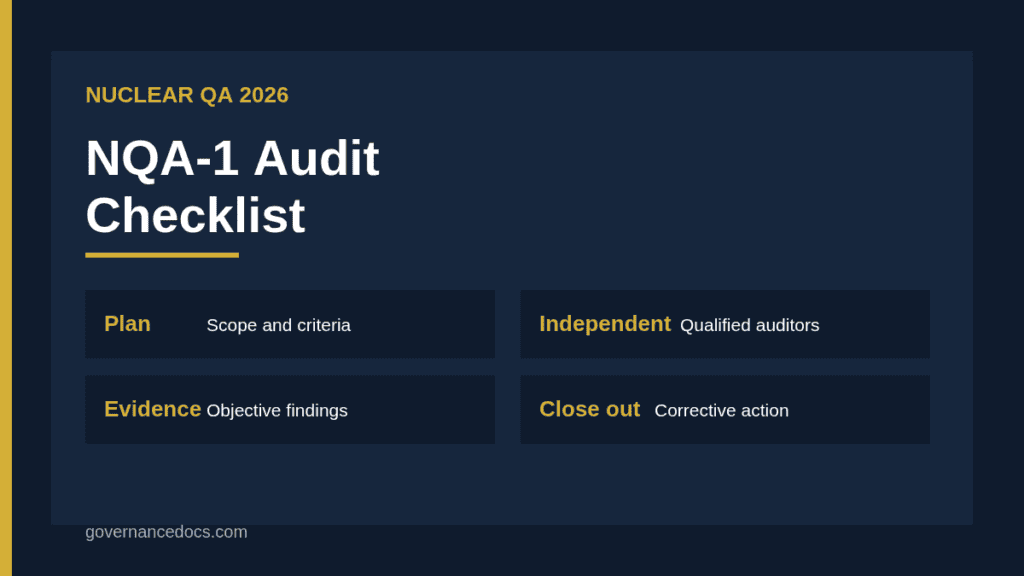
Start from your quality assurance program manual and work down. For each element you commit to, write the questions an auditor would ask and the evidence that would answer them. The checklist should list the requirement, the procedure that implements it, the question and the place to record the objective evidence.
A workable structure follows the program elements:
Audit stage
What to check
Typical evidence
Planning
Scope, criteria, schedule, lead auditor named
Audit plan, notification letter
Preparation
Procedures, prior reports, open corrective actions reviewed
Checklist, document review notes
Performance
Activities match procedures; records are complete
Interview notes, records sampled, observations
Reporting
Findings stated against a requirement with evidence
Audit report to management
Follow-up
Responses, corrective action and verification
Corrective action records, re-verification
Records
Plan, checklist and report retained as quality records
Records index and storage evidence
Organization and QA program: roles, authority and independence of QA
Design control and document control: current revisions at the point of use
Procurement and supplier control: qualified suppliers and flowed-down requirements
Item identification and control: traceability and handling
Inspection, test and calibration: qualified inspectors and calibrated equipment
Nonconformance and corrective action: timely, documented and verified closure
Quality records: legible, retrievable and protected
Every audit starts with a written plan: scope, objectives, criteria, schedule, team and lead auditor. Notify the auditee in advance, and review previous audit reports and open corrective actions before you arrive. If the same finding appears for the third time, it is no longer a finding about the activity; it is a finding about your corrective action process.
Use a risk-based approach to scope. Activities that are more safety-significant, recently changed or with a poor history deserve more attention. Our explanation of the NQA-1 graded approach shows how safety significance drives the depth of controls, and the same logic applies to audit depth.
Performing the nuclear quality assurance audit
Hold an opening meeting, confirm scope and logistics, then sample. Auditors should look at records, interview the people doing the work and watch the work where possible. A record that says an inspection occurred is only half the evidence; observing how the inspection is done is the other half.
Write observations factually. State what you saw, what requirement applies and why it does not meet it. Avoid opinions and avoid solving the problem for the auditee. Close with an exit meeting so nobody sees the findings for the first time in a written report.
Supplier audits and evaluations
Audits are also how you qualify and monitor your suppliers. A supplier evaluation may rely on a survey, a review of the supplier’s QA program, a previous audit or an on-site audit, and the choice depends on safety significance and risk. Our page on NQA-1 supplier evaluation covers evaluation methods.
If you buy commercial items for safety-related use, dedication is a separate activity with its own verification; see commercial-grade dedication. Also check that your purchase orders flow down defect-reporting obligations such as those discussed in 10 CFR Part 21.
Reporting findings and closing them out
A finding should state the requirement, the condition found and the evidence. Classify severity according to your program, issue the report to management within the timeframe your procedures define, and require a response with cause, correction and corrective action. Then verify that the action worked, not merely that it was completed.
Audit findings that stay open for months without action will themselves become findings next time. Tie audit findings into your corrective action system; our article on the corrective action program explains the expected steps. Retain the plan, checklist, report and closure evidence as quality records for the period your program defines.
Templates that save time on your NQA-1 audit checklist
Writing plans, checklists, reports and follow-up forms from scratch takes weeks. The NQA-1 2024 Nuclear Quality Assurance Toolkit includes editable templates across the quality program, including audit and corrective action documents, so your team can tailor them to your own program instead of inventing the format.
For background reading on the standard, see the ANSI overview of ASME NQA-1-2024. Whatever you use, your approved QA program and your customer contract remain the governing documents. For where the standard fits against commercial quality systems, compare NQA-1 vs ISO 9001.
Sample questions to include in your NQA-1 audit checklist
Concrete questions make a checklist usable. For document control, ask whether the revision at the point of use is the current approved one and how obsolete copies are removed. For procurement, ask whether the purchase order includes the technical requirements, quality requirements and right of access, and whether the supplier was on the approved list on the order date. For inspection, ask whether the inspector was qualified, whether the acceptance criteria came from an approved document and whether the measuring equipment was within its calibration interval.
For nonconformances, ask how the item was identified, segregated and dispositioned, and who approved the disposition. For corrective action, ask whether the cause was determined and whether the action was checked for effectiveness. For records, ask whether they are legible, identifiable, retrievable and stored so they are protected from damage. Add a final question that auditors often skip: what changed since the last audit, such as a new procedure, a new site, a new supplier or a new software tool? Change is where problems begin, so the answers tell you where to sample deeper. Every example here is illustrative; write the final questions from your own program.
Common mistakes with an NQA-1 audit checklist
The usual failures are predictable. Checklists are generic and ignore the auditee’s real procedures. Auditors sample only paperwork. Independence is compromised because the auditor is also the process owner. Findings are vague, so the auditee cannot respond. And follow-up is treated as administration, so recurring issues never disappear.
Another frequent mistake is treating the audit as an annual event rather than a management tool. Trend your findings by requirement, site and supplier, and use the trends to decide where next year’s audits should concentrate.
NQA-1 Audit Checklist FAQ
What is an NQA-1 audit checklist?
It is a list of requirement-based questions and evidence expectations used to audit a nuclear quality assurance program or supplier against ASME NQA-1 and the program commitments.
How often should audits be performed?
Frequency is set by your approved QA program and customer requirements. Internal audits are commonly scheduled at least annually per program element, and supplier audit frequency is risk-based.
Can I audit my own department?
No. Auditors must be independent of the area being audited and cannot audit their own work or directly supervise it.
Who retains audit records?
Your QA program defines retention. Plans, checklists, reports and corrective action evidence are normally kept as quality records for the period specified.
Does NQA-1 replace 10 CFR 50 Appendix B?
No. NQA-1 is a consensus standard, while Appendix B is a regulation. Licensees often use NQA-1 to meet Appendix B, subject to their commitments.