NQA-1 supplier evaluation is the process of proving, before you buy and while you keep buying, that a supplier can deliver safety-related items and services that meet nuclear quality requirements. It is one of the most inspected parts of any nuclear quality assurance programme, because a defect that arrives from outside your walls still becomes your responsibility once it is installed.
This guide explains how procurement and supplier controls work in NQA-1 and in 10 CFR 50 Appendix B, how an approved supplier list is built and maintained, what the NRC’s guidance says about audits and evaluations, and what evidence inspectors ask to see. For the standard as a whole, see our overview of NQA-1 and which edition binds you.
Free gap assessment
Are you ready for the 2026 edition of ISO 9001?
Score yourself against the new edition, free, including the risk and opportunity split and the clause 10 renumbering that breaks converted checklists.
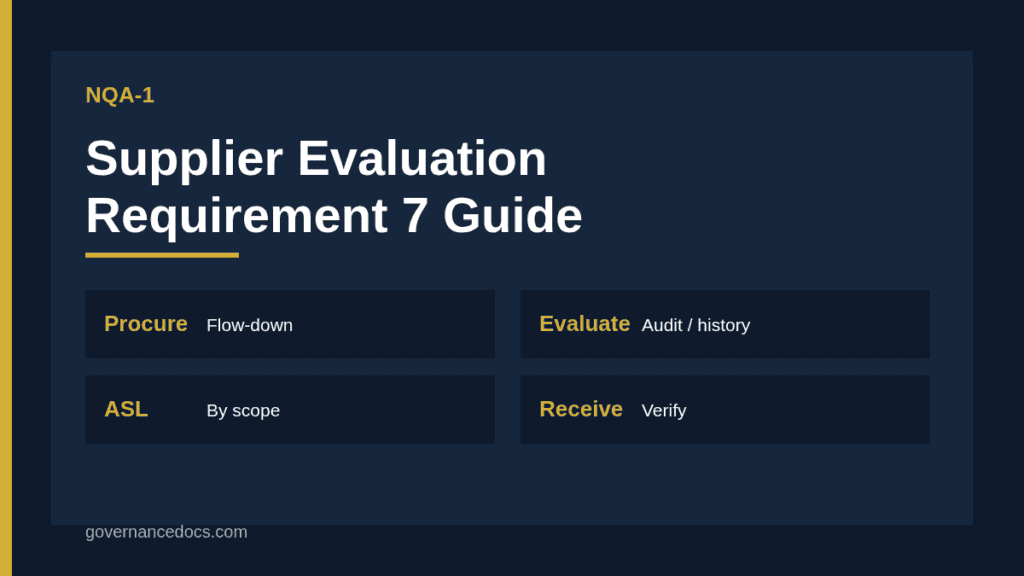
Practitioner summaries place the requirement in NQA-1 Requirement 7, on control of purchased items and services, together with Criteria IV and VII of 10 CFR 50 Appendix B, which deal with procurement document control and the control of purchased material, equipment and services. The core principle is that quality must be built in at the source and not inspected in on receipt. That means flowing requirements to suppliers before work starts, verifying their capability before award and keeping proportionate oversight during production. Our guide to the 18 criteria of Appendix B shows how the procurement criteria fit the rest.
What procurement documents must contain
The purchase order is the vehicle for every requirement, so its content matters as much as the supplier’s capability. Practitioner guidance lists the following elements.
Quality standard. The applicable program standard, such as NQA-1, or equivalents used in other regimes.
Technical requirements. Codes and specifications with the revisions that apply.
Inspection points. Hold and witness points where the purchaser will observe.
Documentation. Records the supplier must supply with delivery.
Defect reporting. The reporting obligations that arise under 10 CFR Part 21.
Right of access. Access for the purchaser, and for the regulator, to the supplier’s facilities and records.
If the order omits a requirement, the supplier is not bound to it, so review procurement documents against the technical and quality requirements before they are issued.
Methods of NQA-1 supplier evaluation
A sound NQA-1 supplier evaluation starts from the principle that the purchaser must evaluate and select suppliers on the basis of their ability to meet the requirements. NQA-1 describes several ways to do this, and the choice depends on the safety significance of the item and the supplier’s history.
Method
What it involves
Typical use
Audit or survey of the supplier’s programme
On-site or remote review of the supplier’s quality assurance programme and its implementation
Safety-related items and services from suppliers with no accreditation
Evaluation of supplier history
Review of the supplier’s past performance, and delivery and quality records
Repeat suppliers with a good record
Evaluation of the supplier’s product
Examination of samples or of the item itself
Where the item can be tested directly
Accreditation or certificate
Use of an accredited programme, such as ASME certification, with verification
Suppliers holding recognised certification
Whichever method you choose, record why. Practitioners note that third-party certificates alone do not replace the purchaser’s own qualification and ongoing oversight, and the NRC’s guidance says that even where ASME accreditation certificates are recognised as evidence of an adequate programme, licensees should ensure that suppliers are effectively implementing their approved programmes.
Calibration and testing laboratories
NRC Regulatory Guide 1.28, Revision 5, which endorses NQA-1b-2011 addenda to the 2008 edition, and the 2012 and 2015 editions, accepts an alternative for calibration and testing services described in NEI 14-05. It allows use of laboratory accreditation from accreditation bodies that are signatories to the ILAC Mutual Recognition Arrangement in place of a commercial-grade survey of the laboratory. Check the current revision of the regulatory guide and the licensee’s own commitments before relying on this route.
The approved supplier list
Most licensees and contractors keep an approved supplier list as the output of NQA-1 supplier evaluation. A good list records, for each supplier, the scope for which it is qualified, the basis of qualification, the date, and the date by which it must be re-qualified. Suppliers are qualified for a scope, not in general: a valve manufacturer approved for one product line is not approved for services it has never been evaluated on. Restrict purchasing of safety-related items to suppliers on the list for that scope, and remove or suspend suppliers whose performance or audit results fall below the standard.
Periodic audits and annual evaluations
The NRC’s guidance, as summarised in commentary on Regulatory Guide 1.28, expects applicants and licensees to conduct or arrange triennial audits of suppliers’ quality assurance programmes and to perform annual evaluations that document supplier performance, taking into account earlier audit results, nonconformance records and operating experience. Treat the interval as a minimum and adjust it with risk: a supplier with repeated nonconformances should be audited sooner. Joint audits shared among purchasers can spread the effort, but each purchaser remains responsible for confirming that the audit scope covers its own purchases.
Source inspection, surveillance and receipt
For high-risk items, source inspection during production catches problems before shipment. Surveillance provides periodic monitoring between formal inspections, with frequency based on supplier history, complexity and safety significance. At receipt, verify identity, quantity, condition and documentation. Check that certificates of conformance match the order, cite current code revisions and are signed by the right authority. Anything that fails goes into the nonconformance process, with the item segregated and controlled, and a defect that could affect safety triggers evaluation under Part 21.
Commercial-grade items
When a supplier does not hold a nuclear quality programme, the purchaser may still use its products in safety-related applications by dedicating them through a formal process. That process is covered in our guide to commercial grade dedication, and it should sit alongside the supplier evaluation rules, not replace them. The NQA-1 graded approach guide explains how the safety significance of an item sets the level of control.
Roles and training for NQA-1 supplier evaluation
Procurement engineering, quality assurance and supply chain staff share the work, so define who does what. Engineering sets the technical and quality requirements, quality assurance evaluates suppliers and approves the list, procurement issues the order and maintains the record, and receiving inspection verifies what arrives. Auditors and surveyors need qualification of their own under the audit requirements of the standard. Train buyers to recognise safety-related items and to refuse to buy them from unlisted suppliers, since most supplier control failures begin with a well-meaning purchase outside the process.
A hypothetical example
A nuclear plant operator needs a batch of relief valves for a safety-related system. Procurement checks the approved supplier list and finds the manufacturer qualified for the valve type, with re-qualification due in five months. Engineering writes technical requirements and hold points, quality adds the standard, records and Part 21 reporting clauses, and the order is issued with right-of-access provisions. The buyer schedules a surveillance visit during final testing, witnesses a pressure test and reviews the material certificates. On receipt, the inspector finds one certificate with an out-of-date code revision, so the item is put on hold. The supplier reissues the certificate and the batch is accepted. The example is illustrative only.
Common findings in NQA-1 supplier evaluation
Qualified for the wrong scope. The supplier is on the list, but not for the item or service purchased.
Certificate accepted without verification. The scope and validity of the accreditation were not checked.
Overdue audits. Supplier audits or annual evaluations were not completed on schedule.
Weak purchase orders. Codes, revisions or hold points are missing.
No follow-up. Findings from an audit remain open with no closure evidence.
Receipt inspection skipped. Documents are filed without being checked against the order.
Evidence inspectors ask for
Expect to be asked for the procurement procedure, the approved supplier list with scopes and dates, audit or survey reports and the follow-up on findings, annual evaluations, examples of purchase orders and their reviews, source inspection and surveillance records, receipt inspection records and nonconformance reports. Keep the trail complete for a sample item from purchase requisition through to installation.
Templates for NQA-1 supplier evaluation
The documents are repeatable: a procurement procedure, a supplier evaluation form, audit plan and report templates, an approved supplier list format, a purchase order review checklist and a receipt inspection form. The Nuclear Quality Assurance Toolkit includes templates for these, which you can adapt to your programme. The regulatory background is in the NRC’s Regulatory Guide 1.28, and you should confirm the current revision and your own licensing commitments.
NQA-1 supplier evaluation FAQ
Which NQA-1 requirement covers suppliers?
Requirement 7, control of purchased items and services, together with Criteria IV and VII of 10 CFR 50 Appendix B.
Is a supplier’s ASME certificate enough?
It is useful evidence, but the purchaser should verify scope and validity and ensure the supplier is effectively implementing its programme.
How often should suppliers be audited?
NRC guidance summarised in commentary expects triennial audits and annual performance evaluations, adjusted by risk and history.
What is an approved supplier list?
A controlled list of suppliers with their qualified scope, qualification basis and re-qualification date, used to restrict purchasing of safety-related items.