CART
10 CFR Part 21 is the NRC regulation that turns a quality problem into a reporting obligation. Under Section 206 of the Energy Reorganization Act, anyone who builds a licensed nuclear facility or supplies a basic component for one must evaluate deviations, decide within 60 days whether they amount to a defect that could create a substantial safety hazard, and tell the NRC within two days of concluding that they do. It is the regulation that makes an NQA-1 program consequential outside the plant fence: a supplier’s nonconformance report can become a federal filing. This guide explains who 10 CFR Part 21 reaches, the definitions that decide whether something is reportable, the four clocks, what the report must contain, and the posting and records duties most suppliers overlook.
Free gap assessment
Are you ready for the 2026 edition of ISO 9001?
Score yourself against the new edition, free, including the risk and opportunity split and the clause 10 renumbering that breaks converted checklists.
Run the free ISO 9001 gap assessment → or View premium report sample
Section 21.2 sets the scope. It reaches NRC licensees and applicants — for source, byproduct and special nuclear material, production and utilization facilities, spent fuel storage installations and repositories — and their directors and responsible officers. It also reaches, and this is the part that matters for the supply chain, “each individual, corporation, partnership, or other entity doing business within the United States” that constructs a licensed facility or “supplies basic components” for one. Consulting, design, analysis, inspection and testing services associated with a basic component are inside the definition of basic component too. The most recent amendment (91 FR 15775, 30 March 2026) added references to the Part 53 licensing framework alongside Parts 50 and 52, so the rule covers advanced reactor licensees and their suppliers on the same terms.
Two consequences follow. First, a supplier does not need an NRC licence to be bound by Part 21; supplying a basic component is enough. Second, the obligation attaches to named people — directors and responsible officers — not only to the company. Section 21.61 provides civil penalties for a director or responsible officer who “knowingly and consciously fails to provide the notice required”.
Almost every Part 21 argument turns on four defined terms in section 21.3.
| Term | Definition (10 CFR 21.3, condensed) | Why it matters |
|---|---|---|
| Basic component | For Part 50/52 plants: a structure, system or component, or part, that affects a safety function necessary to assure reactor coolant pressure boundary integrity, safe shutdown capability, or accident mitigation. For Part 53 plants: a safety-related SSC or part. Includes design, analysis, inspection, testing and consulting services associated with such items. | Only basic components carry Part 21 duties. A commercial grade item becomes a basic component when dedicated. |
| Deviation | A departure from the technical requirements in a procurement document, or from an early site permit, design certification or design approval. | The trigger. A deviation is not yet a defect; it is what must be evaluated. |
| Defect | A deviation in a basic component delivered to a purchaser that, on evaluation, could create a substantial safety hazard; also installation or use of such a component, and certain deviations in facilities offered for acceptance. | The reportable condition. Defect status depends on the evaluation, not the size of the deviation. |
| Substantial safety hazard | A loss of safety function to the extent that there is a major reduction in the degree of protection provided to public health and safety for any NRC-licensed facility or activity. | The threshold. Most deviations do not reach it; the evaluation has to show why. |
| Discovery | Completion of the documentation first identifying the existence of a deviation or failure to comply potentially associated with a substantial safety hazard, within the evaluation procedures. | Starts the 60-day clock. Documenting late does not delay discovery; it creates a second problem. |
Two further definitions bind dedication to Part 21. A dedicating entity — the manufacturer, a third party or the licensee — is responsible under 21.21(c) for identifying and evaluating deviations, reporting defects for dedicated items, and maintaining auditable records of the dedication process. And critical characteristics are the design, material and performance characteristics of a commercial grade item that, once verified, give reasonable assurance it will perform its safety function. Our guide to commercial grade dedication covers the acceptance methods; Part 21 is what makes the dedicating entity answerable for the result.
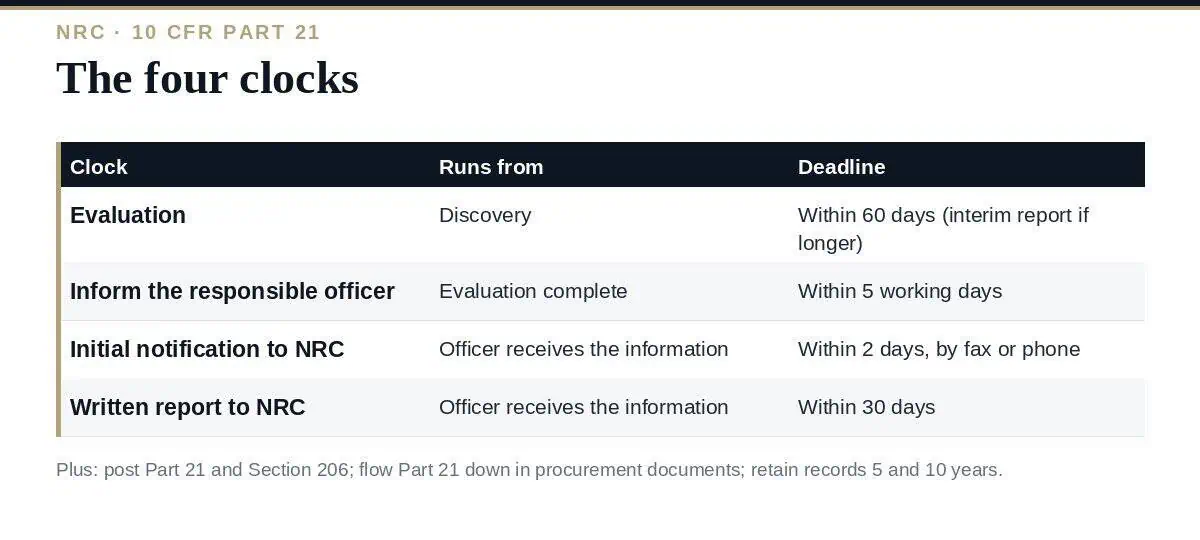
Section 21.21 sets out the procedure every entity in scope “shall adopt”. The timescales are fixed and run from defined events.
| Clock | Runs from | Deadline | Rule |
|---|---|---|---|
| Evaluation | Discovery | As soon as practicable; in all cases within 60 days | 21.21(a)(1) |
| Interim report | Discovery, if the evaluation cannot finish in 60 days | Written interim report to the NRC within 60 days of discovery, stating when the evaluation will complete | 21.21(a)(2) |
| Inform the director or responsible officer | Completion of the evaluation | As soon as practicable; in all cases within 5 working days | 21.21(a)(3) |
| Initial notification to the NRC | Receipt of information by the director or responsible officer | Within 2 days, by facsimile (preferred) to the NRC Operations Center or by telephone | 21.21(d)(3)(i) |
| Written notification | Receipt of information by the director or responsible officer | Within 30 days, to the address in 21.5 | 21.21(d)(3)(ii) |
Three points about the clocks catch suppliers out.
Section 21.21(b) addresses the common case where a supplier finds a deviation but does not have the design information to judge whether it creates a substantial safety hazard — the component’s safety function depends on how the licensee uses it. In that case the supplier “must inform the purchasers or affected licensees within five working days of this determination” so that they can evaluate it. This is not a way out of Part 21; it moves the evaluation to the party that can perform it, and the supplier’s notification has to be documented and retained.
Section 21.21(d)(4) lists the minimum content of the 30-day written notification, “to the extent known”:
Item 6 is the one that needs a working records system: a supplier who cannot say where its basic components went cannot complete the report. That is why 21.51 requires suppliers to retain a record of purchasers of basic components for 10 years after delivery.
Three 10 CFR Part 21 duties sit outside the evaluation-and-report sequence and are the most common inspection findings.
Every entity in scope must post current copies of Part 21, Section 206 of the Energy Reorganization Act, and its own Part 21 procedures “in a conspicuous position on any premises within the United States where the activities subject to this part are conducted”. Where posting the full documents is impractical, a notice describing them, naming the individual to whom reports may be made and stating where they can be examined, is acceptable — but Section 206 must still be posted.
Each procurement document for a facility or basic component must specify, when applicable, that Part 21 applies. This is the flow-down clause: it is how a licensee’s obligation reaches a tier-two machine shop, and its absence from a purchase order is a finding against the purchaser. It pairs with NQA-1 Requirement 4, Procurement Document Control.
Retain evaluations of all deviations and failures to comply for at least 5 years after the evaluation; retain notifications sent to purchasers and licensees for at least 5 years; retain the record of purchasers of basic components for 10 years after delivery. Section 21.41 gives the NRC the right to inspect records, premises, activities and basic components.
Part 21 does not stand alone. It sits on top of the nonconformance and corrective action processes of an Appendix B program — NQA-1 Requirements 15 and 16 — and the evaluation it demands is a screening step inside them. A workable procedure does five things: defines who screens every nonconformance for potential Part 21 applicability and documents that screening (which fixes the discovery date); assigns the evaluation to someone with the design knowledge to judge safety significance, with a route to the purchaser under 21.21(b) when that knowledge is not in-house; sets internal deadlines shorter than the regulatory ones; names the director or responsible officer and the designated notifier under 21.21(d)(5); and closes the loop into the corrective action program so that the “corrective action” item of the written report is real. Our guide to the corrective action program covers the second half; the 18 criteria of Appendix B cover the program it lives in.
Does 10 CFR Part 21 apply to suppliers without an NRC licence?
Yes. Section 21.2 reaches any entity doing business in the United States that supplies basic components for a licensed facility or activity, and their directors and responsible officers, whether or not they hold a licence.
What is the difference between a deviation and a defect?
A deviation is a departure from procurement or design requirements. It becomes a defect only if evaluation shows it could create a substantial safety hazard — a major reduction in the protection of public health and safety.
How long do we have to report?
Evaluate within 60 days of discovery; inform the director or responsible officer within 5 working days of completing the evaluation; notify the NRC Operations Center within 2 days of the officer receiving the information; file the written report within 30 days.
What if we cannot tell whether it is a safety hazard?
Under 21.21(b) a supplier that cannot perform the evaluation must inform the purchasers or affected licensees within five working days so they can evaluate it. Document that notification.
Does Part 21 apply to commercial grade items?
Once a commercial grade item is dedicated for safety-related use it is a basic component, and the dedicating entity carries the Part 21 evaluation, reporting and records duties for it under 21.21(c).
Treat 10 CFR Part 21 as four clocks and three standing duties. Screen every nonconformance so discovery is dated, evaluate inside 60 days or file the interim report, get the finding to the responsible officer inside 5 working days and to the NRC inside 2, and keep the postings, the procurement flow-down and the 5- and 10-year records that an inspector will ask for first.
A Part 21 evaluation and reporting procedure, the screening form, the notification templates and the nonconformance and corrective action procedures it connects to are in the NQA-1 Nuclear Quality Assurance Toolkit, or start with the free templates.

October 11, 2026
October 11, 2026

October 11, 2026
October 11, 2026
October 11, 2026

