CART
NQA-1 software quality assurance is where organisations with a mature nuclear quality
programme most often find a hole. The hardware side of a QA programme is visible, inspected and
audited. The analysis code that sized the component, the spreadsheet that performed the calculation
and the firmware inside the instrument frequently sit outside the programme entirely — and all
three are in scope.
Free gap assessment
Are you ready for the 2026 edition of ISO 9001?
Score yourself against the new edition, free, including the risk and opportunity split and the clause 10 renumbering that breaks converted checklists.
Run the free ISO 9001 gap assessment → or View premium report sample
The requirements are in Part II, Subpart 2.7, Quality Assurance Requirements for Computer
Software for Nuclear Facility Applications. Implementation guidance sits separately in Part IV,
as an application appendix rather than as requirements — a distinction worth keeping straight,
because auditors assess you against Part II and the guidance is there to help you get there.
Subpart 2.7 covers the working substance of a software quality programme: applicability and
classification, the software engineering activities across the lifecycle, and general requirements
including documentation. In practice that means a Software Quality Assurance Plan, controls across
acquisition, development, operation, maintenance and retirement, verification and validation,
configuration management, and problem reporting and corrective action.
The scoping question is the one that decides how much work you have, and organisations habitually
scope it too narrowly. Software in scope typically includes:
What is generally out of scope is software with no path to a safety-related outcome — the
payroll system, the site intranet. The boundary is drawn by consequence, not by technology, and it
should be drawn explicitly in the SQA Plan rather than left to be inferred.
Most nuclear software is bought, not written. Software not produced under a quality assurance
programme compliant with the standard has to be dedicated, using the commercial grade
route in Part II Subpart 2.14 — the same discipline applied to hardware, with critical
characteristics identified and verified by accepted methods.
This surprises people, and it is the most consequential single fact about NQA-1 software quality
assurance. A commercial analysis code from a well-regarded vendor is not compliant simply because it
is widely used and well tested. Somebody has to identify what the code must do correctly for the
safety function to hold, and verify it. Our guide to
commercial grade dedication covers
how that process works.
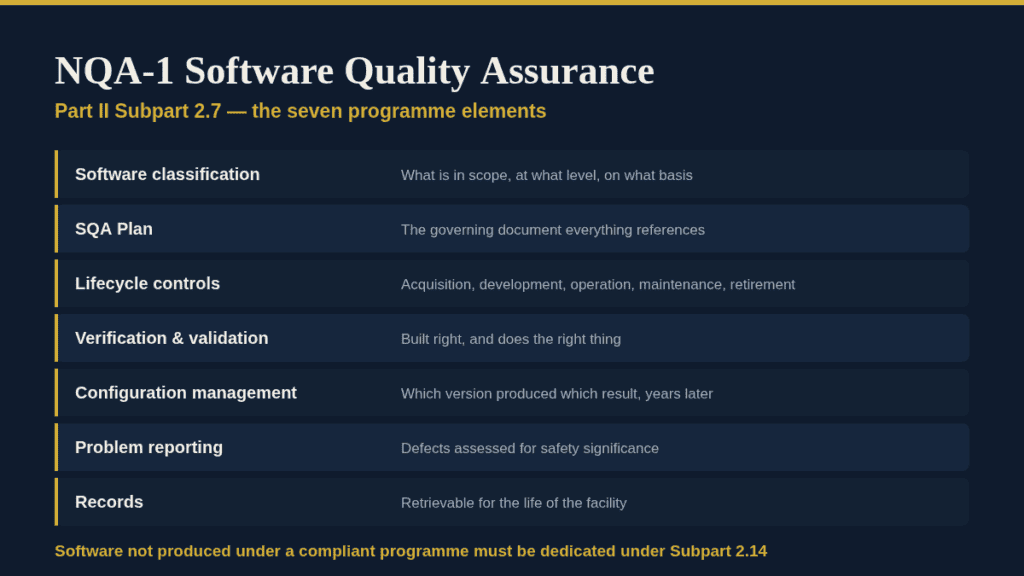
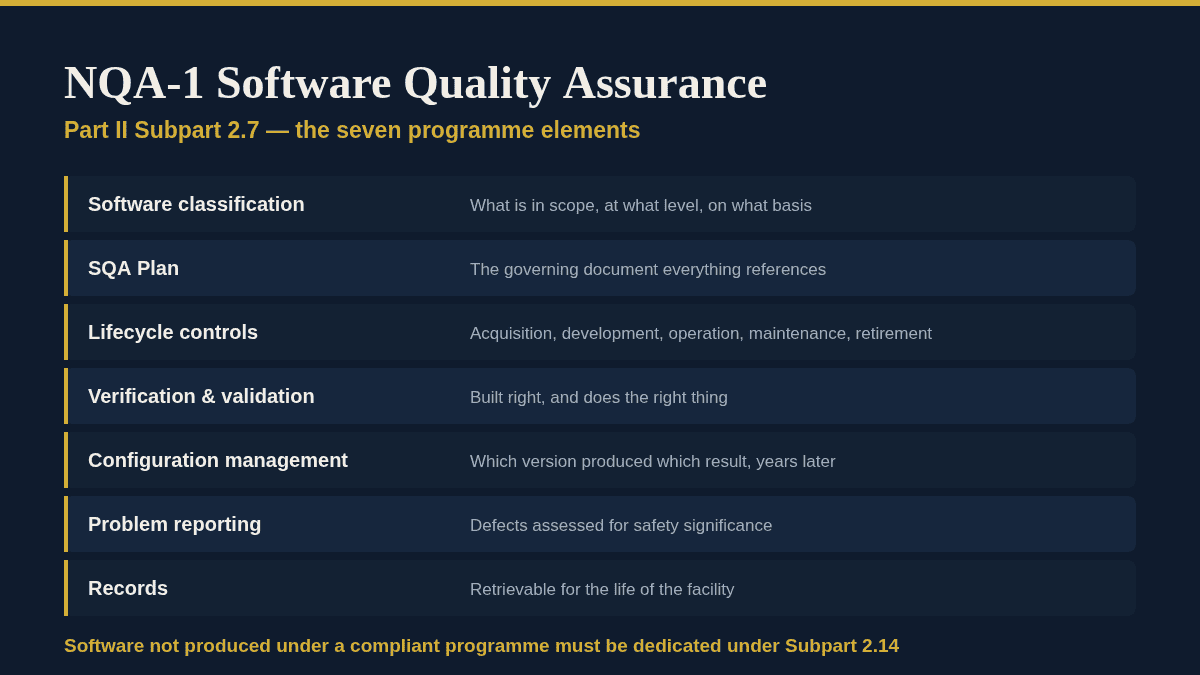
| Element | What it has to establish |
|---|---|
| Software classification | Which software is in scope, at what level, and on what basis |
| SQA Plan | The governing document; everything else references it |
| Lifecycle controls | Acquisition, development, operation, maintenance and retirement |
| Verification and validation | That the software was built right, and that it does the right thing |
| Configuration management | Which version produced which result, years later |
| Problem reporting | Defects found, assessed for safety significance, and corrected |
| Records | Retrievable for the life of the facility, not the life of the tool |
A nuclear facility has a design life measured in decades. The question an auditor will eventually
ask is which version of which code, with which input deck and which settings, produced the result in
the safety analysis — and whether you could reproduce it. Organisations that treat configuration
management as version control on source files, rather than as the traceable link between a result and
everything that produced it, fail that question years after the work was done.
A defect found in safety-related software is not only a software problem. It runs into the same
evaluation machinery as any other defect, including the 10 CFR Part 21 assessment of whether it
constitutes a reportable defect or noncompliance. Your software problem reporting process needs an
explicit hand-off there, rather than sitting inside the engineering team.
The Subpart 2.7 programme, already written.
The NQA-1:2024 Nuclear Quality Assurance Toolkit ships 100+ editable MS Office templates including the Software Quality Assurance Plan, software lifecycle control procedure covering acquisition through retirement, verification and validation, configuration management, problem reporting, and the commercial grade dedication route for acquired software — each mapped to its NQA-1 requirement.
Verification and validation answer two different questions, and conflating them is the most common
technical weakness in this area. Verification asks whether each stage of development correctly
implemented the stage before it — did the code implement the design, did the design implement the
requirements. Validation asks whether the finished software does what the safety application actually
needs. Software can be perfectly verified and still validate badly, because the requirements were
wrong.
For acquired software the same two questions apply, but you cannot inspect the development stages.
That is why the dedication route exists: you identify the critical characteristics of the code —
the physics it must model correctly, the range over which it must be accurate, the conditions under
which it is valid — and verify those directly, typically by benchmarking against known solutions
or against an independently developed calculation.
Independence is the other axis. Under a proportionate NQA-1 software quality assurance programme,
higher-consequence software attracts more independent verification: not the author checking their own
work, and for the most significant items not even the author’s own team. Where that independence sits
should be stated in the SQA Plan rather than decided case by case.
The test cases used to verify safety-related software are quality assurance records. They need the
same control as any other record: identified, reviewed, retained and retrievable. Organisations
routinely treat test scripts as working material, delete the outputs once the test passed, and then
cannot demonstrate years later what was tested or against what expected result.
The practical rule is that a test which cannot be re-run, from the retained artefacts, by someone
who was not there, is not evidence. Retain the input decks, the expected results, the actual results
and the version of the software that produced them, together.
A patch, a version upgrade or a change to a configuration file is a change to something the safety
analysis depends on, and it belongs in change control rather than in IT maintenance. The question to
ask before any upgrade is what previously verified results would need re-verifying — and if the
answer is not known, that is itself a configuration management finding.
Where are the NQA-1 software quality assurance requirements?
Part II, Subpart 2.7, Quality Assurance Requirements for Computer Software for Nuclear Facility
Applications, with implementation guidance published separately in Part IV.
Do spreadsheets count as software?
If a spreadsheet performs a safety-related calculation, yes. Scope is set by consequence, not by the
tool, and spreadsheets are the most commonly overlooked item in the whole programme.
What about commercial software we bought?
Software not produced under a compliant quality assurance programme has to be dedicated under Part II
Subpart 2.14, with critical characteristics identified and verified. Vendor reputation is not
dedication.
Does ISO 9001 or a general software process cover this?
No. Neither reaches the verification, configuration management and records expectations that Subpart
2.7 sets, and neither has any concept of dedication.
How long do software records have to be kept?
Long enough to support the facility, which in practice means decades. Plan retrievability against the
life of the plant rather than the life of the software or the storage medium.
All of these are covered by the NQA-1 Toolkit, or start with the free ISO templates.

October 11, 2026
October 11, 2026
October 11, 2026
October 11, 2026
October 11, 2026

