Privacy risk monitoring is how an organization finds out whether its privacy risks are getting better, worse or simply different, without waiting for a breach or a regulator to tell it. An assessment describes risk at one moment. Data volumes grow, suppliers change, staff turn over and laws move, so a rating that was fair in January may be misleading by June. Monitoring keeps the picture current.
This guide explains how to design privacy risk monitoring: which indicators to use, how to set thresholds, how to collect evidence, how to report and how to trigger reassessment. It is general guidance that draws on frameworks such as the NIST Privacy Framework, whose govern and control functions expect ongoing monitoring, and it can be adapted to your organization.
What privacy risk monitoring covers
Monitoring looks at three things. First, the risks themselves: are ratings still right, and are new risks emerging? Second, the controls: are they operating as intended? Third, the programme: are reviews, assessments and actions happening on time? Together they show whether privacy risk is under control.
It complements periodic assessment. Assessments are deep but infrequent. Monitoring is lighter and continuous, and its job is to detect change and prompt action. Without it, organizations rely on annual reviews and discover problems late.
Choose indicators for privacy risk monitoring
Pick a small set of indicators linked to your main risks and controls, mixing leading indicators, which warn of trouble, with lagging ones, which record outcomes. Leading examples include overdue reviews, unassessed new projects and vendors, and training completion. Lagging examples include incidents, complaints and regulatory contacts.
Tie each indicator to a risk or control in the privacy risk register. If you cannot explain what decision an indicator supports, drop it. Compare with the approach in KRI thresholds and KRI reporting, which apply equally to privacy.
Free privacy risk assessment
Which privacy risks would hurt the people whose data you hold?
List your personal data and processing, pick from 38 privacy risk scenarios, rate them for the people concerned and for you, and plan treatment with ISO 27701 controls. You get a heat map, a process score and the findings an auditor would raise, free.
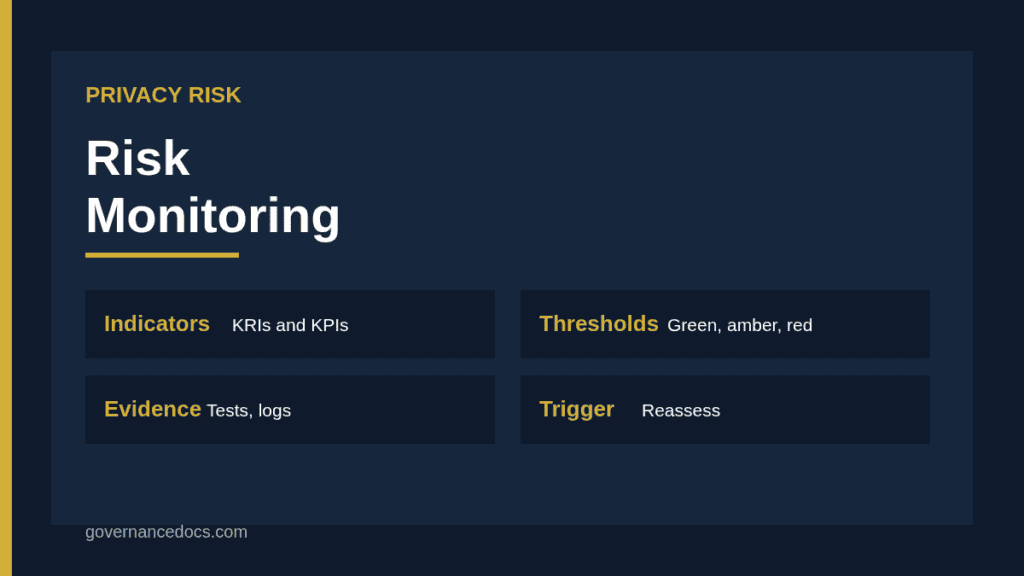
A number without a threshold is not a signal. Define green, amber and red levels for each indicator, and say what happens at each: green needs no action, amber needs an explanation and a plan, red needs escalation. Base thresholds on your privacy risk appetite and on legal deadlines.
Assign an owner to each indicator, responsible for collecting the data, explaining changes and proposing action. Document the definition and data source, so results are consistent from one period to the next.
Indicator
What it shows
Example threshold
Overdue reviews of high-risk processing
Whether assessments are current
No high-risk item overdue by more than 30 days
Data subject request timeliness
Health of rights handling
At least 95 percent within the legal deadline
Privacy incidents and near misses
Control failures and culture
Downward trend, all reported within 24 hours
Open high-rated risks and overdue actions
Treatment progress
No high action older than 90 days
Vendor privacy assessments completed
Third-party coverage
100 percent of critical vendors on time
Collect evidence, not just numbers
Indicators can be gamed or misread, so back them with evidence. Sample records, test controls, review logs and check that reported numbers match the source. For example, confirm that deletion jobs actually deleted data, that access reviews were completed and that consent records exist for a sample of people.
Combine self-reporting by process owners with independent checks by the privacy team or internal audit. Where automated tools provide data, such as data discovery or consent platforms, verify that they are configured correctly and cover all relevant systems.
Monitor changes that alter risk
Some of the most important signals are changes: new systems, new suppliers, new data uses, new markets, organizational changes and new laws. Build monitoring of change into project, procurement and legal processes, so the privacy team hears early. A simple question on change forms, such as “does this affect personal data?”, works well.
Track regulatory developments and enforcement decisions in your sectors. If a regulator fines a peer for a practice you also use, treat it as a trigger to reassess. Keep a log of external developments and the response.
Report privacy risk monitoring to leaders
Give leaders a concise dashboard: key indicators with status colours, trends, top risks, overdue actions, incidents, and decisions needed. Add short commentary explaining what changed and why. Report monthly to the privacy team and quarterly to executives or the board.
Highlight exceptions rather than listing everything. Leaders need to know where to act. Include positive news too, such as improved response times, since it shows that investment works and helps sustain support.
Trigger reassessment
Define what causes a risk to be re-scored or a full assessment to be repeated: amber or red indicators, incidents, complaints, material changes to processing, new suppliers, regulatory changes or audit findings. Write the triggers into your privacy review process.
When a trigger fires, record the reassessment and its outcome, update the register and inform owners. Link to privacy risk scoring so the score reflects the new position, and to privacy risk treatment for new actions.
Use privacy risk monitoring to improve the programme
Look for patterns. If incident reports cluster around one team or one system, investigate root causes. If data subject requests are always late in one function, fix the process. If risk ratings are consistently changed at review, the scoring may need calibration. Turn insights into improvements, and track whether they work.
Review the monitoring set once a year. Retire indicators that no longer drive decisions, add new ones for emerging risks and adjust thresholds as the programme matures.
Common mistakes in privacy risk monitoring
Frequent errors include too many indicators, indicators nobody owns, no thresholds, reliance on self-reported data alone, monitoring compliance tasks but not risk, reporting only good news, failing to link findings to reassessment and neglecting changes in the business. Another is treating monitoring as an annual exercise rather than a routine.
Avoid these by keeping the set small, assigning owners, verifying data and closing the loop from signal to action.
Monitoring privacy in projects and suppliers
Many privacy risks arrive through projects and suppliers, so monitor both. For projects, track the share that completed a privacy review before launch, the number with open high risks and the average time to complete a review. For suppliers, track the share of critical vendors with a current assessment, contract terms in place and no unresolved findings. Add both to the dashboard so leaders see whether the intake processes work, and investigate quickly when a project or supplier appears that nobody told the privacy team about.
Roles and cadence
Write down who does what and when. The privacy lead owns the monitoring framework and the dashboard. Process owners supply data and explain variances. Internal audit or a second reviewer samples the evidence. A governance forum reviews the results and decides on action. Put the dates in a calendar for the year, so the reviews happen even when everyone is busy, and keep short minutes recording decisions and follow-up items so that the trail is clear if a regulator asks how you oversee privacy risk.
A short worked example
A retail group monitors ten indicators. In one quarter, the dashboard shows data subject request timeliness falling from 97 percent to 84 percent, two new vendors onboarded without privacy assessments and a rise in reported near misses in the loyalty programme. Each is amber or red.
The privacy lead investigates: a staff change slowed request handling, procurement bypassed the intake form and a new marketing feature exposed more data than intended. Actions are agreed, owners named and reassessments triggered. Within two months, indicators return to green, and the process gaps are closed.
Tools and automation
Start simple: a spreadsheet dashboard and a monthly review can be enough. As volumes grow, consider a governance, risk and compliance tool, a privacy management platform or business intelligence dashboards fed from ticketing, incident and vendor systems. Automate data collection where it is reliable, and keep a human review of unusual results.
Whatever tool you use, keep definitions and data sources documented, protect the dashboard as sensitive information and back up the history, so trends can be shown over time.
Structuring the assessment
If you want a report and workbook that link risks, controls, indicators and review dates in one place, the Privacy Risk Assessment Report and Workbook provides a structured layout for privacy risk assessment. Whatever tool you use, effective privacy risk monitoring watches a few well-chosen indicators, tests the evidence and turns every signal into a decision.
Privacy risk monitoring FAQ
What should privacy risk monitoring track?
The state of key risks, whether controls operate as intended, and whether programme activities such as reviews and assessments are on time, using a small set of indicators tied to decisions.
How often should we report?
Monthly to the privacy team and quarterly to senior leaders, with urgent issues escalated immediately.
What are leading indicators in privacy?
Measures that warn of trouble before harm occurs, such as overdue reviews, unassessed projects and vendors, and low training completion.
What should trigger a reassessment?
Amber or red indicators, incidents, complaints, material changes to processing or suppliers, regulatory changes and audit findings.
How do we make sure the numbers are reliable?
Document definitions, verify against source data, sample records and combine self-reporting with independent checks.