CART
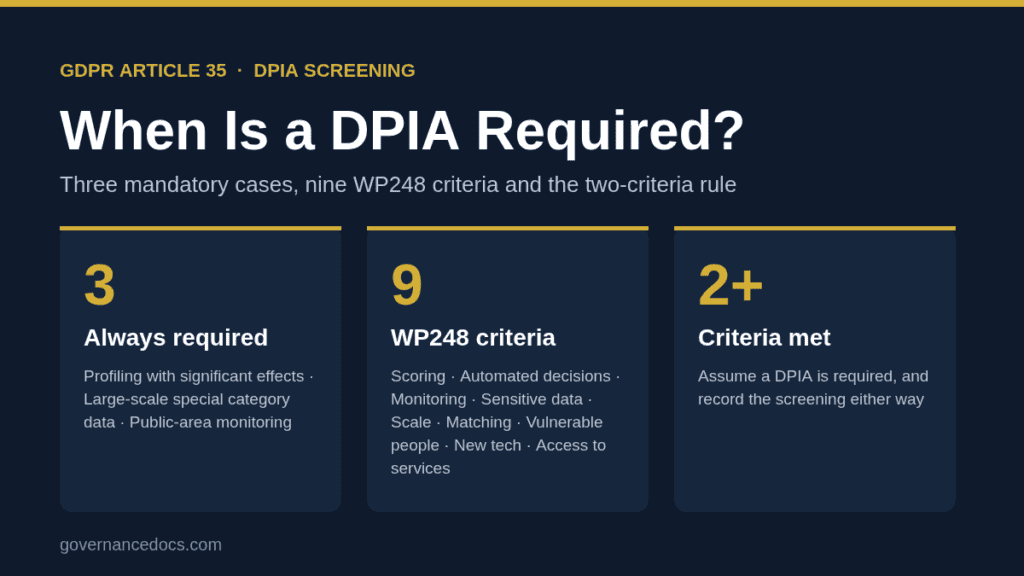
When is a DPIA required? Under Article 35 of the GDPR, whenever a type of processing is likely to result in a high risk to the rights and freedoms of the people whose data it is, and always before that processing starts. The difficulty is the word “likely”: the regulation names only three cases outright and leaves the rest to judgment. This guide sets out every source you need to make that judgment and record it: the three mandatory cases, the nine criteria European regulators use, your authority’s own list, and the situations where a DPIA is not needed.
It is written for the person who has to answer the question for a new project, often in a hurry, and then defend the answer to an auditor or a regulator.
Article 35(1) requires the controller to carry out a data protection impact assessment “prior to the processing” where a type of processing, “in particular using new technologies”, and taking into account its nature, scope, context and purposes, is likely to result in a high risk to the rights and freedoms of natural persons. Three points in that sentence matter in practice:
UK GDPR keeps the same wording, so the answer is the same in the UK and the EU.
Article 35(3) names three kinds of processing that always need a DPIA:
If any one of these applies, the screening is over, and the answer to when is a DPIA required is simple: now, before the processing starts.
For everything else, the Article 29 Working Party’s DPIA guidelines (WP248 rev.01), endorsed by the European Data Protection Board, give nine criteria that point to high risk:
| Criterion | What it covers | Typical example |
|---|---|---|
| 1. Evaluation or scoring | Profiling and predicting, especially performance, finances, health, preferences, location | Credit or fraud scoring; behavioural profiles |
| 2. Automated decisions with legal or similar effect | Decisions made without meaningful human involvement | Automatic rejection of loan or job applications |
| 3. Systematic monitoring | Observing, monitoring or controlling people | Employee monitoring; tracking online behaviour |
| 4. Sensitive or highly personal data | Special category and criminal data, plus location, financial data and private communications | Health apps; payment histories; messages |
| 5. Large scale | Number of people, volume of data, duration, geographical extent | A national customer base |
| 6. Matching or combining datasets | Linking data from different sources or purposes in unexpected ways | Enriching customer records with third-party data |
| 7. Vulnerable people | Anyone with less power in the relationship | Children, employees, patients, the elderly |
| 8. Innovative technology | New technology, or a new use of existing technology | AI, biometrics, connected devices |
| 9. Preventing a right or a service | Processing that decides whether someone can use a service or enter a contract | Screening that decides access to credit or insurance |
The guidelines say that in most cases, processing meeting two of the criteria will require a DPIA, and that the more criteria are met, the more likely the processing is to be high risk. They also say a single criterion can be enough in some cases, and that where it is unclear whether a DPIA is required, one should be done. The ICO takes the same line.
So the practical answer to when is a DPIA required is: at two criteria, assume yes; at one, think hard and record why; at none, record the screening anyway.
Article 35(4) requires each supervisory authority to publish a list of processing that always needs a DPIA in its country, and Article 35(5) allows it to publish a list that does not. Check the list for every country where you operate. The ICO’s list for the UK, for example, adds ten types of processing, including innovative technology, denial of service, large-scale profiling, biometric and genetic data, data matching, invisible processing, tracking, targeting children or other vulnerable people, and processing where a breach could put someone’s physical safety at risk. The ICO explains each one in its guidance on when a DPIA is needed.
The WP248 guidelines list the situations where a DPIA is not needed:
Even then, the screening decision and the reasons for it should be written down. “We looked and decided no DPIA was needed, because…” is itself evidence of accountability.
| Processing | Criteria met | DPIA? |
|---|---|---|
| Telematics and in-cab cameras in company vans | Scoring, monitoring, highly personal data, employees, new technology | Yes |
| Loyalty app tracking shoppers in store | Profiling, monitoring, location data, large scale, combined datasets | Yes |
| AI tool that shortlists job applicants | Evaluation, automated decisions, preventing access to a job | Yes |
| Monthly email newsletter to subscribers | None | No; record the screening |
| New HR system for existing staff records | Employees (one criterion) | Borderline; a DPIA is good practice |
Our DPIA example walks through the first of these from screening to sign-off.
Whatever the answer, write the screening down. A short record is enough, but it should cover:
That record answers the question an auditor or regulator will ask first: how did you decide when is a DPIA required for this processing? It also gives you a baseline, so that when the processing changes you can see which criteria have moved. Keep screenings with your records of processing activities so the two stay in step.
A DPIA is not a one-off. Article 35(11) expects a review at least when the risk represented by the processing changes, and processing that did not need a DPIA when it started can need one after a change: a new purpose, new data, a new technology or a new group of people. Build the screening question into your change process, not only into new projects.
Failing to carry out a required DPIA is an infringement of Article 35 in its own right, whether or not anything goes wrong. Under Article 83(4) it falls in the tier of fines of up to 10 million euros or 2% of worldwide annual turnover, whichever is higher. Regulators have also treated a missing DPIA as an aggravating factor when something does go wrong.
The controller. Where a data protection officer is designated, their advice should be sought, and it is good practice to record it in the screening.
No. The short answer to when is a DPIA required is: only where high risk is likely. But every new system that processes personal data should be screened, and the screening recorded.
No. The DPIA is the controller’s duty, but Article 28(3)(f) requires processors to assist the controller with it.
A privacy risk assessment covers all of your processing; a DPIA covers one high-risk operation in depth. Our comparison of privacy risk assessment vs DPIA explains how they fit together. For the method, see our full DPIA guide.
If you are still asking when is a DPIA required for your own project, our free DPIA template starts with exactly this screening, gives you the verdict and records your reasoning, then takes you through the rest of the DPIA if one is needed. For the policies and records around it, see the GDPR Toolkit.


September 28, 2026
September 28, 2026
September 28, 2026
September 28, 2026
September 28, 2026

