CART
An EOMS policy — the educational organization policy that clause 5.2 of ISO 21001:2025 requires top management to establish — is the shortest document in an educational organization management system and the one the rest hangs from. ISO 21001 says so directly: its introduction describes the policy statements as “framed by the educational organization’s culture … and by the EOMS principles”, and states that they “provide the framework for the establishment of the EOMS objectives”. That gives the document its two anchors. It has to carry the commitments the harmonized structure requires of every management system policy, and it has to express the eleven EOMS principles that ISO 21001 lists in 0.4 and details in Annex B — focus on learners and other beneficiaries, visionary leadership, engagement of people, process approach, improvement, evidence-based decisions, relationship management, social responsibility, accessibility and equity, ethical conduct in education, and data security and protection. This guide sets out what the EOMS policy must contain, how each principle becomes a commitment an auditor can test, how it relates to mission, vision and strategy as the standard defines them, a worked structure, and the five faults that make a policy fail its first audit.
| Requirement (harmonized structure, clause 5.2) | What it means for an educational organisation | Audit evidence |
|---|---|---|
| Appropriate to the purpose and context of the organisation | Written for a school, college, university or training function — not a generic quality policy with ‘learner’ substituted | Policy reads against the context analysis in 4.1 and the beneficiaries in 4.2 |
| Provides a framework for setting objectives | Every objective in 6.2 traces to a policy commitment | Objectives register cross-referenced to policy statements |
| Commitment to satisfy applicable requirements | Regulatory, awarding-body, accreditation, funder and learner requirements | Requirements register; policy names the classes of requirement |
| Commitment to continual improvement of the EOMS | Improvement that reaches provision, not only documents | Improvement log with entries a learner would notice |
| Available as documented information | Controlled, versioned, approved by top management | Version, date, signature |
| Communicated within the organisation | Educators, staff, volunteers and external providers know what it commits them to | Induction records; awareness evidence under 7.3 |
| Available to relevant interested parties, as appropriate | Learners, parents, employers, regulators can read it | Published on the website or prospectus |
Those seven are the same for every harmonized management system standard, which is why an ISO 9001-certified provider’s quality policy already meets most of them. What makes the document an EOMS policy rather than a quality policy is the second anchor. Our guide to ISO 21001 vs ISO 9001 covers the wider difference.
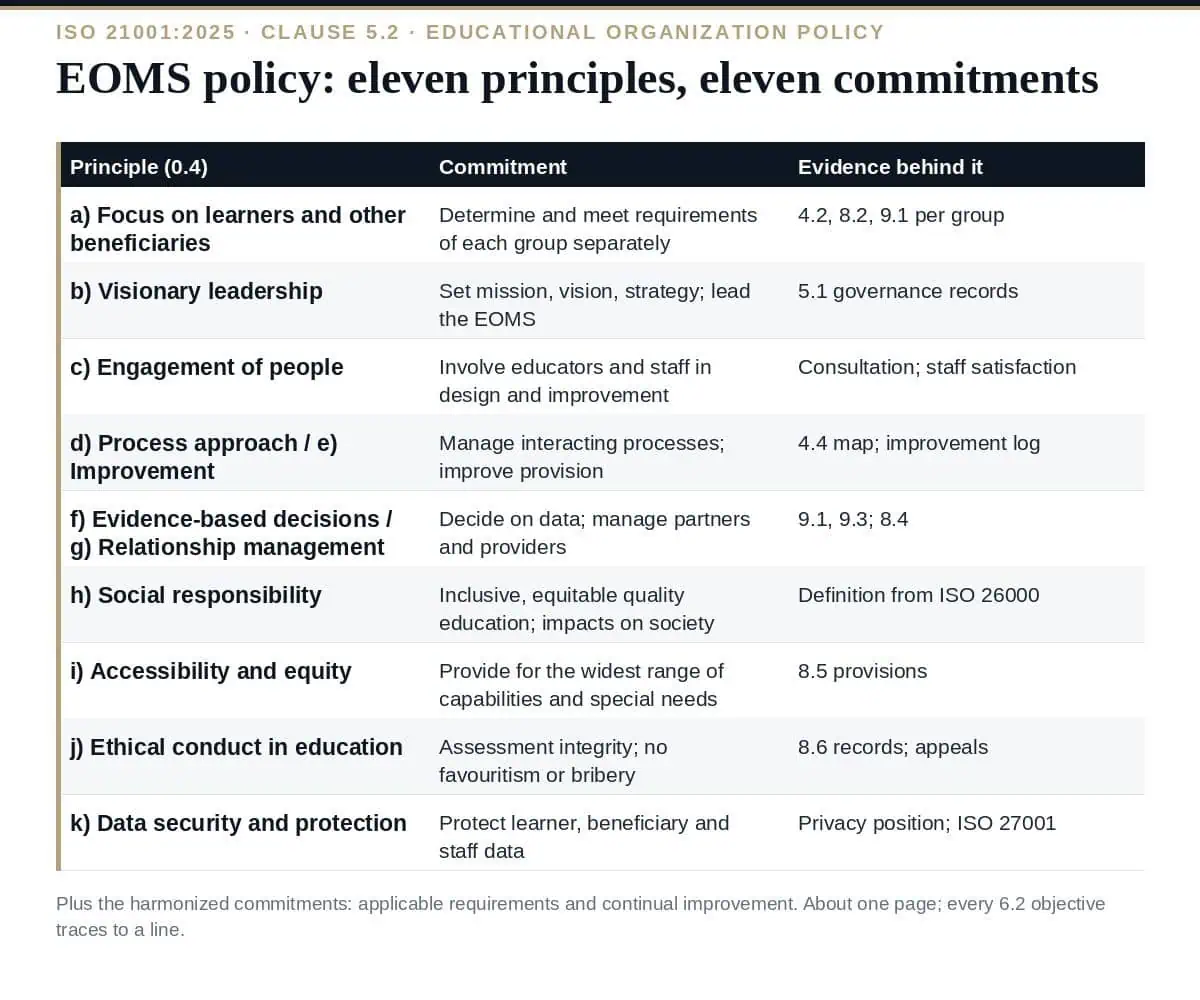
| EOMS principle (ISO 21001:2025, 0.4) | Policy commitment | What the auditor looks for behind it |
|---|---|---|
| a) Focus on learners and other beneficiaries | Determine and meet the requirements of learners and of other beneficiaries separately | Beneficiary analysis (4.2); requirements records (8.2); satisfaction measured per group (9.1) |
| b) Visionary leadership | Top management sets and communicates mission, vision and strategy and leads the EOMS | 5.1 evidence: governance minutes, resource decisions |
| c) Engagement of people | Involve educators and staff in designing and improving provision | Consultation records; staff satisfaction (9.1) |
| d) Process approach | Manage admission, design, delivery, assessment and support as interacting processes | Process map (4.4); measures per process |
| e) Improvement | Improve educational products, services and the EOMS continually | Improvement log; management review outputs |
| f) Evidence-based decisions | Decide on outcomes, satisfaction and audit data | Analysis and evaluation records (9.1); review inputs (9.3) |
| g) Relationship management | Manage relationships with employers, partners, awarding bodies and external providers | External provider controls (8.4); Annex D communication |
| h) Social responsibility | Provide inclusive and equitable quality education for all; act on impacts on society and environment | Definition 3.29 drawn from ISO 26000; climate and community considerations in context |
| i) Accessibility and equity | Make provision usable by learners within the widest range of capabilities; provide for learners with special needs | Special-needs provisions (8.5); accessibility of premises, materials and platforms |
| j) Ethical conduct in education | Assess with integrity; prevent bribery, favouritism and conflicts of interest | Assessment integrity and appeals records (8.6); ISO 37001 is in the bibliography |
| k) Data security and protection | Protect learner, beneficiary and staff data | Privacy position; ISO/IEC 27001 is in the bibliography |
A policy that names all eleven and commits to each in one sentence is about a page long and is auditable line by line. A policy that quotes the principles as a list without commitments is not — the auditor cannot test “we value accessibility” but can test “we determine and provide the adjustments learners with special needs require”.
ISO 21001 defines the three terms the policy sits among. Mission is the “reason for being, mandate and scope of an organization, translated into the context in which it operates” (3.31); vision is its “aspirations … in relation to its desired future condition” aligned with the mission (3.30); strategy is the “plan to accomplish the organization’s mission and achieve the organization’s vision” (3.32). Clause 0.6 places the policy between them: framed by culture and principles, it frames the objectives, which are “periodically revised to ensure the educational organization’s mission is effectively and efficiently accomplished while walking the continuous path towards the achievement of the educational organization’s vision”. In practice the EOMS policy should quote or reference the mission, state the commitments, and stop; vision and strategy live in their own documents, and objectives live in 6.2. Our guide to ISO 21001 implementation places the policy in the build sequence.
What is an EOMS policy?
The educational organization policy required by clause 5.2 of ISO 21001:2025: top management’s documented commitments for the educational organization management system, framed by the eleven EOMS principles and providing the framework for the objectives in 6.2.
How long should it be?
About a page. One commitment per principle, the two harmonized commitments (applicable requirements, continual improvement), a mission reference and the approval block.
Can our quality policy serve as the EOMS policy?
As a base. It already meets the harmonized requirements; it needs the beneficiary distinction and commitments on accessibility and equity, ethical conduct in education, social responsibility and data protection to become an EOMS policy.
Where are the eleven principles explained?
Listed in clause 0.4 of ISO 21001:2025 and analysed in Annex B. The introduction and annex list are readable on the ISO Online Browsing Platform.
Does the policy need to be public?
Clause 5.2 requires it to be available to relevant interested parties as appropriate. For an education provider, learners, parents, employers and regulators are those parties, so publication is the usual answer.
Write the EOMS policy as eleven testable commitments plus the two the harmonized structure requires, frame it with the mission, point it at the objectives, approve it, publish it and brief it. Then check that every objective in 6.2 traces back to a line in it — because that trace is what the standard means when it says the policy provides the framework for the objectives.
The EOMS Policy template with the eleven commitments drafted, the EOMS Manual, the objectives register and the communication plan are in the ISO 21001 Educational Management Toolkit, or start with the free templates.

September 20, 2026
September 19, 2026
September 19, 2026

September 19, 2026

September 19, 2026

