CART

Pillar 3 disclosure is the third leg of the Basel framework — after minimum capital requirements (Pillar 1) and supervisory review (Pillar 2) — and it works by publication: banks disclose their capital, risk-weighted assets, leverage, liquidity and risk management in standardised templates so that the market can discipline what supervisors cannot see every day. The Basel Committee’s DIS standard sets the templates and tables, fixes the format for the ones that must be comparable across banks, sets frequency and timing, and requires a formal policy with board-level attestation.
The version of DIS10 in force from 1 January 2026 added the cryptoasset exposure disclosures, and a further version is scheduled for 1 January 2027. This guide sets out what the DIS standard requires, the template families and the ones that matter most, the frequency rules, the five guiding principles a disclosure has to meet, how national implementation diverges, and the six failures that turn a Pillar 3 report into a compliance artefact nobody reads.
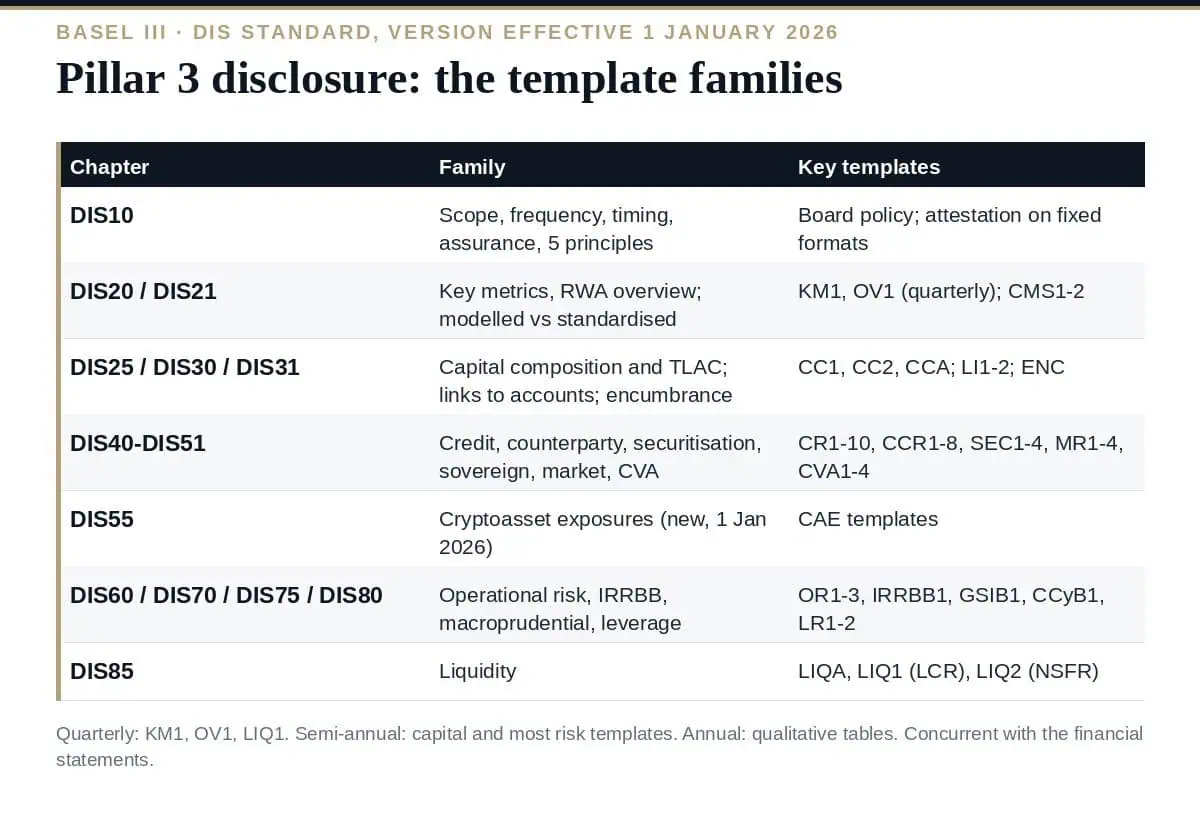
Every Pillar 3 disclosure starts from DIS10, which sets the scope and the rules that apply across every template: disclosures are made at the top consolidated level, published in a standalone Pillar 3 report or a clearly identified section of the financial report, at a frequency fixed per template, concurrently with the financial statements, and subject to a formal board-approved disclosure policy with internal controls and, for the fixed-format templates, an attestation that they were prepared in accordance with the standard.
It also states the guiding principles: disclosures should be clear, comprehensive, meaningful to users, consistent over time and comparable across banks. The Committee publishes the full set of templates and tables in Excel so that the fixed formats are reproduced exactly. Our guide to Basel III covers where Pillar 3 sits in the framework.
| Chapter | Family | Key templates | What they show |
|---|---|---|---|
| DIS20 | Overview of risk management, key prudential metrics and RWA | KM1 key metrics (quarterly), OV1 RWA overview (quarterly), OVA risk management approach (annual) | The one-page summary of capital, leverage, liquidity ratios and RWA by risk type — the templates every reader starts with |
| DIS21 | Comparison of modelled and standardised RWA | CMS1, CMS2 | The output-floor comparison: RWA under the full standardised approach against actual RWA |
| DIS25 | Composition of capital and TLAC | CC1, CC2, CCA; TLAC1–3 for G-SIBs | Every line of regulatory capital reconciled to the balance sheet, and the features of each instrument |
| DIS30 / DIS31 | Links to financial statements; asset encumbrance | LI1, LI2, LIA; ENC | Reconciliation of accounting and regulatory scope; encumbered assets |
| DIS35 | Remuneration | REMA, REM1–3 | Pay policy and the deferred and variable components |
| DIS40–DIS51 | Credit risk (DIS40), counterparty credit risk (DIS42), securitisation (DIS43), sovereign exposures (DIS45), market risk (DIS50), CVA risk (DIS51) | CR1–CR10, CCR1–CCR8, SEC1–SEC4, MR1–MR4, CVA1–CVA4 | Exposures, RWA and the approach used, by asset class and model |
| DIS60 / DIS70 / DIS75 / DIS80 | Operational risk, IRRBB, macroprudential measures, leverage ratio | OR1–OR3, IRRBB1, GSIB1, CCyB1, LR1–LR2 | Loss data and the SMA; interest-rate risk in the banking book; G-SIB indicators and CCyB by geography; the leverage exposure measure |
| DIS85 | Liquidity | LIQA, LIQ1 (LCR), LIQ2 (NSFR) | The LCR as a quarterly average of daily values and the NSFR at quarter end, weighted and unweighted |
| DIS55 | Cryptoasset exposures | CAE templates, effective 1 January 2026 | Exposures, capital and liquidity treatment of cryptoassets by group |
Three families do most of the work for most readers. KM1 and OV1 are the summary an analyst reads first; CC1 and CC2 are what a debt investor reads; LIQ1 and LIQ2 are what a treasurer benchmarks. A bank whose Pillar 3 disclosure gets those six right and the rest correct is doing the job; one that gets the rest right and those six inconsistent with the financial statements has a credibility problem. Our guide to LCR vs NSFR covers what LIQ1 and LIQ2 measure.
| Frequency | Templates | Rule |
|---|---|---|
| Quarterly | KM1, OV1, LIQ1 (for large banks), the leverage summary, credit-risk RWA flow | Published with the quarterly financial report, or as soon as possible after it |
| Semi-annual | CC1, CC2, most credit, counterparty, securitisation and market risk templates | With the half-year and annual reports |
| Annual | The qualitative tables (OVA, CRA, LIQA, REMA and the rest), remuneration, IRRBB | With the annual report |
Timing is concurrent: the Pillar 3 report is published no later than the financial statements it accompanies, and a bank that reports quarterly financials publishes the quarterly templates quarterly. Signposting is allowed — a template disclosed in the financial statements need not be repeated — but the reader must be able to find it, and fixed-format templates keep their format wherever they appear.
The Basel DIS standard is transposed with variations. The EU implements Pillar 3 through Part Eight of the Capital Requirements Regulation and the EBA’s implementing technical standards, with the EBA moving towards a centralised Pillar 3 data hub for collecting and publishing disclosures; the UK through the PRA’s Disclosure rules; the US through the agencies’ capital rules and, for the largest firms, the FR Y-15. Scope thresholds, the set of templates applied to smaller banks, and ESG-related disclosures differ across all three. The Basel Committee’s implementation monitoring reports that two jurisdictions implemented further elements of the disclosure framework in the year to September 2025 — Pillar 3 is among the standards where transposition is still moving.
What is Pillar 3 disclosure?
The market-discipline pillar of the Basel framework: banks publish standardised templates and tables on capital, RWA, leverage, liquidity and risk management under the Basel Committee’s DIS standard, at set frequencies, concurrently with their financial statements, under a board-approved policy with attestation for the fixed-format templates.
Which templates matter most?
KM1 key metrics and OV1 RWA overview for the summary; CC1 and CC2 for capital composition and reconciliation; LIQ1 and LIQ2 for the LCR and NSFR. The rest — credit, counterparty, securitisation, market, operational, IRRBB, remuneration — support them.
How often must a bank disclose?
KM1, OV1 and the LCR quarterly; capital composition and most risk templates semi-annually; qualitative tables and remuneration annually — always concurrently with the corresponding financial report.
What changed on 1 January 2026?
The DIS standard version in force from that date added the cryptoasset exposure disclosures in DIS55; a further version is scheduled for 1 January 2027.
Is Pillar 3 audited?
Not by external auditors as a rule; the standard requires internal controls, a board-approved policy and an attestation that fixed-format templates were prepared in accordance with the standard, and supervisors review the disclosures.
Treat Pillar 3 disclosure as a governed product: a board policy, templates built from regulatory data and reconciled to the accounts, fixed formats kept fixed, a narrative written for this year’s risks, published with the financial statements. The DIS standard is a specification; the six templates readers actually use are where accuracy earns its return.
The Pillar 3 Disclosure Policy, the Capital Management Policy, the RWA Calculation Standard, the Leverage Ratio Procedure and the Metrics and KRI Catalogue are in the Basel III Prudential Risk Toolkit, or start with the free templates.

September 20, 2026
September 19, 2026

September 19, 2026

September 19, 2026

September 19, 2026

