CART

Basel III endgame is the American name for the last instalment of the post-crisis capital reforms — the credit, market, operational and CVA risk standards the Basel Committee finalised between 2017 and 2019 and set to apply from 1 January 2023 — and in the United States it has now been proposed twice. The first proposal, in July 2023, would have raised large-bank capital sharply and was withdrawn in substance after a year of opposition.
The second arrived on 19 March 2026: three proposals from the Federal Reserve, FDIC and OCC that “implement the final components of the Basel III agreement”, collapse the dual-stack calculation into one, recalibrate credit, market and operational risk, revise the G-SIB surcharge, and — by the agencies’ own estimate — modestly reduce capital for large banks and moderately reduce it for smaller ones.
Comments closed on 18 June 2026; no final rule has been issued as of 19 September 2026. This guide sets out where the US stands, what the three proposals contain, the two capital rules that did finalise while the endgame stalled, how the US compares with the EU and the UK, and what a bank should be doing while the final rule is pending.
The Basel Committee’s “final Basel III” package — revised standardised and internal-ratings approaches for credit risk, a standardised approach for operational risk replacing the models, a revised CVA framework, the Fundamental Review of the Trading Book for market risk, a leverage ratio buffer for G-SIBs and a 72.5% output floor on modelled risk-weighted assets — was published in December 2017 and January 2019 and was due to apply from 1 January 2023 with a five-year phase-in for the floor.
The Committee’s September 2025 progress summary reports that the revised credit and operational risk standards and the output floor are effective in around 80% of its 27 member jurisdictions, the CVA standard in nearly 70% and the revised market risk standards in nearly 40%. The United States is the largest jurisdiction where none of it is yet in force. Our guide to Basel III covers the framework and the adoption picture.
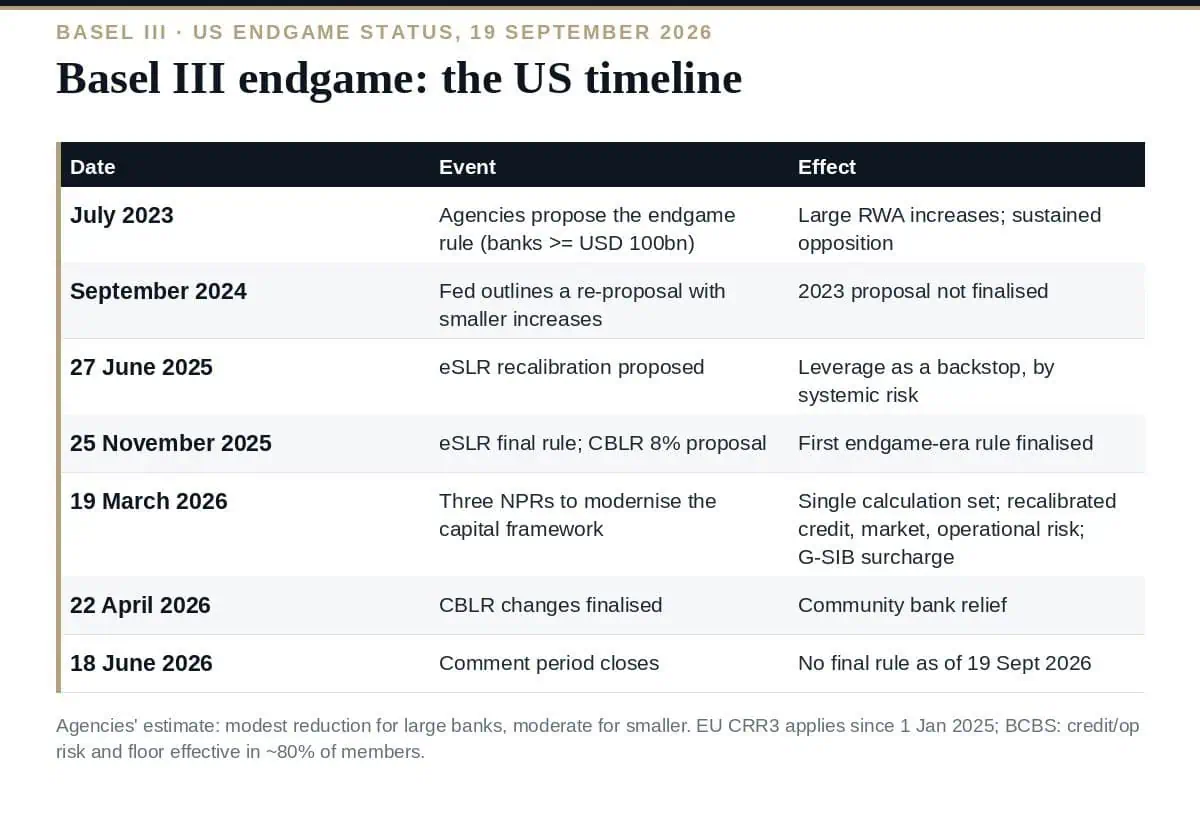
| Date | Event | Effect |
|---|---|---|
| July 2023 | Agencies propose the Basel III endgame rule for banks with $100 billion or more in assets | Large increases in risk-weighted assets; sustained opposition from banks, Congress and within the Board |
| September 2024 | The Fed’s Vice Chair for Supervision outlines a re-proposal with materially smaller increases | The 2023 proposal is not finalised |
| 27 June 2025 | Agencies propose to recalibrate the enhanced supplementary leverage ratio | Leverage standard to act as a backstop, based on each firm’s systemic risk |
| 25 November 2025 | Agencies finalise the eSLR rule; propose lowering the community bank leverage ratio to 8% | The first endgame-era rule finalised; depository-institution eSLR capped at 1%, total no more than 4% |
| 19 March 2026 | Agencies request comment on three proposals to “modernize the regulatory capital framework” | The second endgame proposal; comments due 18 June 2026 |
| 22 April 2026 | Agencies finalise changes to the community bank leverage ratio | Relief for the smallest banks |
| 18 June 2026 | Comment period closes on the three proposals | Final rule pending as of 19 September 2026 |
The agencies’ release describes three notices of proposed rulemaking.
The agencies’ own summary of the impact is the sentence banks quoted back: the proposals “would modestly reduce capital requirements for large banks and moderately reduce requirements for smaller banks”, while overall capital “would still be substantially higher than they were before the financial crisis”. That is the reverse of the 2023 proposal’s direction, and it is why the Basel III endgame is now as much a debate about fidelity to the international standard as about capital levels.
Two pieces of the capital framework moved without waiting. The enhanced supplementary leverage ratio final rule of 25 November 2025 sets the eSLR for the largest bank holding companies and their depository subsidiaries by reference to each organisation’s systemic risk, so that leverage operates as a backstop rather than the binding constraint — with the depository-institution standard capped at one percentage point, an overall requirement of no more than 4%. And the community bank leverage ratio was reworked: proposed at 8% instead of 9% with a four-quarter grace period in November 2025, and finalised in April 2026. Neither is Basel III endgame content, but both change the capital stack the endgame rule will land on.
| Jurisdiction | Instrument | Status on 19 September 2026 |
|---|---|---|
| European Union | Regulation (EU) 2024/1623 (CRR3) and Directive (EU) 2024/1619 (CRD6) | CRR3 applies from 1 January 2025, with the output floor phasing in over five years; the market risk (FRTB) own-funds requirements were postponed by Commission Delegated Regulation (EU) 2024/2795, with further postponement proposed since |
| United Kingdom | PRA Basel 3.1 policy statements | Implementation date moved to 1 January 2027 by the PRA’s January 2025 statement; the PRA’s current statement governs |
| United States | Three NPRs of 19 March 2026 | Proposed; comments closed 18 June 2026; no final rule |
| Basel Committee members overall | Domestic rules | Credit and operational risk standards and the output floor effective in about 80% of the 27 members; market risk in nearly 40% |
The Committee’s Regulatory Consistency Assessment Programme will eventually grade the US rule for consistency, as it has other members’; the March 2026 proposals’ departures from the international text — the single-stack approach and the recalibrations — are what that assessment will examine.
What is the Basel III endgame?
The US implementation of the Basel Committee’s final post-crisis reforms — revised credit, operational, CVA and market risk standards and the output floor — published internationally in 2017–19 and due from 1 January 2023. The US proposed a rule in July 2023, withdrew it in substance, and re-proposed on 19 March 2026 with three NPRs whose comment period closed on 18 June 2026.
Has the Basel III endgame been finalised in the US?
No. As of 19 September 2026 the March 2026 proposals are pending a final rule. Two related rules did finalise: the enhanced supplementary leverage ratio in November 2025 and community bank leverage ratio changes in April 2026.
Will it raise capital requirements?
The agencies estimate the March 2026 proposals would modestly reduce capital requirements for large banks and moderately reduce them for smaller banks, with overall capital remaining well above pre-crisis levels — the opposite direction from the 2023 proposal.
What did the 2026 proposals change from 2023?
A single set of risk-based calculations instead of two, revised calibrations for credit, market and operational risk, market risk applying only to banks with significant trading activity, mortgage-related relief, and a separate G-SIB surcharge proposal.
Where do the EU and UK stand?
The EU’s CRR3 has applied since 1 January 2025 with the FRTB own-funds requirements postponed by delegated regulation; the UK’s PRA moved Basel 3.1 to 1 January 2027 in January 2025.
Treat the Basel III endgame as a proposal with a known direction and an unknown date: model the March 2026 stacks alongside the current rules, build the operational risk and mortgage data now, track the AOCI transition, and keep the Pillar 2 assessment current. The eSLR and community bank rules show the agencies will finalise pieces separately; the endgame rule itself is the one still to land.
The Capital Management Policy, the RWA Calculation Standard, the Capital Planning and Forecasting Procedure, the Market Risk and FRTB Policy, the Operational Risk SMA Policy and the Cross-Regulatory Mapping are in the Basel III Prudential Risk Toolkit, or start with the free templates.

September 20, 2026
September 19, 2026

September 19, 2026

September 19, 2026

September 19, 2026

