CART
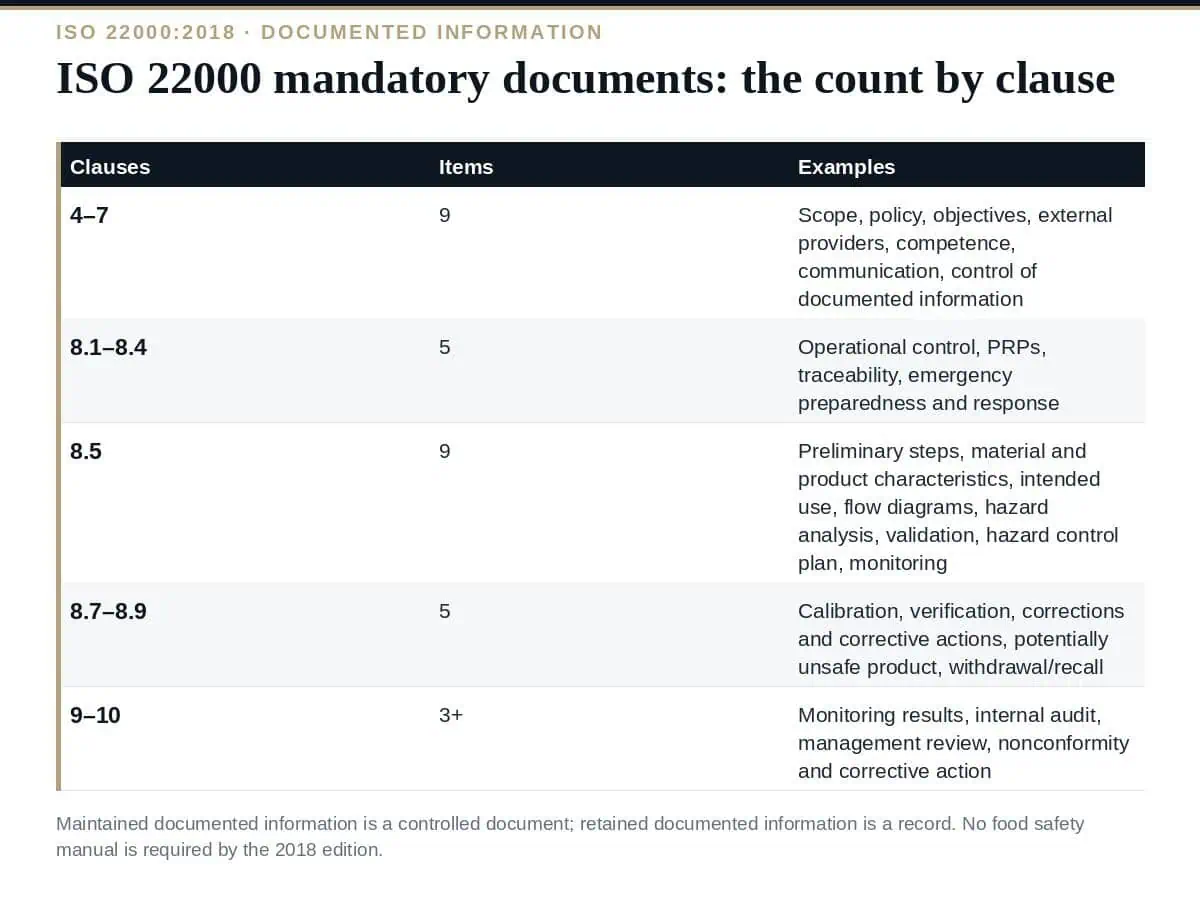
ISO 22000 mandatory documents are the documented information the standard explicitly requires an organisation to maintain or retain — and ISO 22000:2018 requires more of it than most ISO management system standards, because clause 8 turns each Codex HACCP step into a documented requirement and adds prerequisite programmes, traceability, emergency preparedness and verification on top. Thirty items is the honest count: nine from the management-system clauses 4 to 7, eighteen from clause 8, and three from clauses 9 and 10.
The list below gives each one with its clause, whether it is a document to maintain or a record to retain, and what an auditor expects it to contain — followed by the documents that are not required by the text but that every certification audit asks for anyway, and a sequence for producing the set without duplicating it.
ISO 22000:2018 follows the harmonised structure, so it never says “procedure” or “record” as a requirement; it says documented information that must be maintained (a living document) or retained (evidence of what happened). The distinction decides how each item is controlled under clause 7.5: maintained information is version-controlled and approved; retained information is protected from alteration and kept for a defined period. The list below marks each item accordingly. Our guide to ISO 22000 covers the structure the list follows.
| # | Clause | Documented information | Maintain / retain | What it must show |
|---|---|---|---|---|
| 1 | 4.3 | Scope of the FSMS | Maintain | Products and services, processes and production sites covered; the activities that can affect end-product safety |
| 2 | 5.2 | Food safety policy | Maintain | Appropriate to the organisation, providing a framework for objectives, committing to applicable requirements and continual improvement; communicated and available to interested parties |
| 3 | 6.2 | FSMS objectives | Maintain | Measurable, consistent with the policy, monitored, communicated, updated; with what, who, when and how evaluated |
| 4 | 7.1.6 | Control of externally developed elements | Retain | Evaluation, selection and monitoring of external providers of processes, products or services that affect the FSMS |
| 5 | 7.2 | Competence | Retain | Evidence of competence of the food safety team and persons doing work under the organisation’s control that affects food safety |
| 6 | 7.4.2 | External communication | Retain | Evidence of communication with external providers, customers, authorities and others on food safety |
| 7 | 7.4.3 | Internal communication | Retain (as required) | Communication of changes that affect food safety to the food safety team in time to update the hazard analysis |
| 8 | 7.5.1 | Documented information required by the standard and by the organisation | Maintain | The set itself, identified and controlled |
| 9 | 7.5.3 | Control of documented information | Maintain | Distribution, access, storage, change control, retention and disposition; external documents identified and controlled |
| # | Clause | Documented information | Maintain / retain | What it must show |
|---|---|---|---|---|
| 10 | 8.1 | Operational planning and control | Retain | Evidence that the processes were carried out as planned |
| 11 | 8.2.4 | Prerequisite programmes | Maintain | The PRPs established, with selection and establishment against ISO/TS 22002 or equivalent, for the organisation’s context |
| 12 | 8.3 | Traceability system | Retain | Records identifying lots of received material to suppliers and end product to the first stage of distribution; verification and test of the system’s effectiveness |
| 13 | 8.4.1 | Emergency preparedness and response | Maintain | Procedures for potential emergencies and incidents that can affect food safety |
| 14 | 8.4.2 | Emergency response | Retain | Records of tests and of actual emergencies, with review and update |
| 15 | 8.5.1.1 | Preliminary steps | Retain | Applicable statutory, regulatory and customer requirements; products, processes and equipment; hazards relevant to the FSMS |
| 16 | 8.5.1.2 | Characteristics of raw materials, ingredients and product contact materials | Maintain | Composition, origin, packaging, storage and shelf life, preparation before use, acceptance criteria |
| 17 | 8.5.1.3 | Characteristics of end products | Maintain | Product name, composition, characteristics relevant to food safety, intended shelf life and storage, packaging, labelling, distribution method |
| 18 | 8.5.1.4 | Intended use | Maintain | Intended use, reasonably expected handling, unintended but reasonably expected mishandling; consumer groups and vulnerable groups |
| 19 | 8.5.1.5 | Flow diagrams and description of processes | Maintain | Flow diagrams per product or category, confirmed on site by the food safety team, and descriptions of processes and process environment |
| 20 | 8.5.2 | Hazard analysis | Maintain | Hazard identification with acceptable levels; hazard assessment (severity and likelihood) identifying significant hazards; selection and categorisation of control measures as CCP or OPRP |
| 21 | 8.5.3 | Validation of control measures | Retain | Evidence that the control measures, and combinations of them, are capable of achieving the intended control before implementation |
| 22 | 8.5.4 | Hazard control plan (HACCP/OPRP plan) | Maintain | Per CCP and OPRP: hazards controlled, critical limits or action criteria, monitoring procedures, corrections and corrective actions, responsibilities, records |
| 23 | 8.5.4.4 | Monitoring records | Retain | Monitoring results at CCPs and OPRPs, signed by the person monitoring and reviewed |
| 24 | 8.7 | Control of monitoring and measuring | Retain | Calibration or verification of monitoring and measuring equipment and software; action when equipment is found out of calibration |
| 25 | 8.8.1 | Verification | Retain | Verification activities against the plan: PRPs implemented, hazard analysis updated, hazard control plan implemented and effective, hazard levels within acceptable levels |
| 26 | 8.9.2–8.9.3 | Corrections and corrective actions | Retain | Nature of nonconformities, causes, consequences, actions taken, results, and the review of effectiveness |
| 27 | 8.9.4 | Handling of potentially unsafe products | Retain | Evaluation for release and the disposition of nonconforming product |
| 28 | 8.9.5 | Withdrawal/recall | Maintain and retain | The procedure with named authority, and records of withdrawals and recalls and their verification, including tests of the procedure |
| # | Clause | Documented information | Maintain / retain | What it must show |
|---|---|---|---|---|
| 29 | 9.1.1 | Monitoring, measurement, analysis and evaluation results | Retain | What was monitored, methods, when, results and evaluation of FSMS performance |
| 30 | 9.2.2 | Internal audit programme and results | Retain | The audit programme and the evidence of implementation and results; management review input |
| — | 9.3.3 | Management review outputs | Retain | Decisions on continual improvement and updates to the FSMS, resource needs, policy and objectives revision |
| — | 10.1 | Nonconformity and corrective action | Retain | Nature of nonconformities, actions and results (system-level; product-level is 8.9) |
Counting 9.3.3 and 10.1 separately gives 32 ISO 22000 mandatory documents; they are grouped here because most organisations hold them in the same records as 8.9 and 9.2. Our guide to product recall under clause 8.9.5 covers item 28 in depth.
| Document | Why the auditor asks | Clause it evidences |
|---|---|---|
| Food safety manual or FSMS description | Not required since the 2018 edition; still the fastest way to show the system’s structure | 4.4 |
| Organisation chart and food safety team appointment | 8.5.1.1 requires a food safety team with a leader; 5.3 requires roles assigned | 5.3, 8.5.1.1 |
| Allergen management procedure | A PRP under ISO/TS 22002-1 and a hazard in almost every hazard analysis | 8.2, 8.5.2 |
| Supplier approval procedure | 7.1.6 evidence needs a process behind it | 7.1.6 |
| Training matrix | The practical form of 7.2 competence evidence | 7.2 |
| Verification schedule | 8.8.1 requires verification to be planned | 8.8.1 |
| Mock recall records | 8.9.5 requires the procedure to be tested | 8.9.5 |
| Risks and opportunities register | 6.1 requires actions to be planned; a register is the evidence | 6.1 |
How many mandatory documents does ISO 22000 require?
Around thirty explicitly required items of documented information: nine in clauses 4–7, eighteen in clause 8 and three or more in clauses 9–10, depending on how the records are grouped. Clause 8 is the largest because each Codex HACCP step and each of PRPs, traceability, emergency preparedness and verification is a documented requirement.
Does ISO 22000 require a food safety manual?
No. The 2018 edition requires documented information, not a manual; many organisations keep a short FSMS description because it helps the auditor, but it is not mandatory.
What is the difference between maintain and retain?
Maintained documented information is a living document — policy, procedures, the hazard control plan — under version control. Retained documented information is a record — monitoring results, verification, audits — kept as evidence and protected from alteration.
Is the HACCP plan a mandatory document?
Yes — as the hazard control plan under clause 8.5.4, covering CCPs and OPRPs, together with the preliminary-step documents (8.5.1), the hazard analysis (8.5.2) and validation records (8.5.3).
Do the PRPs have to be documented?
Yes. Clause 8.2 requires the PRPs to be established, implemented, maintained and updated, and documented information on their selection, establishment, monitoring and verification to be kept — normally against ISO/TS 22002 for the relevant sector.
Build the ISO 22000 mandatory documents from clause 8 outward: the preliminary-step descriptions first, a single hazard analysis worksheet, a hazard control plan whose rows define the monitoring records, PRP procedures with their verification, and the traceability, emergency and recall procedures tested together — then the policy, objectives, communication and control documents of clauses 4–7 and the audit and review records of clauses 9–10 that sit around them.
The FSMS manual set, the food safety policy and objectives, the prerequisite programme manual, the hazard analysis of raw, packing and product contact materials, the CCP and OPRP monitoring and verification plans, the identification and traceability, emergency preparedness, non-conforming product, internal audit and management review procedures are in the ISO 22000 Toolkit, or start with the free templates.


September 22, 2026
September 21, 2026
September 21, 2026
September 20, 2026
September 20, 2026

