CART

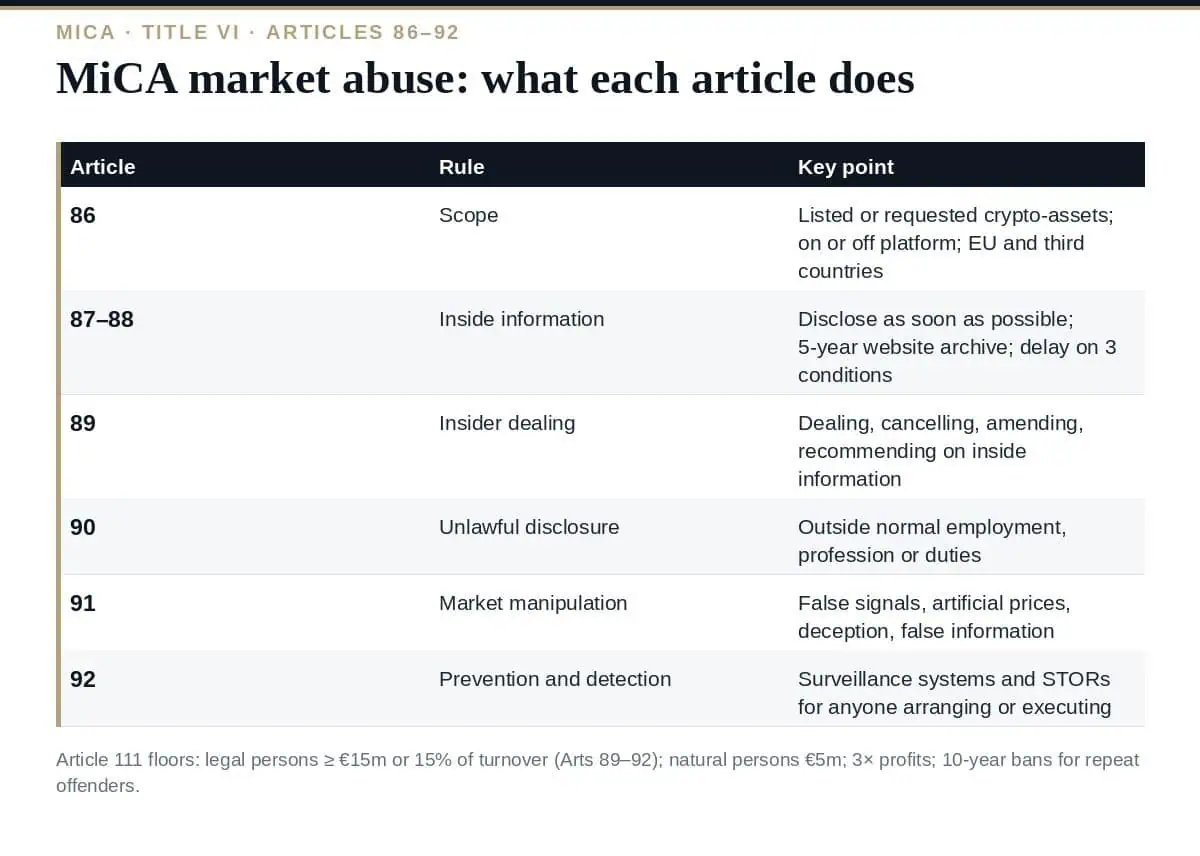
MiCA market abuse rules — Title VI of Regulation (EU) 2023/1114, Articles 86 to 92 — bring insider dealing, unlawful disclosure of inside information and market manipulation in crypto-assets under a regime modelled on the Market Abuse Regulation, and they reach further than most crypto firms assume. The Title applies to any person, on or off a trading platform, in the Union or in a third country, in respect of any crypto-asset admitted to trading or for which admission has been requested.
Issuers must disclose inside information as soon as possible and keep it on their website for five years; anyone professionally arranging or executing transactions must run systems to prevent and detect abuse and report suspicions without delay; and Article 111 sets the penalty floor at €15 million or 15% of annual turnover for legal persons, €5 million for natural persons, and three times the profits gained, with a ten-year management ban for repeat offenders. This guide sets out the scope, the three prohibitions with the behaviours the Regulation names, the disclosure duty and its delay conditions, the Article 92 surveillance obligation and ESMA’s standards under it, the sanctions, and how a CASP or issuer builds compliance.
| Article 86 | Provision | Practical consequence |
|---|---|---|
| 86(1) | Acts by any person concerning crypto-assets admitted to trading, or for which a request for admission to trading has been made | The trigger is admission to a trading platform, not the type of token; a crypto-asset traded only peer-to-peer and never listed is outside |
| 86(2) | Any transaction, order or behaviour concerning those crypto-assets, whether or not on a trading platform | OTC trades, DeFi interactions and social-media conduct concerning a listed asset are in scope |
| 86(3) | Actions and omissions in the Union and in third countries | A non-EU person manipulating a token listed on an EU platform is within the Title |
Because the trigger is admission to trading, the population of in-scope assets is set by CASPs operating trading platforms — and it includes asset-referenced tokens and e-money tokens once listed. Our guide to the MiCA Regulation covers the Titles around this one.
Article 87 defines inside information as information of a precise nature, not made public, relating directly or indirectly to one or more issuers, offerors or persons seeking admission, or to one or more crypto-assets, which if public would likely have a significant effect on the price of those crypto-assets or a related crypto-asset — and, for persons executing client orders, precise information conveyed by a client about pending orders. Article 88 attaches the disclosure duty.
| Article 88 | Requirement | Note |
|---|---|---|
| 88(1) | Issuers, offerors and persons seeking admission inform the public as soon as possible of inside information that directly concerns them, in a way enabling fast access and complete, correct and timely assessment | Not combined with marketing |
| 88(1) | Post and maintain on the website, for at least five years, all inside information required to be disclosed | A dated archive is the evidence |
| 88(2) | Disclosure may be delayed on the issuer’s own responsibility where all three conditions are met: immediate disclosure would prejudice legitimate interests; delay is not likely to mislead the public; confidentiality can be ensured | Mirrors MAR Article 17(4) |
| 88(3) | After a delayed disclosure is made, inform the competent authority that it was delayed and provide a written explanation of how the conditions were met — or, where the Member State so provides, keep a record to produce on request | The delay record must be written at the time |
| Prohibition | Article | What it covers |
|---|---|---|
| Insider dealing | 89 | Possessing inside information and using it to acquire or dispose of the crypto-assets it relates to, for own or third-party account; cancelling or amending an order placed before the information was possessed; submitting, modifying or withdrawing a bid; recommending or inducing another person to deal, and dealing on such a recommendation knowing or ought to know it rests on inside information |
| Unlawful disclosure | 90 | Disclosing inside information other than in the normal exercise of employment, profession or duties; onward disclosure of an Article 89 recommendation where the discloser knows or ought to know its basis |
| Market manipulation | 91 | Transactions, orders or behaviour giving false or misleading signals as to supply, demand or price, or securing an abnormal or artificial price, unless for legitimate reasons; using a fictitious device or deception; disseminating false or misleading information including rumours, where the person knew or ought to have known |
Article 91(3) names behaviours that are manipulation “inter alia”: securing a dominant position over supply or demand that fixes prices or creates unfair trading conditions; placing, cancelling or modifying orders that disrupt or delay the platform, make genuine orders harder to identify, or create a false or misleading signal, in particular by initiating or exacerbating a trend; and voicing an opinion about a crypto-asset in the media while holding a position and profiting from the price impact without disclosing the conflict. Layering, spoofing, wash trading and undisclosed paid promotion are all inside those words.
Any person professionally arranging or executing transactions in crypto-assets must have effective arrangements, systems and procedures to prevent and detect market abuse, and must report without delay to the competent authority of the Member State where it is registered or headquartered any reasonable suspicion regarding an order or transaction — including cancellations and modifications — and “other aspects of the functioning of the distributed ledger technology such as the consensus mechanism” where market abuse may have been, is being or is likely to be committed.
ESMA was mandated to draft regulatory technical standards on the arrangements and the reporting template by 30 December 2024 and guidelines on supervisory practices by 30 June 2025; those standards define the suspicious transaction and order report (STOR) format and the expectations for surveillance. Our guide to CASP authorisation covers where the Article 92 systems sit in the authorisation file.
| Who is caught by Article 92 | Why |
|---|---|
| CASPs operating a trading platform | They arrange transactions; the platform is where most abuse occurs |
| CASPs executing orders or dealing on own account | They execute transactions |
| Brokers, OTC desks and market makers in listed crypto-assets | Professionally arranging or executing |
| Credit institutions and investment firms providing crypto-asset services under Article 60 notifications | Same activity, same duty |
| Measure (Article 111(5)) | For infringements of Articles 88–92 |
|---|---|
| Public statement and cease-and-desist order | Naming the person and the infringement |
| Disgorgement | Profits gained or losses avoided, where determinable |
| Withdrawal or suspension of a CASP’s authorisation | The commercial end of the business |
| Management ban | Temporary; at least 10 years for a repeated infringement of Articles 89–92 |
| Ban on dealing on own account | Temporary, for responsible management or other natural persons |
| Fines — profit-based | At least three times the profits gained or losses avoided, even above the caps below |
| Fines — natural persons | At least €1 million (Article 88) or €5 million (Articles 89–92) |
| Fines — legal persons | At least €2.5 million or 2% of total annual turnover (Article 88); at least €15 million or 15% of turnover (Articles 89–92) |
These are floors the Member States must give their competent authorities, and national criminal law may apply in addition. The 15% turnover figure for manipulation and insider dealing is among the highest in EU financial regulation.
Our MiCA compliance checklist places Title VI alongside the other Titles.
What does MiCA market abuse cover?
Title VI, Articles 86–92: insider dealing, unlawful disclosure of inside information and market manipulation concerning any crypto-asset admitted to trading or for which admission has been requested, by any person, on or off a trading platform, in the EU or in a third country.
Does MiCA market abuse apply to DeFi or OTC trades?
If the crypto-asset is admitted to trading on an EU platform, Article 86(2) applies the Title to any transaction, order or behaviour concerning it, whether or not it takes place on a platform. The asset’s listing status, not the venue of the conduct, decides.
Who must report suspicious transactions?
Any person professionally arranging or executing transactions in crypto-assets — trading platforms, brokers, order executors, own-account dealers — under Article 92, without delay, to the competent authority where they are registered, using ESMA’s template.
Can an issuer delay disclosing inside information?
Yes, under Article 88(2), where immediate disclosure would prejudice legitimate interests, the delay is not likely to mislead the public, and confidentiality can be ensured — then inform the competent authority with a written explanation once disclosed.
What are the penalties for MiCA market abuse?
Article 111 floors: for legal persons at least €15 million or 15% of annual turnover (Articles 89–92) or €2.5 million or 2% (Article 88); for natural persons €5 million or €1 million; at least three times the profits gained; disgorgement; authorisation withdrawal; and management bans of at least ten years for repeat offenders.
Treat MiCA market abuse as MAR for crypto with a wider reach: map every listed asset you issue or trade, run the issuer disclosure procedure with its five-year archive and delay record, build Article 92 surveillance across on-chain and off-chain data with STORs filed without delay, and police promotion and personal dealing — because the sanctions are set at 15% of turnover and reach the management body by name.
The Market Abuse Prevention Policy, the inside information and disclosure procedure with the delay record, the insider list and personal account dealing policy, the Article 92 surveillance procedure and the STOR template are in the MiCA Toolkit, or start with the free templates.

September 21, 2026
September 20, 2026
September 20, 2026
September 19, 2026

September 19, 2026

