CART
An asset-referenced token and an e-money token are the two kinds of stablecoin MiCA regulates, and the line between them is drawn by one question: what does the token reference? Article 3(1)(7) of Regulation (EU) 2023/1114 defines an e-money token (EMT) as a crypto-asset that purports to maintain a stable value by referencing the value of one official currency; Article 3(1)(6) defines an asset-referenced token (ART) as a crypto-asset that is not an EMT and purports to maintain a stable value by referencing another value or right or a combination — one or more official currencies, commodities, crypto-assets, or a basket.
The classification decides who may issue the token, whether the white paper is approved or merely notified, what own funds and reserve rules apply, how holders redeem, and which supervisor watches it. Both regimes have applied since 30 June 2024 under Title III (ARTs) and Title IV (EMTs). This guide sets the two side by side, article by article, and explains the significant-token tier, the means-of-exchange cap and the prohibition on interest that apply to both.
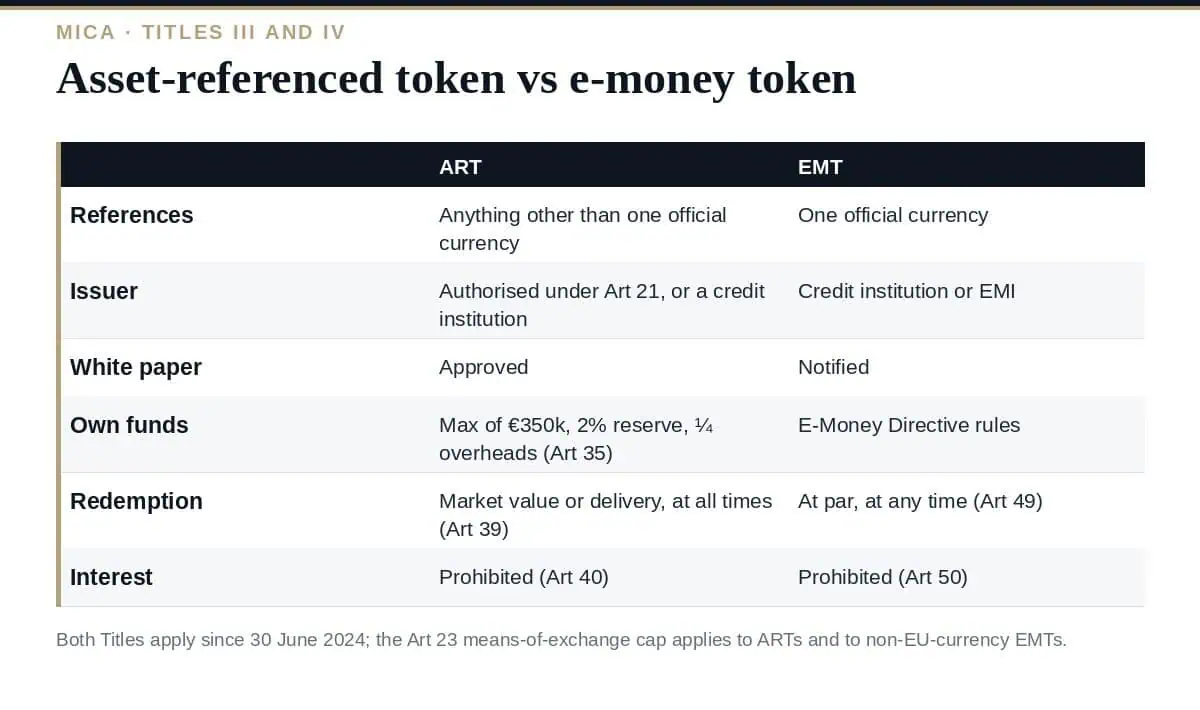
| Asset-referenced token (ART) | E-money token (EMT) | |
|---|---|---|
| Definition | Article 3(1)(6): a crypto-asset that is not an EMT and purports to maintain a stable value by referencing another value or right or a combination thereof, including one or more official currencies | Article 3(1)(7): a crypto-asset that purports to maintain a stable value by referencing the value of one official currency |
| Typical examples | A token referencing a basket of currencies, gold, a crypto-asset, or an index (an ART) | A euro-, dollar- or sterling-referenced stablecoin |
| Legal nature | A crypto-asset under Title III | Deemed electronic money (Article 48(2)); Title IV applies alongside the E-Money Directive |
| Where it sits | Title III, Articles 16–47 | Title IV, Articles 48–58 |
The definition is by reference, not by design: a token that references a single official currency is an EMT whatever its issuer calls it, and a token that references two currencies is an ART even if each is a major currency. A token referencing a non-EU currency such as the US dollar is still an EMT — but Article 58(3) applies the Article 23 means-of-exchange cap to it. Our guide to the MiCA Regulation covers the wider structure.
| Asset-referenced token | E-money token | |
|---|---|---|
| Eligible issuer | A legal person or other undertaking established in the Union and authorised under Article 21 by its home competent authority, or a credit institution complying with Article 17 | A credit institution or an electronic money institution |
| White paper | Approved by the competent authority as part of authorisation | Notified to the competent authority and published under Article 51; not approved |
| Exemptions | Article 16(2): average outstanding value never exceeds €5 million over 12 months (issuer not linked to a network of other exempt issuers), or the offer is solely to qualified investors — a white paper is still drawn up and notified | None equivalent; a limited-network or small-EMI status under the E-Money Directive may apply to the institution |
| Third-party offerors | Permitted with the issuer’s written consent; must comply with Articles 27, 29 and 40 | Permitted with the issuer’s written consent; must comply with Articles 50 and 53 |
The practical consequence is that an EMT issuer needs a licence that exists outside MiCA — a banking or e-money licence — while an ART issuer can be a purpose-built entity authorised under MiCA itself. Our guide to the crypto-asset white paper covers what the document contains in each case.
| Asset-referenced token | E-money token | |
|---|---|---|
| Own funds | Article 35: at all times at least the highest of €350,000; 2% of the average reserve of assets; a quarter of the preceding year’s fixed overheads | The E-Money Directive’s own-funds rules for an EMI, or CRR for a credit institution |
| Reserve | Article 36: a reserve of assets covering the referenced assets’ risks and redemption liquidity, legally segregated from the issuer’s estate; Article 38: any invested part in highly liquid instruments with minimal market, credit and concentration risk | Article 54: at least 30% of funds received deposited in separate accounts at credit institutions; the remainder invested in secure, low-risk, highly liquid instruments denominated in the referenced currency |
| Significant tier | Article 43: EBA classifies as significant where at least three criteria are met — more than 10 million holders; issued value, market cap or reserve above €5 billion; more than 2.5 million transactions and €500 million per day; issuer is a DMA gatekeeper; international significance; interconnectedness; multiple tokens plus a crypto-asset service | Article 56: the same Article 43(1) criteria; at least three met |
| Significant consequences | Article 45: remuneration policy, custody by multiple CASPs, liquidity management policy and stress testing, own-funds percentage raised to 3% of the reserve; EBA supervision | Article 58: EMIs issuing significant EMTs apply MiCA’s reserve rules (Articles 36–38, 45) instead of the E-Money Directive’s safeguarding, and the raised own funds; independent reserve audit every six months |
| Asset-referenced token | E-money token | |
|---|---|---|
| Redemption right | Article 39: at all times, either in funds equivalent to the market value of the referenced assets or by delivery of the assets; a written redemption policy with conditions, thresholds and timeframes | Article 49: at any time and at par value, in funds; issued at par on receipt of funds; holders have a claim against the issuer |
| Fees | Redemption policy may set conditions; fees must be proportionate | Redemption free of charge except as Article 49 allows |
| Interest | Article 40: prohibited — for the issuer and for CASPs providing services in the token | Article 50: prohibited — the same, notwithstanding Article 12 of the E-Money Directive |
| What counts as interest | Any remuneration or benefit related to the length of time the holder holds the token | The same |
The interest ban is the provision that distinguishes MiCA most sharply from the US GENIUS Act debate and from bank deposits; a “reward” for holding either token type is interest under Articles 40 and 50 whatever it is called. Our guide to GENIUS Act vs MiCA covers that comparison.
Article 23 applies to any asset-referenced token, and via Article 58(3) to EMTs denominated in a currency that is not an official currency of a Member State. Where the estimated quarterly average number and aggregate value of transactions per day associated with the token’s use as a means of exchange within a single currency area exceed 1 million transactions and €200 million, the issuer must stop issuing and, within 40 working days, submit a plan to bring both figures back under the thresholds.
The competent authority uses the higher of the issuer’s information, its own estimates and the ECB’s. The cap is what makes a euro-referenced EMT the only stablecoin design that can scale as a payment instrument in the EU without hitting a hard stop.
| If you want to… | The design MiCA points to | Why |
|---|---|---|
| Issue a euro or other EU-currency stablecoin for payments | EMT from a credit institution or EMI | Redemption at par, e-money status, no Article 23 cap |
| Issue a US-dollar stablecoin in the EU | EMT from an EMI | Still an EMT, but the Article 23 cap applies through Article 58(3) |
| Reference a basket, gold, or a crypto-asset | Asset-referenced token authorised under Article 21 | Not a single official currency, so not an EMT |
| Run a small or professional-only product | Asset-referenced token under the Article 16(2) exemption | €5 million average outstanding or qualified investors only; white paper still notified |
| Pay holders a yield | Neither | Articles 40 and 50 prohibit interest on both |
What is an asset-referenced token under MiCA?
Article 3(1)(6): a crypto-asset that is not an e-money token and purports to maintain a stable value by referencing another value or right or a combination — one or more official currencies, commodities, crypto-assets or a basket. Issuers are authorised under Article 21 or are credit institutions, and Title III (Articles 16–47) applies.
What is the difference between an asset-referenced token and an e-money token?
An EMT references exactly one official currency and must be issued by a credit institution or e-money institution, with the white paper notified and redemption at par at any time. An asset-referenced token references anything else, is authorised under MiCA itself with an approved white paper, holds a segregated reserve, meets Article 35 own funds and redeems at market value or by delivery.
Is a US-dollar stablecoin an asset-referenced token in the EU?
No — it references one official currency, so it is an EMT and must be issued by a credit institution or EMI. But Article 58(3) applies the Article 23 means-of-exchange cap (1 million transactions and €200 million per day in a single currency area) to EMTs in non-EU currencies.
Can either token pay interest?
No. Article 40 (ARTs) and Article 50 (EMTs) prohibit issuers and CASPs from granting interest, and any benefit linked to how long a holder holds the token is treated as interest.
When did the ART and EMT rules start to apply?
30 June 2024, under Article 149(3), six months before the rest of MiCA applied on 30 December 2024.
Classify by reference first: one official currency makes an EMT and requires a bank or e-money licence; anything else makes an ART and requires MiCA authorisation, an approved white paper, Article 35 own funds and an Article 36 reserve. Then design for the rules both share — redemption at any time, no interest, the significant-token tier, and the Article 23 cap for anything that is not an EU-currency EMT — because those are the provisions that decide whether the token can operate at scale.
The token classification assessment, the Article 35 own-funds calculator, the reserve of assets policy, the redemption policy and the white paper templates for both token types are in the MiCA Toolkit, or start with the free templates.

October 11, 2026
October 11, 2026

October 11, 2026

October 11, 2026

October 11, 2026

