CART
Counterfeit parts are the supply-chain risk AS9100 names in its own clause: 8.1.4, Prevention of Counterfeit Parts, requires the organisation to “plan, implement, and control processes, appropriate to the organization and the product, for the prevention of counterfeit or suspect counterfeit part use and their inclusion in product(s) delivered to the customer”. The clause is short and its NOTE is long — training, obsolescence monitoring, sourcing from original or authorised manufacturers, traceability, verification and test methods, monitoring of external reporting, and quarantine and reporting of suspect parts — and the IAQG’s published key changes for IA9100 turn those NOTE items into requirements. A counterfeit part is, in the standard’s definition, an unauthorised copy, imitation, substitute or modified part knowingly misrepresented as a specified genuine part of an original or authorised manufacturer; the electronic component that fails at altitude and the fastener with a forged certificate are both in scope. This guide sets out what 8.1.4 requires, the seven elements of a prevention process and how each is evidenced, the sourcing hierarchy that does most of the work, the detection methods, what to do when a suspect part is found, and where AS5553, AS6174, AS6081 and the DFARS counterfeit rules add obligations.
| Element | AS9100D | IA9100 (pending, per IAQG key changes) |
|---|---|---|
| Requirement | Plan, implement and control processes for the prevention of counterfeit or suspect counterfeit part use and their inclusion in delivered product | Retained |
| NOTE items — training; obsolescence monitoring; controls for acquiring from original or authorised manufacturers, distributors or other approved sources; traceability to original or authorised manufacturers; verification and test methodologies; monitoring of counterfeit parts reporting from external sources; quarantine and reporting of suspect or detected counterfeit parts | Guidance — ‘should consider’ | ‘NOTE items now requirements’, per the IAQG clause-by-clause summary |
| Flow-down | 8.4.3: information for external providers includes the need to prevent the use of counterfeit parts | Expanded sub-tier control expected |
| Definition | Counterfeit part: an unauthorized copy, imitation, substitute, or modified part knowingly misrepresented as a specified genuine part of an original or authorized manufacturer | Retained |
The practical reading is that an organisation certified to Rev D that treats the NOTE as its process design has nothing to change when IA9100 arrives; one that has a one-paragraph policy and no records does. Our guide to IA9100 covers the revision’s timing.
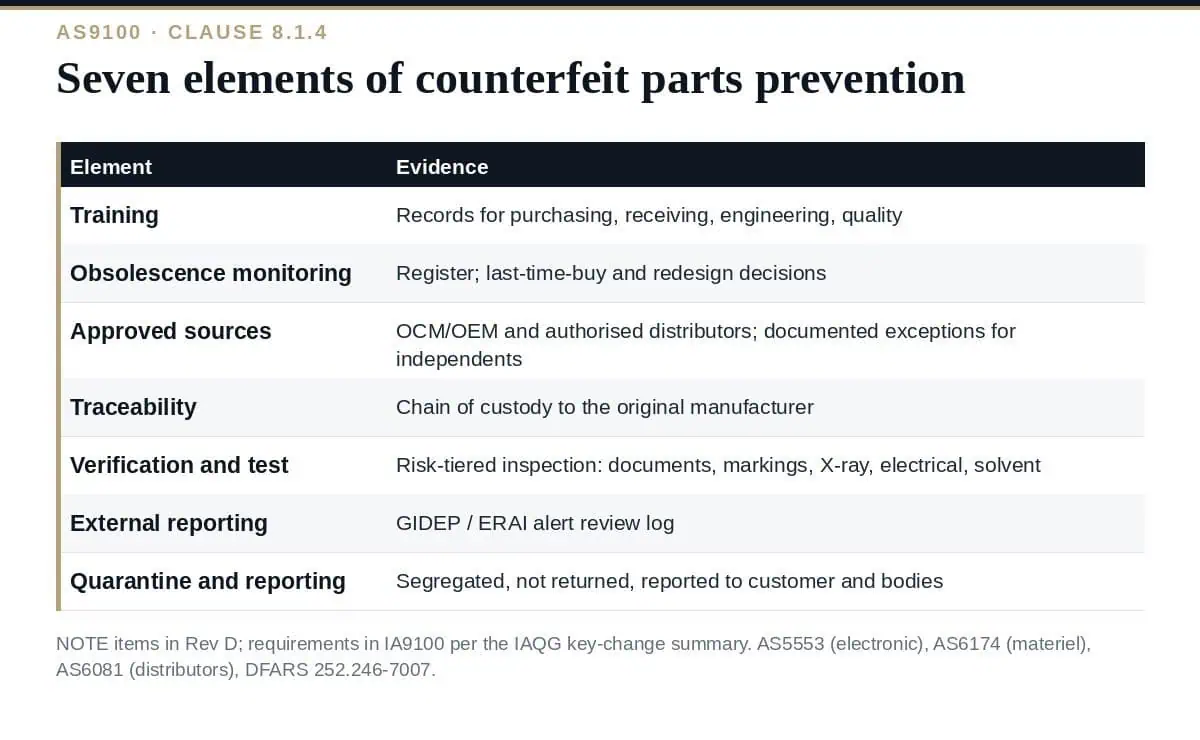
| Element | What it involves | Evidence an auditor asks for |
|---|---|---|
| 1. Training | Purchasing, receiving inspection, engineering and quality personnel trained in counterfeit risk, indicators and the organisation’s procedure | Training records and content; awareness on the receiving dock, not only in quality |
| 2. Obsolescence monitoring | Parts approaching or past end of life identified, because obsolete and long-lead parts are where counterfeits enter | An obsolescence register; last-time-buy and redesign decisions; a link to the risk register |
| 3. Approved sources | Purchase from the original component manufacturer (OCM/OEM) or its authorised distributors; independent distributors and brokers only under a documented risk-based exception | Approved supplier list flagging source type; exception approvals with the added verification each carried |
| 4. Traceability | Documentation tracing each part to the original or authorised manufacturer — certificates of conformance, manufacturer date and lot codes, the unbroken chain of custody | Traceability documents reviewed at receipt; a defined response to gaps |
| 5. Verification and test | Inspection and test proportionate to source risk: documentation review, visual and marking inspection, dimensional, X-ray, decapsulation, electrical test, solvent and heated-solvent tests for remarking | Inspection plans by risk tier; test reports; laboratory accreditation where external |
| 6. Monitoring external reporting | Subscription to and review of counterfeit reporting sources — GIDEP and ERAI are the ones the sector uses — and customer and industry alerts | Alert review log with actions taken on relevant reports |
| 7. Quarantine and reporting | Suspect parts segregated so they cannot re-enter the supply chain; reported to the customer, to the reporting bodies and, where applicable, to authorities; not returned to the supplier | Quarantine records, reports filed, disposition decisions |
Most counterfeit parts prevention is procurement discipline. The sector’s hierarchy, formalised in SAE AS5553 for electronic parts and AS6174 for materiel, runs: the original manufacturer; the manufacturer’s authorised distributor; an authorised aftermarket manufacturer; and only then independent distributors and brokers, each step down carrying more verification. The organisation’s counterfeit risk is largely the fraction of its spend that sits in the last tier, and the process should be able to state that fraction. Where an independent source is unavoidable — obsolescence again — the mitigations are contractual (AS6081-compliant distributors, return and remedy clauses), documentary (full traceability or an explicit acknowledgement of its absence) and physical (the test regime the risk tier calls for). Our guide to AS9100 vs ISO 9001 covers how 8.4’s external provider controls carry these requirements.
Receiving inspection is where the process either works or does not; a procedure that ends with “check the CoC” has one of the four.
| Rule | Applies to | What it adds |
|---|---|---|
| SAE AS5553 | Electronic parts; often flowed down by primes | The detailed avoidance, detection, mitigation and disposition process for electrical, electronic and electromechanical parts |
| SAE AS6174 | Materiel — raw materials, castings, fasteners, non-electronic parts | The equivalent process for non-electronic items |
| SAE AS6081 | Independent distributors of electronic parts | The distributor-side requirements primes may demand of brokers |
| DFARS 252.246-7007 and -7008 | US DoD contractors and their supply chains for electronic parts | A counterfeit electronic part detection and avoidance system; sourcing from original manufacturers or authorised suppliers with defined exceptions; GIDEP reporting |
| AS9120 | Distributors and stockists | The distributor’s own 8.1.4 obligations, plus splitting, storage and traceability rules that preserve the chain of custody |
What does AS9100 require for counterfeit parts?
Clause 8.1.4: processes, appropriate to the organisation and product, to prevent counterfeit or suspect counterfeit parts being used or delivered. Its NOTE lists training, obsolescence monitoring, approved-source purchasing, traceability, verification and test, monitoring of external reports, and quarantine and reporting — items the IAQG says become requirements in IA9100.
What is a counterfeit part?
AS9100’s definition: an unauthorised copy, imitation, substitute or modified part knowingly misrepresented as a specified genuine part of an original or authorised manufacturer. Remarked electronic components, cloned parts, salvaged parts sold as new and fasteners with forged certificates all qualify.
Are independent distributors banned?
No, but they are the last resort in the sourcing hierarchy and carry added verification. Primes commonly require AS6081 compliance from independent distributors and documented risk-based approval for each purchase from one.
What should we do with a suspect part?
Quarantine it and its lot, do not return it to the supplier, confirm by test, report to the customer and to GIDEP or ERAI (and under DFARS where applicable), trace any product it reached, and run a corrective action on the process that let it in.
Does counterfeit prevention apply to non-electronic parts?
Yes. AS9100 8.1.4 covers parts generally; AS6174 supplies the process for materiel — raw material, castings, forgings, fasteners — where forged certificates are the common counterfeit.
Build the counterfeit parts process from the seven NOTE items as if they were already requirements — because in IA9100 they will be — with the sourcing hierarchy doing most of the work, receiving inspection doing the rest, and a quarantine-and-report procedure that keeps a suspect part out of the supply chain rather than sending it back into it.
The Counterfeit Parts Prevention Procedure with the seven elements, the approved source register, the receiving inspection checklist, the suspect part quarantine and reporting form and the supplier flow-down clauses are in the AS 9100/9110/9120 Aerospace QMS Toolkit, or start with the free templates.

September 21, 2026
September 20, 2026
September 20, 2026
September 19, 2026

September 19, 2026

