CART
Critical limits are the numbers a HACCP plan lives or dies by: the value at each critical control point that separates safe product from unsafe, monitored during production and acted on the moment it is breached. Codex defines a critical limit as a criterion, observable or measurable, which separates acceptability from unacceptability of the food; 9 CFR 417.2(c)(3) requires the FSIS HACCP plan to list them at each CCP and to design them so that the applicable performance standards are met; 21 CFR 117.135(c)(1) asks the same of process controls, as the maximum or minimum value to which a parameter must be controlled. The requirement is simple to state and routinely got wrong in three ways — limits that cannot be measured, limits that have never been validated, and operating targets mistaken for limits. This guide explains what a critical limit is and is not, where the values come from, how they are validated, how they connect to monitoring and corrective action, and the errors that turn a plan with numbers in it into a plan with no limits at all.
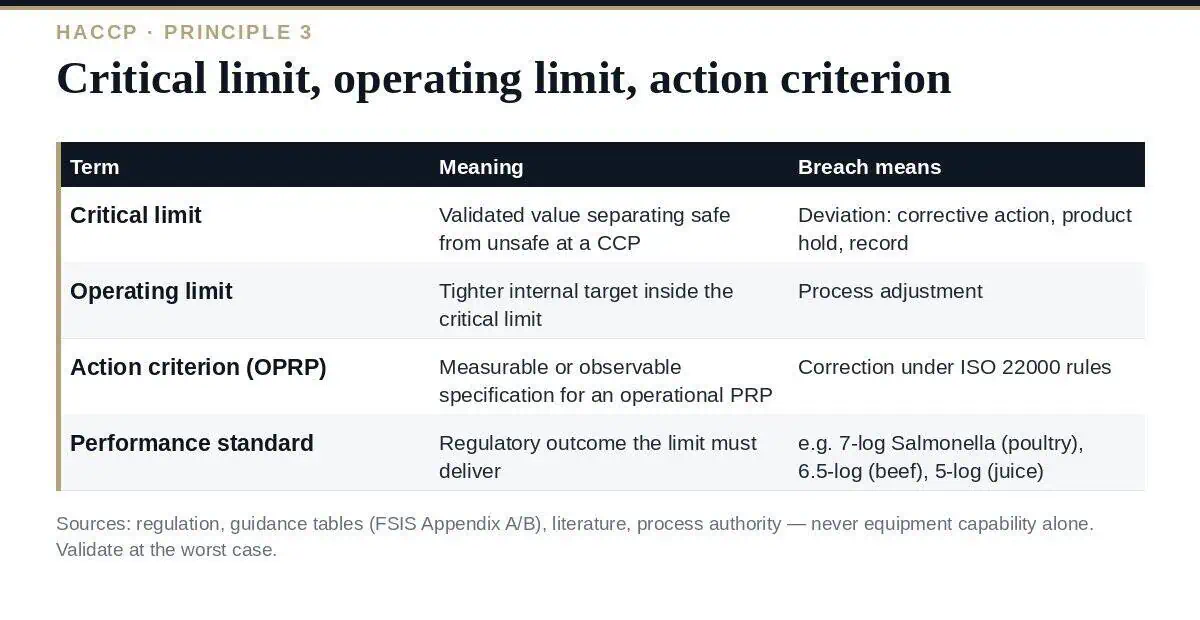
| Term | Meaning | Example at a cook CCP |
|---|---|---|
| Critical limit | The validated value that separates acceptable from unacceptable; a breach means the product is potentially unsafe and corrective action is required | Internal temperature ≥ 74 °C (165 °F) held for the validated time |
| Operating limit (target) | A tighter internal value set to keep the process away from the critical limit; a breach is a process adjustment, not a deviation | Set point 78 °C; adjust below 76 °C |
| Action criterion (ISO 22000 OPRP) | A measurable or observable specification for an operational PRP; not a critical limit, and a breach is handled differently | Sanitizer concentration in range before start-up |
| Performance standard | The regulatory outcome the limit must deliver | 7-log₁₀ Salmonella reduction for fully cooked poultry (9 CFR 381.150); 6.5-log₁₀ for cooked beef (9 CFR 318.17); 5-log for juice (21 CFR 120.24) |
| Specification | A quality or customer requirement, not a safety limit | Colour, moisture, weight |
Two consequences follow. A critical limit must be measurable or observable at the CCP, in real time or close to it — “adequately cooked”, “visually clean” and “supplier certificate on file” are not limits because nothing at the step can be measured against them. And a critical limit is a boundary, not a target: the target belongs to the operating limit, and confusing the two produces either a plan whose every small drift is a recorded deviation, or one whose real breaches are treated as adjustments.
| Source | What it gives you | When it is enough on its own |
|---|---|---|
| Regulation and performance standards | The outcome, and sometimes the number: FSIS lethality and stabilization standards; the juice 5-log requirement; state and retail food codes | When the standard is written as a time/temperature or process value your equipment can deliver and monitor |
| Regulatory guidance tables | Time/temperature combinations that achieve the standard — FSIS Appendix A (lethality) and Appendix B (stabilization), FDA’s Fish and Fishery Products Hazards and Controls Guidance | When your product and process match the assumptions the table states (humidity, product type, fat content) |
| Scientific literature | D- and z-values, pH and water activity growth boundaries, thermal death data for the organism of concern | When the study conditions match your product; otherwise it is an input to your own validation |
| Process authority or challenge study | A limit established for your specific product and process, with inoculated-pack or worst-case data | When published data does not fit — novel products, marginal processes, combined hurdles |
| Equipment capability | What the line can do | Never on its own — capability sets the operating limit, science sets the critical limit |
The common parameters are time and temperature (cooking, pasteurization, chilling, holding), pH and titratable acidity, water activity, salt and preservative concentration, humidity, flow rate, metal detector sensitivity by test piece size, sieve or filter aperture, and sanitizer concentration and contact time. Whichever parameter is chosen, it must be the one that actually controls the hazard: a metal detector limit stated as “detector on” is a presence check, not a limit; the limit is the test-piece size it must reject.
Codex step 8 in the 2020 revision reads “establish validated critical limits”, and both US regimes require validation: 9 CFR 417.4(a)(1) initial validation “that the HACCP plan is functioning as intended”, and 21 CFR 117.160 validation by a PCQI before implementation or within 90 days of first production, with “scientific and technical evidence (or, when such evidence is not available or is inadequate, conducting studies)”. Validation answers one question: does this value, delivered by this equipment on this product at the worst case, control the hazard? Four elements make the validation file complete.
Our guide to HACCP validation vs verification covers the difference between proving the limit works and checking it is being applied.
The limit dictates the monitoring: what is measured, with what instrument, where, how often, by whom, and what is recorded. 9 CFR 417.5(a)(3) requires records of “actual times, temperatures, or other quantifiable values” — a tick in a box is not a monitoring record. The limit also dictates the corrective action, which 9 CFR 417.3(a) requires the plan to identify for each deviation: identify and eliminate the cause, bring the CCP back under control, establish measures to prevent recurrence, and ensure no product injurious to health enters commerce. A deviation record therefore names the limit, the measured value, the product affected since the last good check, its disposition, and the sign-off. Under Part 117, § 117.150 asks for the same elements as corrective action procedures, and distinguishes corrections — minor, isolated problems fixed in a timely way — from corrective actions.
Our guide to the HACCP hazard analysis covers the step before the limit — which hazard the number exists to control — and OPRP vs CCP covers when a measure gets a critical limit and when it gets an action criterion.
What are critical limits in HACCP?
The criterion at each critical control point — observable or measurable, in Codex’s words — that separates acceptable food from unacceptable. A value outside the limit means the product is potentially unsafe and corrective action is required. They are HACCP principle 3 and are required by 9 CFR 417.2(c)(3) and, as process control values, by 21 CFR 117.135(c)(1).
What is the difference between a critical limit and an operating limit?
The critical limit is the safety boundary; the operating limit is a tighter internal target that keeps the process away from it. Exceeding an operating limit is a process adjustment; exceeding a critical limit is a deviation with product disposition and a record.
Do critical limits have to be validated?
Yes. Codex step 8 is ‘establish validated critical limits’; 9 CFR 417.4(a)(1) requires initial validation; 21 CFR 117.160 requires validation by a PCQI with scientific and technical evidence or studies. The file must connect the number to your product and equipment at the worst case.
Can a critical limit be observable rather than measured?
Under the 2020 Codex revision, yes — a visual criterion such as a sealed pack or a colour change can be a limit if it separates acceptable from unacceptable and can be monitored consistently. Most limits remain numerical because numbers are easier to validate and defend.
What happens when a critical limit is exceeded?
The corrective action in the plan: identify and eliminate the cause, restore control, prevent recurrence, and hold and disposition all product produced since the last acceptable check. The record shows the limit, the measured value, the product and the decision.
Set critical limits as validated boundaries on the parameter that actually controls the hazard: one value or combination per CCP, measurable or observable at the step, tied to a regulation, guidance table, study or process authority and confirmed on your own line at the worst case, with an operating limit inside it and a corrective action beyond it. A plan whose limits meet that test has numbers that mean something; one whose limits do not has a list.
The Critical Limits Register, the CCP Monitoring Plan and Monitoring Records, the Corrective Action Records and the Calibration and Verification procedure that hold the limits, the readings and the deviations together are in the HACCP Toolkit, or start with the free templates.

September 20, 2026
September 20, 2026
September 19, 2026

September 19, 2026

September 19, 2026

