CART
HACCP vs HARPC is the comparison every US food facility has to settle before it writes a food safety plan, because the two are not interchangeable and the regulator does not treat them as such. HACCP — Hazard Analysis and Critical Control Points — is the Codex method: seven principles applied through twelve steps, controlling significant hazards at critical control points with measurable critical limits. HARPC — Hazard Analysis and Risk-Based Preventive Controls — is what the Food Safety Modernization Act wrote into 21 CFR Part 117 Subpart C for FDA-registered facilities: a hazard analysis that must be written whatever its outcome, preventive controls that go beyond CCPs to allergen, sanitation and supply-chain controls, a recall plan, and a Preventive Controls Qualified Individual who owns the plan. This guide sets the two side by side on eight points, explains which facilities are under HARPC and which remain under HACCP by regulation, shows how a Codex HACCP plan is converted into a Part 117 food safety plan, and lists the gaps an FDA investigator finds when a facility assumes its HACCP plan is enough.
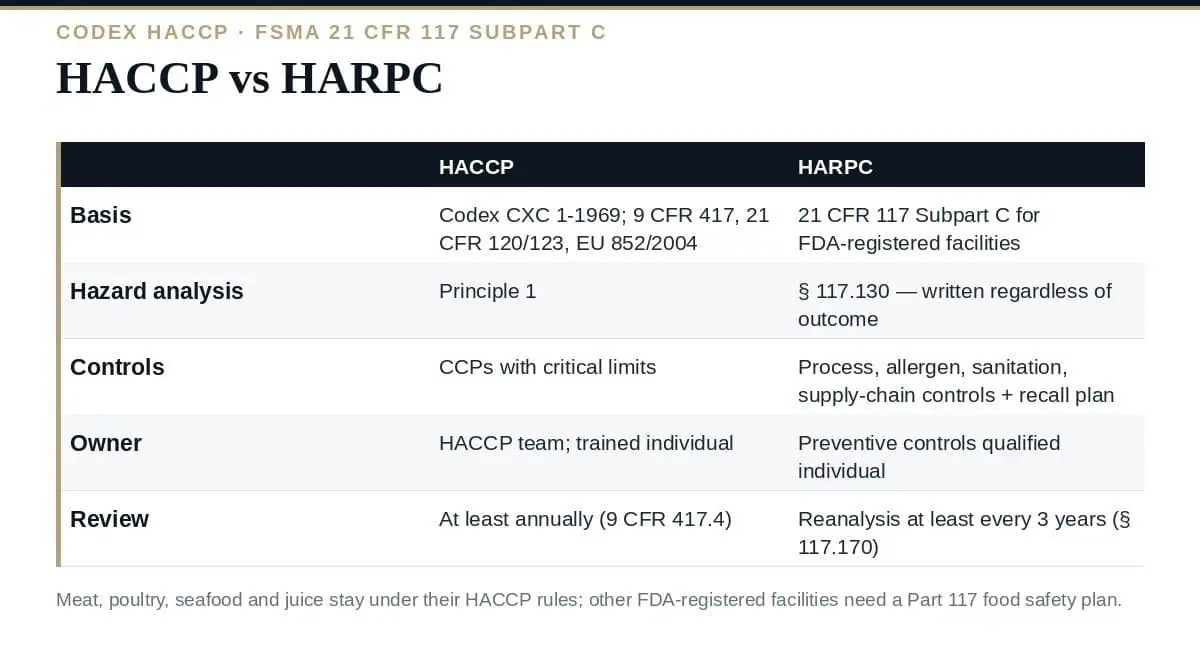
| HACCP (Codex CXC 1-1969, HACCP annex) | HARPC (FSMA, 21 CFR 117 Subpart C) | |
|---|---|---|
| Legal basis | An international method; mandatory where a regulation adopts it — USDA meat and poultry (9 CFR 417), FDA seafood (21 CFR 123) and juice (21 CFR 120), EU Regulation 852/2004 | US federal rule for facilities required to register with FDA under section 415 of the FD&C Act, unless exempt |
| Hazard analysis | Principle 1: identify hazards and control measures; documented as part of the plan | § 117.130: identify and evaluate known or reasonably foreseeable hazards; ‘must be written regardless of its outcome’; must consider biological, chemical (including radiological) and physical hazards, and hazards introduced intentionally for economic gain |
| Unit of control | The critical control point, with a critical limit that separates acceptable from unacceptable | The preventive control — ‘controls at CCPs, if there are any CCPs’, plus controls other than at CCPs |
| Types of control | CCPs; prerequisite programmes sit underneath the plan | § 117.135(c): process controls, food allergen controls, sanitation controls, supply-chain controls, a recall plan, and other controls as appropriate |
| Management components | Monitoring, corrective actions, verification, records (principles 4–7) | § 117.140: monitoring, corrective actions and corrections, verification — ‘as appropriate to the nature of the preventive control’ |
| Validation | Step 8 (validated critical limits) and step 11 in the 2020 Codex revision | § 117.160: by or overseen by a PCQI, before implementation or within 90 days of first production; not required for allergen, sanitation, recall and supply-chain controls |
| Who owns the plan | The HACCP team; regulation may require a trained individual (9 CFR 417.7) | One or more preventive controls qualified individuals — § 117.126(a)(2), § 117.180 |
| Reanalysis | Review at least annually or on significant change (Codex; 9 CFR 417.4 annual reassessment) | § 117.170: the whole plan at least once every 3 years, and on significant change, new hazard information, an unanticipated problem or an ineffective control |
The through-line of HACCP vs HARPC is that HARPC keeps the HACCP hazard analysis and widens the set of controls it feeds. A facility whose only hazards are controlled at cooking and metal-detection CCPs will find its Part 117 plan looks like its HACCP plan plus a recall plan and a supply-chain programme. A facility with allergen changeovers, environmental Listeria risk in a ready-to-eat area and ingredients whose hazards are controlled by the supplier will find HARPC asks for three kinds of control HACCP never named. Our guide to the seven HACCP principles covers the method both start from.
| Facility | Regime | Basis |
|---|---|---|
| FDA-registered manufacturer, processor, packer or holder of human food | HARPC — 21 CFR 117 Subparts C and G | § 117.126 food safety plan requirement |
| Meat, poultry and egg products under USDA FSIS inspection | HACCP — 9 CFR 417 | FSIS’s own HACCP regulation; § 117.5(d) exempts activities subject to the meat and poultry acts |
| Seafood processors | HACCP — 21 CFR 123 | § 117.5(b): Subparts C and G do not apply to activities subject to Part 123 if in compliance with it |
| Juice processors | HACCP — 21 CFR 120, including the 5-log pathogen reduction | § 117.5(c): same exemption for Part 120 activities |
| Qualified facility (very small business under $1,000,000 in annual human-food sales, adjusted for inflation, or majority direct-to-qualified-end-user sales under $500,000) | Modified requirements — § 117.201 attestation | § 117.5(a); Subparts C and G do not apply |
| Low-acid canned foods (Part 113), dietary supplements (Part 111) and the other activities § 117.5 exempts | The specific rule for what it covers; Subpart C only where § 117.5 leaves hazards uncovered | § 117.5(d) onward — read the paragraph that names your product |
| Retail food establishments, restaurants, farms | Not required to register — outside Subpart C; state and local codes apply, often HACCP-based | § 117.5 and the registration rule |
Our guide to prerequisite programmes covers where PRPs stop and controls begin under ISO 22000, which draws the same line.
What is the difference in HACCP vs HARPC?
HACCP is the Codex method of controlling significant hazards at critical control points with critical limits. HARPC is FSMA’s rule in 21 CFR 117 Subpart C: the same hazard analysis, written regardless of outcome, feeding a wider set of preventive controls — process, allergen, sanitation and supply-chain — plus a recall plan, a PCQI and reanalysis every three years.
Does a HACCP plan satisfy FSMA?
Only if the facility is under a HACCP regulation FSMA defers to — meat and poultry (9 CFR 417), seafood (21 CFR 123) or juice (21 CFR 120). Other FDA-registered facilities need a Part 117 food safety plan; a HACCP plan is the starting point, not the finish.
Is HARPC harder than HACCP?
Wider rather than harder. The hazard analysis is the same discipline; HARPC adds controls HACCP treated as prerequisites, a recall plan and a qualified individual, and it requires written conclusions even where no control is needed.
Who can be the PCQI?
Someone who has completed training equivalent to the FDA-recognized standardized curriculum, or is qualified through job experience to develop and apply a food safety system — 21 CFR 117.3. The PCQI need not be an employee.
How often is a HARPC plan reviewed?
The whole plan at least once every three years under § 117.170, and sooner on a significant change, new hazard information, an unanticipated problem or an ineffective control. USDA HACCP plans are reassessed at least annually.
Settle HACCP vs HARPC by regulation first — meat, poultry, seafood and juice stay with their HACCP rules; every other FDA-registered facility needs a Part 117 food safety plan. Then convert rather than start over: keep the hazard analysis, write it regardless of outcome, reclassify the controls into the four Part 117 kinds, add the recall plan and the PCQI, and put the three-year reanalysis in the calendar.
The Hazard Analysis Worksheets, the CCP monitoring and verification plans, the Corrective Action Records, the Product Recall & Withdrawal Procedure and the Guideline for Allergen Control that carry a HACCP plan into a Part 117 food safety plan are in the HACCP Toolkit, or start with the free templates.

September 20, 2026
September 20, 2026
September 19, 2026

September 19, 2026

September 19, 2026

