CART

Greenwashing stops being a reputational risk and becomes an unfair commercial practice across the European Union on 27 September 2026. That is the date from which Member States must apply Directive (EU) 2024/825 — the Empowering Consumers for the Green Transition Directive — which adds a list of sustainability-claim practices to the blacklist in Annex I of the Unfair Commercial Practices Directive, banned in all circumstances without any need to prove that a consumer was misled. Generic environmental claims, self-invented sustainability labels, carbon-neutral claims based on offsetting, and future-performance promises without a verified plan are all on it. There is no transition period. This guide explains what the Directive prohibits and from when, what it requires for the claims that remain permitted, what happened to the separate Green Claims Directive, and how a company builds the claims control that keeps its marketing on the right side of the line.
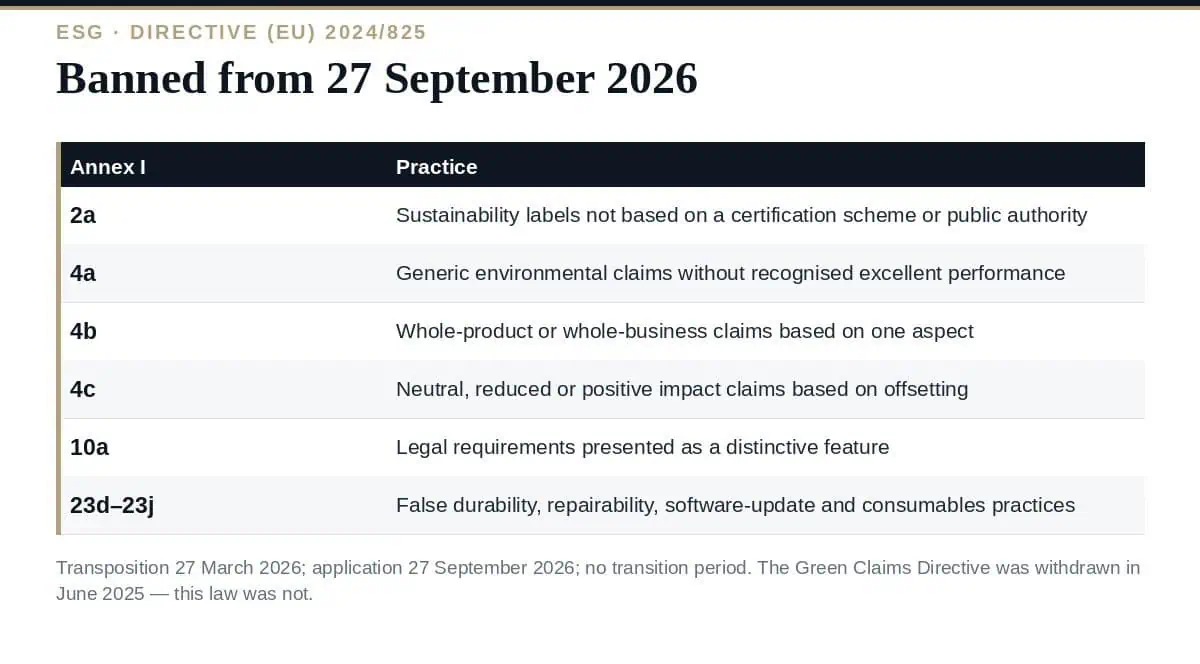
Directive (EU) 2024/825 was adopted on 28 February 2024. It amends two existing directives — the Unfair Commercial Practices Directive 2005/29/EC and the Consumer Rights Directive 2011/83/EU — rather than creating a new regime, which is why it bites so hard: the practices it adds to Annex I of the UCPD are per se unfair, prohibited in every Member State, enforced by consumer authorities and actionable by competitors and consumer organizations. Member States had to transpose it by 27 March 2026 and must apply their measures from 27 September 2026. Claims that were acceptable the day before may be unlawful the day after; the Directive contains no grandfathering for existing packaging or campaigns.
The Green Claims Directive — a separate 2023 proposal that would have required ex-ante verification of explicit environmental claims by accredited bodies — is not this law. The Commission withdrew it in June 2025. Nothing in that withdrawal touches Directive 2024/825, which was already adopted and in force; the rules below are binding regardless.
The Directive adds the following to the Annex I blacklist of practices that are unfair in all circumstances.
| Annex I point | Practice banned outright | What it means in practice |
|---|---|---|
| 2a | Displaying a sustainability label that is not based on a certification scheme or not established by public authorities | No self-created eco-badges, leaf logos or ‘sustainable choice’ tags unless a third-party certification scheme with monitoring stands behind them |
| 4a | Making a generic environmental claim for which the trader is not able to demonstrate recognised excellent environmental performance relevant to the claim | ‘Eco-friendly’, ‘green’, ‘climate-friendly’, ‘sustainable’, ‘natural’, ‘environmentally correct’ and similar are prohibited unless the product meets a recognized standard of excellence — an EU Ecolabel-level benchmark — that the claim relates to |
| 4b | Making an environmental claim about the entire product or the trader’s entire business when it concerns only a certain aspect of the product or a specific activity of the business | ‘Sustainable packaging’ cannot become ‘sustainable product’; a recycled-content claim about one component cannot cover the whole item |
| 4c | Claiming, based on the offsetting of greenhouse gas emissions, that a product has a neutral, reduced or positive impact on the environment in terms of greenhouse gas emissions | ‘Carbon neutral’, ‘climate neutral’, ‘net zero’ and ‘CO2 compensated’ claims are banned where they rest on offsets rather than reductions in the product’s own value chain |
| 10a | Presenting requirements imposed by law on all products within the relevant product category on the Union market as a distinctive feature of the trader’s offer | ‘Free of banned substance X’ when the substance is banned for everyone is unlawful |
| 23g, 23h | Falsely claiming that under normal conditions of use a good has a certain durability in terms of usage time or intensity; presenting a good as allowing repair when it does not | Durability and repairability claims must be true and substantiated |
| 23d–23f, 23i, 23j | Withholding that a software update will negatively impact functioning; presenting an update as necessary when it only adds features; marketing a good with a feature introduced to limit its durability; inducing early replacement of consumables; withholding that non-original consumables, parts or accessories impair functionality | Applies to electronics, appliances and connected products |
Alongside the blacklist, the Directive tightens the general test. Environmental claims about future performance — “net zero by 2040”, “100% recyclable by 2030” — are misleading unless backed by clear, objective, publicly available and verifiable commitments set out in a detailed and realistic implementation plan with measurable, time-bound targets, and regularly verified by an independent third-party expert whose findings are made available to consumers. Comparative environmental claims must state the method and the products compared. And “sustainability label” is defined broadly — any voluntary trust mark, quality mark or equivalent that sets a product, process or business apart on environmental or social characteristics.
| Claim type | Still allowed? | Condition |
|---|---|---|
| Specific, substantiated environmental claim | Yes | Relates to a defined aspect; supported by evidence the trader holds; not extended to the whole product or business |
| Certified sustainability label | Yes | Based on a certification scheme with third-party monitoring, or established by a public authority |
| Comparative environmental claim | Yes | Method disclosed; comparison is between like products and objective |
| Future environmental performance claim | Yes | Public commitments, a realistic implementation plan with measurable time-bound targets, independent third-party verification published |
| Emissions-reduction claim | Yes | Based on reductions in the product’s or business’s own value chain, evidenced by the inventory |
| Neutrality claim based on offsets | No | Prohibited in all circumstances |
| Generic claim (‘eco-friendly’, ‘green’) | Only with recognized excellent performance | In practice, only where the product meets an EU Ecolabel or equivalent benchmark relevant to the claim |
Any trader making business-to-consumer claims in the EU, regardless of where it is established. The rules attach to the claim, not to the company’s reporting status: a company outside CSRD scope that sells to EU consumers is fully within them. Business-to-business claims are outside the UCPD but sit under national unfair-competition and advertising law, where the same evidence standard is increasingly applied — and a B2B claim that reaches a consumer through a customer’s marketing is the customer’s problem and then, contractually, yours. Enforcement is by national consumer authorities with penalties set nationally; the Directive also preserves the right of competitors and consumer bodies to bring actions, which is where much greenwashing enforcement has historically come from.
When do the EU greenwashing rules apply?
From 27 September 2026, under Directive (EU) 2024/825. Member States had to transpose it by 27 March 2026. There is no transition period for existing claims, packaging or campaigns.
Is ‘carbon neutral’ banned?
Where the claim rests on offsetting greenhouse gas emissions, yes — claims of neutral, reduced or positive environmental impact based on offsets are on the Annex I blacklist. A reduction claim evidenced by the company’s own value-chain emissions remains possible.
Can we still say ‘eco-friendly’?
Only if the product has recognized excellent environmental performance relevant to the claim, such as an EU Ecolabel. Generic environmental claims without that are prohibited in all circumstances.
What happened to the Green Claims Directive?
The Commission withdrew that separate proposal in June 2025. It would have added pre-approval of claims by accredited verifiers. Directive 2024/825 was already adopted and is unaffected.
Does this apply to non-EU companies?
Yes, to any trader making business-to-consumer claims in the EU market, regardless of where it is established. The rules attach to the claim.
Treat 27 September 2026 as a hard date: inventory every sustainability claim, remove the generic terms, the self-made labels and the offset-based neutrality claims, trace everything else to evidence held in the ESG policy and the emissions inventory, and put a documented sign-off between the claim and the customer. Greenwashing enforcement in the EU no longer needs to prove anyone was misled — only that the claim was made.
The ESG policy templates and environmental policy that a claims-control process is anchored to, with the aspects and impacts registers and an ESG gap analysis tool, are in the ESG Toolkit, or start with the free templates.

September 20, 2026
September 20, 2026
September 19, 2026

September 19, 2026

September 19, 2026

