CART

ESG KPIs are where sustainability stops being a narrative and becomes something a board can govern: a defined metric, a unit, a data source, an owner, a target and a trend. The problem is not a shortage of candidate indicators — the ESRS alone contain hundreds of datapoints and GRI has dozens of topic standards — but choosing the ones a board should see, defining them so the number is the same next quarter, and getting data that would survive limited assurance. This guide sets out the twelve ESG KPIs boards most often ask for across the three pillars, with the definition, unit and source standard for each, explains how the choice is driven by the materiality assessment rather than by fashion, and gives the documentation discipline that makes an ESG KPI reportable rather than aspirational.
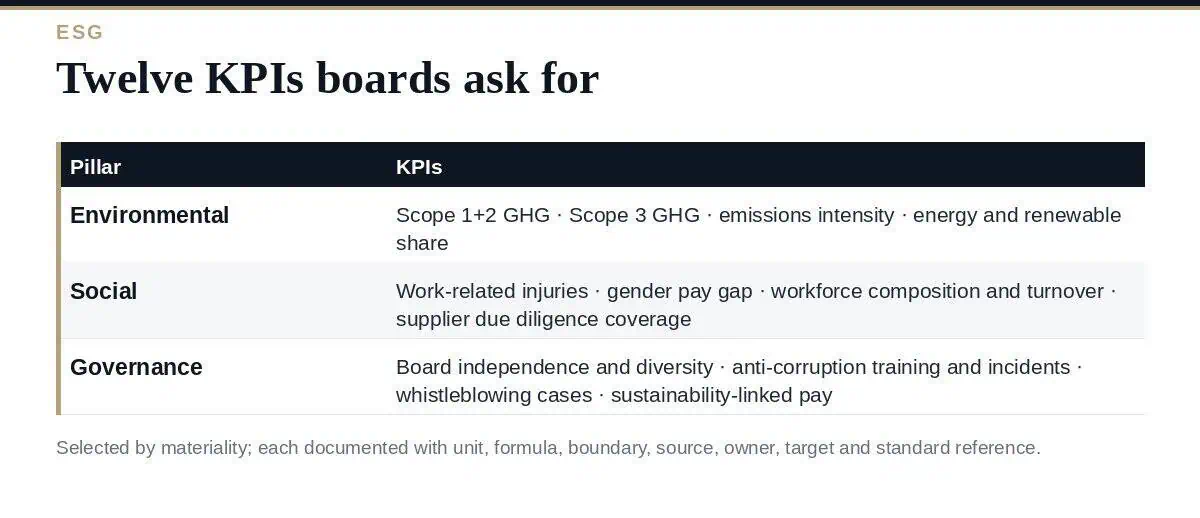
The materiality assessment comes first. Under the ESRS a company reports the datapoints for the topics its double materiality assessment found material; under IFRS S1 and S2 it reports what is material to investors; under GRI it reports its most significant impacts. A KPI set built the other way round — picking metrics the company already has and calling them material — fails assurance and misleads readers. The twelve below are the metrics that are material for most companies and requested by most boards; a materiality assessment adds sector-specific ones (water for beverages, biodiversity for agriculture, financed emissions for banks) and may remove some. Our guide to the double materiality assessment covers the selection step.
| KPI | Definition | Unit | Source standard |
|---|---|---|---|
| Scope 1 and 2 GHG emissions | Direct emissions and purchased-energy emissions, Scope 2 by both location- and market-based methods | tCO2e | GHG Protocol; ESRS E1; IFRS S2; GRI 305 |
| Scope 3 GHG emissions | Value-chain emissions by the material categories of the fifteen, with method stated | tCO2e; % of categories measured vs estimated | GHG Protocol Scope 3 Standard; ESRS E1; IFRS S2 |
| Emissions intensity | Total or Scope 1+2 emissions per unit of revenue, output or floor area | tCO2e per €m revenue (or per unit) | ESRS E1; IFRS S2; GRI 305-4 |
| Energy consumption and renewable share | Total energy consumed within the organization; share from renewable sources | MWh; % | ESRS E1; GRI 302 |
| KPI | Definition | Unit | Source standard |
|---|---|---|---|
| Work-related injuries | Recordable injury rate and fatalities for employees and, where material, non-employee workers | Rate per 200,000 or 1,000,000 hours; count | ESRS S1; GRI 403-9; ISO 45001 performance evaluation |
| Gender pay gap | Difference between average pay of male and female employees as a percentage of male pay | % | ESRS S1; GRI 405-2 |
| Workforce composition and turnover | Headcount by gender, region and contract type; voluntary and total turnover | Count; % | ESRS S1; GRI 2-7, 401-1 |
| Supplier due diligence coverage | Share of critical or high-risk suppliers assessed for social and environmental criteria in the period | % of suppliers; % of spend | ESRS S2; GRI 308, 414 |
| KPI | Definition | Unit | Source standard |
|---|---|---|---|
| Board independence and diversity | Share of independent directors; gender and other diversity of the board | % | ESRS G1 / GOV disclosures; GRI 2-9, 405-1 |
| Anti-corruption training and incidents | Share of relevant staff trained; confirmed incidents and actions taken | %; count | ESRS G1; GRI 205-2, 205-3 |
| Whistleblowing cases | Reports received, substantiated and closed, with time to close | Count; days | ESRS G1; EU Whistleblowing Directive |
| Sustainability-linked remuneration | Share of executive variable pay tied to ESG targets, and the targets | % | ESRS GOV-3; IFRS S2 para 29(g) |
Emissions dominate the environmental pillar because every framework starts there and because targets, transition plans and climate risk all rest on the inventory; our guide to Scope 1, 2 and 3 emissions covers how it is built. The social pillar is dominated by the workforce because it is the one social topic material to almost every company. The governance pillar is where the ESG KPIs overlap with what audit committees already track — which is a reason to reuse the existing numbers, not to invent parallel ones.
Limited assurance under the CSRD, and the reasonable assurance some jurisdictions are moving toward, test the process that produced the number. A KPI that cannot show its definition, data source and calculation fails regardless of whether the number is right. The documentation fields are the same ones NIST recommends for any performance measure: an identifier, the goal it serves, the scope, the metric statement, the formula, the target, the evidence and data source, the collection and reporting frequency, and the responsible owner. Two ESG-specific additions: the standard and datapoint reference (ESRS E1-6, GRI 305-1) so the KPI is traceable to the disclosure requirement, and the boundary — which entities, sites and workers are included — because ESG numbers are more often wrong on boundary than on arithmetic.
| Field | Example: Scope 1 emissions |
|---|---|
| Identifier and standard reference | ENV-01; ESRS E1-6; GRI 305-1 |
| Definition | Direct GHG emissions from owned or controlled sources, all seven Kyoto gases, operational control boundary |
| Formula | Σ (activity data × emission factor × GWP), by source |
| Unit | tCO2e |
| Data sources | Fuel invoices (facilities), fleet fuel cards, refrigerant service records; factors: DESNZ 2026 |
| Boundary | All consolidated entities under operational control; excludes joint ventures without control (listed) |
| Frequency | Collected quarterly; reported annually; base year 2024 |
| Target | −42% by 2030 against 2024 (SBTi near-term) |
| Owner | Head of Facilities (data); Chief Sustainability Officer (reporting) |
What are ESG KPIs?
Defined, unit-based metrics for the environmental, social and governance topics a company’s materiality assessment found material — emissions, energy, injuries, pay gap, workforce, supplier due diligence, board composition, anti-corruption, whistleblowing, ESG-linked pay — each with a source, owner and target.
How many ESG KPIs should a board see?
Around twelve: the material metrics with trends and targets. The full datapoint set required by the ESRS, ISSB or GRI belongs in the sustainability statement, not the board pack.
Which standard do ESG KPIs come from?
The ESRS for companies in CSRD scope, IFRS S1 and S2 where the ISSB standards are adopted, and GRI for impact reporting. Most core KPIs — emissions, injuries, pay gap, diversity, anti-corruption — are defined in all three with minor differences.
What makes an ESG KPI assurable?
A documented definition, formula, unit, boundary, data source, frequency, owner and standard reference — so that the assurance provider can test the process, not only the number.
Do we need Scope 3 as a KPI?
For most companies, yes: it is usually the largest share of the footprint, the ESRS and IFRS S2 require it by category, and the SBTi requires a Scope 3 target where it exceeds 40% of total emissions.
Choose ESG KPIs from the materiality assessment, take the twelve above as the starting set, define each in the documentation fields with its standard reference and boundary, put a target beside every actual, and report measured and estimated separately. That is a KPI set a board can govern and an assurance provider can test — which, since the CSRD, is the same thing.
ESG policy templates, the environmental aspects and impacts registers where the environmental KPIs are recorded, the anti-bribery and corporate governance policies behind the governance KPIs, and an ESG gap analysis tool are in the ESG Toolkit, or start with the free templates.

September 20, 2026
September 20, 2026
September 19, 2026

September 19, 2026

September 19, 2026

