CART
HACCP validation asks whether your control measure is capable of controlling the hazard at all. Verification asks whether it is being applied as planned. Monitoring asks what is happening right now. Three different questions, three different sets of records — and auditors keep finding all three collapsed into one folder labelled “checks”.
This guide separates them, covers what evidence each one needs, and explains when a plan has to be validated again.
Free gap assessment
Would your HACCP plan survive an inspection?
Score the whole of the Codex text, free - the good hygiene practices as well as the seven principles, with the US and EU overlays on top.
Run the free HACCP gap assessment → or View premium report sample
| Question | When | Typical evidence | |
|---|---|---|---|
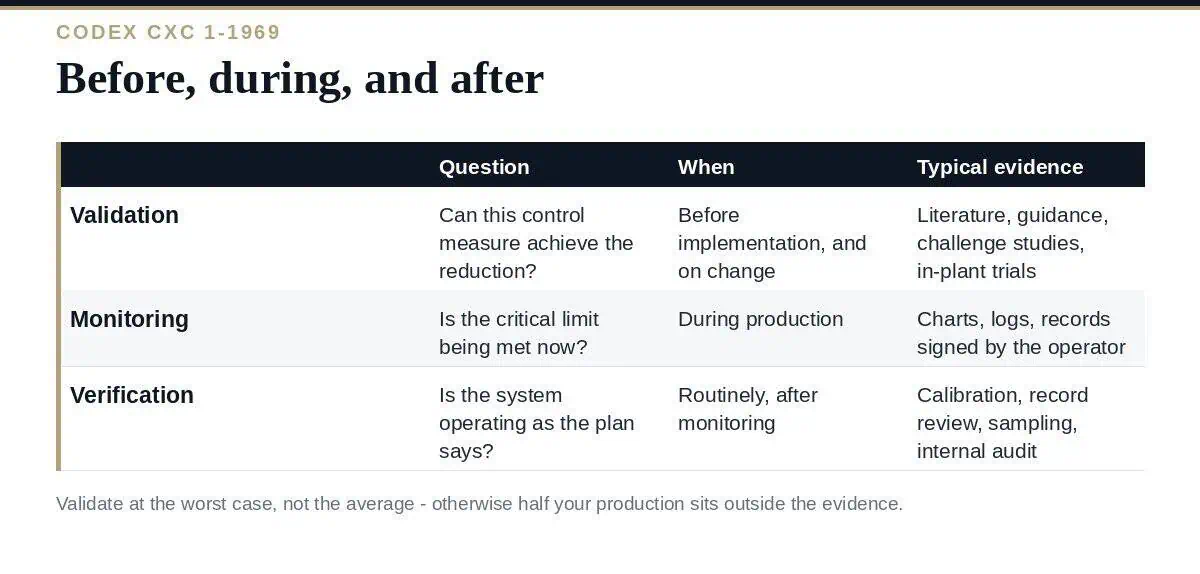
| Validation | Can this control measure achieve the required reduction? | Before implementation, and on change | Scientific literature, regulatory guidance, challenge studies, in-plant trials |
| Monitoring | Is the critical limit being met at this CCP, now? | Continuously or at a planned frequency during production | Charts, logs, automated records signed by the operator |
| Verification | Is the system operating as the plan says? | Routinely, after monitoring | Calibration, record review, sampling and testing, internal audit |
The Codex General Principles of Food Hygiene, CXC 1-1969, sets the definitions the rest of the industry works from, and the 2020 revision sharpened exactly this distinction. Validation obtains evidence that a control measure, properly implemented, is capable of controlling the hazard to a specified outcome. Verification applies methods and tests, in addition to monitoring, to determine whether the control measure is or has been operating as intended.
HACCP validation is about capability, and it is done once for a given process and control measure — not repeated every week. The evidence usually comes from one of four places:
The most common gap is the fourth. A literature-based critical limit is a good start, but HACCP validation has to connect that limit to your equipment, your product’s thickest piece, your slowest line speed, your coldest incoming material. A schedule validated for a competitor’s oven is a citation waiting to happen.
Run HACCP validation at the hardest condition the process will legitimately see, and the easier ones are covered. Validate at the average and half your production sits outside the evidence.
Verification is the routine business of checking that the plan is being followed and still works:
Codex expects verification procedures to be established and performed at regular intervals, and the whole system to be reviewed at least annually or whenever a significant change occurs. Our guide to the 12 Codex steps covers where verification sits in the sequence.
Revalidate — do not simply verify — when any of these happen:
What is the difference between HACCP validation and verification?
Validation proves the control measure can work before you rely on it. Verification confirms it is working as planned once you do. Validation is about capability, verification is about conformity.
Is monitoring a form of verification?
No. Monitoring is the planned observation or measurement at the CCP against its critical limit. Verification is what happens in addition to monitoring, including review of the monitoring records themselves.
How often should HACCP validation be done?
On introduction and on change. There is no routine calendar frequency, unlike verification — although the annual system review should confirm that nothing has changed that would invalidate it.
Does a supplier certificate validate our critical limit?
No. A supplier document can be an input, but validation has to establish that the control measure works in your process, on your equipment, with your product.
Who should perform verification activities?
Someone other than the person performing the monitoring, with the competence to interpret what they are reviewing. Independence here is what makes the record credible.
Keep three separate records and label them plainly: HACCP validation evidence per control measure, monitoring records per CCP, and verification records with names and dates. Validate at the worst case rather than the average, tie every critical limit back to evidence that applies to your own equipment, and set the triggers for revalidation in writing so a formulation change does not quietly outrun the science behind your plan.
Validation records, verification schedules and CCP monitoring forms are in the HACCP Toolkit, or start with the free ISO templates.

October 25, 2026
October 24, 2026

October 24, 2026

October 23, 2026
October 23, 2026

