CART
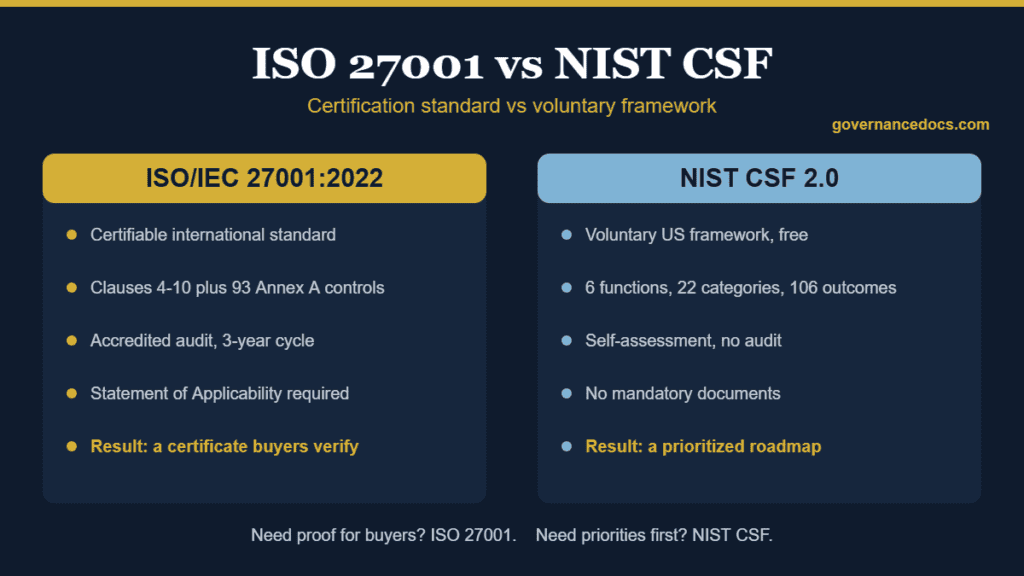
ISO 27001 vs NIST CSF comes down to one question: do you need proof, or do you need a plan? ISO/IEC 27001 is a certifiable international standard — an accredited auditor examines your information security management system (ISMS) and issues a certificate your customers can verify. The NIST Cybersecurity Framework (CSF) 2.0 is a free, voluntary framework from the U.S. National Institute of Standards and Technology. There is no NIST CSF certificate. If enterprise buyers are holding up deals until you show evidence, you need ISO 27001. If you mainly need to organize and prioritize security work, start with NIST CSF.
Free gap assessment
Where do you actually stand against ISO 27001?
Score every management system clause and all 93 Annex A controls, free, and get a prioritised gap list back.
Run the free ISO 27001 gap assessment → or View premium report sample
Both frameworks manage the same thing — information security risk — but they were built for different jobs. ISO 27001 is a management-system standard with auditable requirements and a certificate at the end. NIST CSF is a common language for describing cybersecurity outcomes, designed so a CISO, a board member and an engineer can look at the same picture and agree on what to fix first.
That difference decides most cases. In the ISO 27001 vs NIST CSF debate you are not really comparing two competing standards; you are choosing between a certification programme and a prioritization tool. Plenty of mature teams run both.
Before you can settle ISO 27001 vs NIST CSF for your own business, it helps to be precise about what each document contains and who publishes it.
ISO/IEC 27001 is published jointly by ISO and IEC. The current edition, ISO/IEC 27001:2022, was published in October 2022 and costs CHF 155 from the ISO store. A free 2024 amendment (Amd 1:2024, “Climate action changes”) added climate considerations to the management-system clauses. The three-year transition from the 2013 edition closed on 31 October 2025, so every valid certificate now refers to the 2022 edition.
The standard has two parts. Clauses 4 to 10 set the mandatory management-system requirements: scope, leadership, risk assessment and treatment, competence, documented information, internal audit, management review and corrective action. Annex A then lists 93 controls across four themes — 37 organizational, 8 people, 14 physical and 34 technological. You select controls based on your risk assessment and justify every inclusion and exclusion in a Statement of Applicability, which clause 6.1.3 makes mandatory. Our guide to the ISO 27001:2022 Annex A controls breaks the four themes down control by control.
Free ISO 27001 risk assessment
Which of your risks sit above your appetite line?
Set your own risk criteria, pick from 61 information security risk scenarios, rate likelihood and impact, and decide how to treat each one. You get a heat map, a process score and the findings an auditor would raise, free.
Run the free risk assessment → or View premium report sample
Certification is carried out by an accredited certification body on a three-year cycle: a Stage 1 documentation review, a Stage 2 implementation audit, then annual surveillance audits and a full recertification in year three. According to ISO’s own figures, more than 70,000 ISO/IEC 27001 certificates were reported across 150 countries in the ISO Survey 2022.
The NIST Cybersecurity Framework is a free publication from the U.S. Department of Commerce. Version 2.0, released on 26 February 2024, was the first edition written for any organization in any sector — earlier versions were aimed at U.S. critical infrastructure.
CSF 2.0 organizes cybersecurity into six functions: Govern, Identify, Protect, Detect, Respond and Recover. Govern is the headline addition in 2.0, and it moved cyber risk explicitly into the boardroom. Underneath the six functions sit 22 categories and 106 subcategories. Each subcategory describes an outcome — that backups are created, protected, maintained and tested, for example — rather than a prescriptive control.
You use it by building Organizational Profiles: a Current Profile of what you do today, a Target Profile of where you need to be, and the gap between them becomes your roadmap. Four Implementation Tiers (Partial, Risk Informed, Repeatable, Adaptive) describe how rigorous your risk governance is. Nobody audits any of it. Our NIST Cybersecurity Framework guide walks through the profile process in more detail.
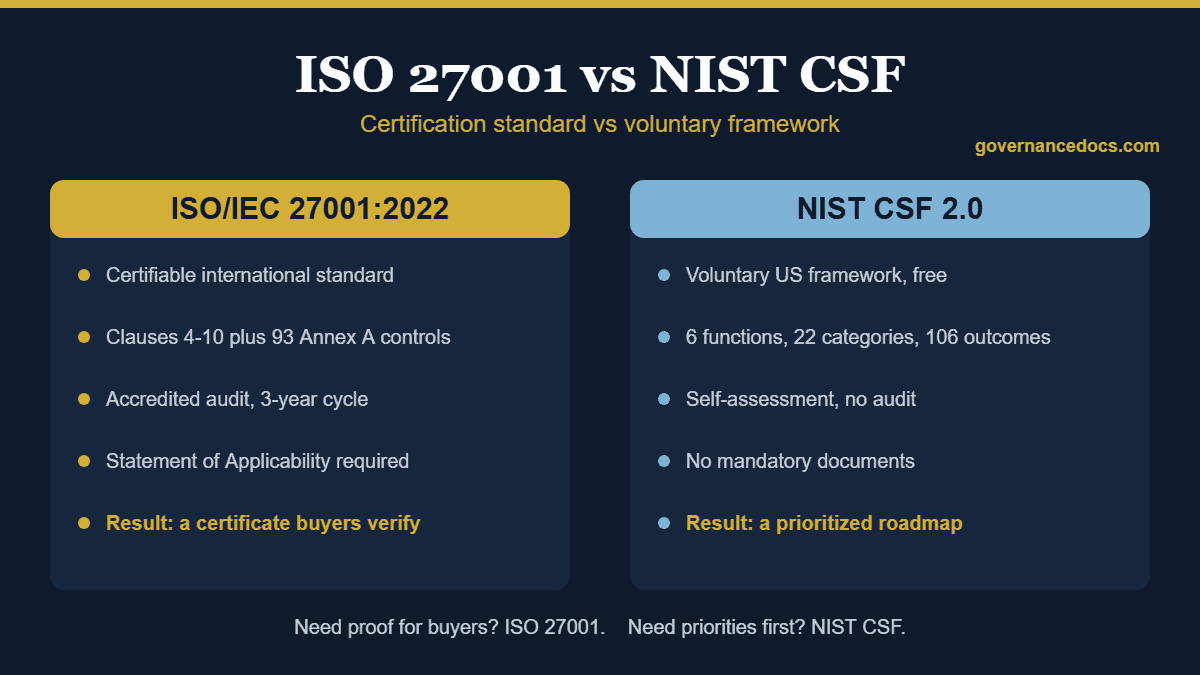
| Factor | ISO/IEC 27001 | NIST CSF 2.0 |
|---|---|---|
| Type | Certifiable international standard | Voluntary framework and guidance |
| Published by | ISO and IEC (JTC 1/SC 27) | NIST, U.S. Department of Commerce |
| Current version | ISO/IEC 27001:2022 plus Amd 1:2024 | CSF 2.0 (February 2024) |
| Structure | Clauses 4–10 plus 93 Annex A controls in 4 themes | 6 functions, 22 categories, 106 subcategories |
| Certification | Yes — accredited body, three-year cycle | None exists |
| Independent audit | Stage 1, Stage 2, annual surveillance | Self-assessment only |
| Mandatory documents | Yes, including the Statement of Applicability | None specified |
| Cost of the document | CHF 155 (amendment free) | Free download |
| Strongest recognition | Global — EU, UK, Middle East and Asia procurement | United States, critical infrastructure, federal supply chain |
| What you end up with | A certificate and a running ISMS | A prioritized roadmap and a maturity picture |
An ISO 27001 certificate is a third-party assertion with an accreditation trail behind it. A prospect can check it with the certification body. “Aligned to NIST CSF” is your own claim about yourself. Both can be true and useful, but only one clears a procurement gate.
Security questionnaires overwhelmingly ask whether you hold ISO 27001 certification or a SOC 2 report. They rarely ask for a CSF profile. If your sales cycle keeps stalling on a vendor security review, the framework question is already answered for you — and the follow-up question is usually ISO 27001 or SOC 2, which we compare in ISO 27001 vs SOC 2.
Annex A hands you 93 named controls and asks which ones your risk assessment justifies. CSF hands you 106 outcomes and leaves control selection entirely to you, pointing to Informative References (including ISO 27001 and NIST SP 800-53) for the specifics. Teams that want a shopping list find ISO more concrete; teams that already have controls and want a scoring model find CSF more flexible.
CSF has no audit fee, no certification body and no surveillance cycle — but the internal effort of profiling, remediating and reporting is real and recurring. ISO 27001 adds external audit fees on top of that internal effort. Typical all-in ISO 27001 costs range from roughly $8,000 for a very small, tightly scoped organization to $60,000 or more for a complex multi-site scope; see our ISO 27001 certification cost breakdown for the full picture. Treat those as typical ranges, not quotes.
If your exposure is European — NIS2, DORA, GDPR — an ISO 27001 ISMS maps far more naturally onto what supervisors expect, as we explain in NIS2 vs ISO 27001. If you sell to the U.S. federal government, be careful not to confuse frameworks: those contracts generally point to NIST SP 800-171 and CMMC, not to CSF. CSF is the strategic layer; SP 800-171 and SP 800-53 are the control catalogues.
ISO 27001 vs NIST CSF is partly a question of timing. Start with CSF when:
The ISO 27001 vs NIST CSF answer flips as soon as someone external needs convincing. Choose certification when:
The most common mature pattern is not ISO 27001 vs NIST CSF at all — it is CSF as the operating model and ISO 27001 as the certification wrapper. You use CSF profiles and Tiers to plan and report internally, then certify the ISMS so you have something to hand a customer. NIST publishes Informative References that map CSF subcategories to ISO 27001 and SP 800-53, so evidence collected once generally serves both.
The sequencing that works for most growing companies: build a CSF Current and Target Profile to find your gaps, close the worst ones, then formalize the whole thing as an ISMS and book the Stage 1 audit. Our complete guide to ISO 27001 covers what that formalization involves, and the ISO 27001 timeline sets expectations on how long it takes.
Whichever way the ISO 27001 vs NIST CSF decision goes, the written artefacts overlap heavily. Both paths expect an information security policy set, an asset inventory, a documented risk assessment method and register, a risk treatment plan, access control and supplier security procedures, an incident response plan, and evidence that you review and improve. ISO 27001 adds the Statement of Applicability, the internal audit programme and management review records on top.
Writing all of that from a blank page is where most programmes lose months. The ISO 27001 Toolkit gives you 175 auditor-written, fully editable Word and Excel templates — policies, procedures, registers and the Statement of Applicability — for a one-time $99, so your team spends its time on implementation rather than drafting.
No. NIST does not run a certification or accreditation scheme for the Cybersecurity Framework, and no body can issue a recognized “NIST CSF certificate.” Vendors may sell readiness assessments or attestation-style reports against CSF, but these are not equivalent to accredited ISO 27001 certification.
ISO 27001, if the deals justify it. Enterprise procurement asks for verifiable evidence, and a certificate is the shortest route past a vendor security review. Use NIST CSF first if you are still six to twelve months away from being auditable — it will tell you what to fix in the meantime.
Partly. CSF-driven work produces real controls and evidence an auditor will accept, but it does not produce the management-system artefacts ISO requires — scope, Statement of Applicability, internal audit programme, management review. Expect to add those.
No. They are complementary, and NIST’s own mappings assume overlap. The either/or framing only matters when budget or attention is limited and you have to sequence one before the other.
In practice, yes. The requirements text is copyrighted and sold by ISO and national standards bodies, although the 2024 climate amendment is free. NIST CSF 2.0, by contrast, is free to download.
Frame ISO 27001 vs NIST CSF around what your business needs to show, not around which document is better written. If someone is waiting for evidence before they sign, get certified. If nobody is asking yet and you need to spend a limited budget well, start with CSF and build toward an ISMS you can certify when the demand arrives.

October 11, 2026
October 11, 2026

October 11, 2026
October 11, 2026
October 11, 2026

