CART
For any company building trust in how it handles data, one decision comes up early: ISO 27001 vs SOC 2. Both demonstrate strong information security, but they work differently and suit different markets. This guide explains what each is, how they differ, and how to choose — or pursue both.
For the full detail on the standard, see our complete ISO 27001 guide.
Free gap assessment
Where do you actually stand against ISO 27001?
Score every management system clause and all 93 Annex A controls, free, and get a prioritised gap list back.
Run the free ISO 27001 gap assessment → or View premium report sample
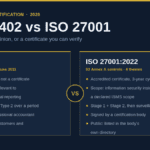
ISO 27001 is an international standard you get certified against, resulting in a certificate recognised worldwide. SOC 2 is an attestation performed by a CPA firm, resulting in a detailed report that is especially familiar to buyers in North America. Both prove you manage information security well; the difference lies in format, geography, and how the assurance is delivered.
| ISO/IEC 27001 | SOC 2 | |
|---|---|---|
| What it is | An international standard you can be certified against | An attestation report on your controls, written by a CPA firm |
| Issued by | An accredited certification body | A licensed CPA firm, under AICPA standards |
| What you receive | A certificate, valid three years | A report describing the auditor’s findings |
| What is assessed | A management system: clauses 4–10 plus the 93 Annex A controls you select | Your controls against the Trust Services Criteria you scope in |
| Control selection | Risk-driven, justified in a Statement of Applicability | You design the controls; the auditor tests what you claim |
| Cycle | Certification audit, then annual surveillance, recertification at year three | A new report each year; Type 2 covers an observation period |
| Recognised in | Globally, including the EU, UK, GCC and Asia | Predominantly North America |
| Usually asked for by | Enterprise and public-sector buyers outside the US | US enterprise buyers and their procurement teams |
ISO/IEC 27001 is the international standard for an Information Security Management System. You build an ISMS, select controls from Annex A based on risk, and an accredited body certifies you against the standard. The certificate is valid for three years with annual surveillance and is understood globally — making ISO 27001 the default request in many international and European markets.
SOC 2 is a reporting framework from the American Institute of CPAs, based on five Trust Services Criteria: security, availability, processing integrity, confidentiality, and privacy. A CPA firm examines your controls and issues a report. A Type 1 report assesses control design at a point in time, while a Type 2 report tests operating effectiveness over a period, usually several months. SOC 2 is especially common among US technology and SaaS companies.
Choose based on your customers. If you sell internationally or into European and regulated markets, ISO 27001 is usually expected. If your customers are primarily US-based technology buyers, they may ask for SOC 2. Many companies eventually pursue both — and because the underlying controls overlap heavily, building a strong ISO 27001 ISMS covers much of what SOC 2 requires. Doing the control work once, mapped to both, is the efficient path.
Build the security foundation for both.
Our ISO 27001 Toolkit gives you a complete ISMS whose controls also cover much of SOC 2 — policies, risk assessment, and Annex A controls, editable in Word and Excel.
Free ISO 27001 risk assessment
Which of your risks sit above your appetite line?
Set your own risk criteria, pick from 61 information security risk scenarios, rate likelihood and impact, and decide how to treat each one. You get a heat map, a process score and the findings an auditor would raise, free.
Run the free risk assessment → or View premium report sample
ISO 27001 is an international standard you get certified against; SOC 2 is a US attestation report based on the Trust Services Criteria. ISO 27001 yields a certificate; SOC 2 yields a report.
Neither is universally better — it depends on your customers. ISO 27001 suits international and European markets; SOC 2 is common among US technology buyers.
Yes, and many companies do. The underlying controls overlap significantly, so a strong ISO 27001 ISMS covers much of what SOC 2 requires.

October 25, 2026
October 24, 2026
October 24, 2026
October 23, 2026
October 23, 2026

