

Project Management Officer: The Complete 2026 PMO Guide
A project management officer is a person who works in a PMO and keeps the organization’s projects planned, reported and controlled to a common standard. The PMO itself is the team or function, usually a project, programme or portfolio management office. The two terms share an acronym, which is why so many job ads, org charts and interview questions get them mixed up.
This guide separates the role from the office, explains the PMO types you will meet, sets out PMO roles and responsibilities in one table, and gives you a six-step setup plan with KPIs you can report from month one.
Free gap assessment
How consistently are projects actually run?
A vendor-neutral maturity assessment against ISO 21502, free, so predictive, agile and hybrid teams are scored on the same basis.
Run the free project management maturity assessment → or View premium report sample
What is a PMO? The office and the officer
So, what is a PMO? In most organizations it is a project management office: a central function that sets project standards, collects status information and gives leadership one view of delivery. Larger organizations split it into project, programme and portfolio offices.
The ambiguity comes from three things:
- PMO as the office. “The PMO wants your status report by Thursday” means the function.
- PMO as the person. Some organizations, especially in the UK and public sector, call an individual “the PMO” or advertise a “PMO officer” post.
- PMO as programme or portfolio office. The same three letters can mean a programme management office or a portfolio office, with a wider remit than a single project.
When you read a job description or a governance document, check which one is meant. A charter that says “the PMO approves change requests” needs to name a role, not an acronym.
What a project management officer actually does
A project management officer is usually a mid-level role, between a PMO analyst or coordinator and the head of PMO. The officer does not normally run projects. The officer makes sure the people who run projects follow the agreed method and that leadership gets reliable information.
A typical week for a project management officer looks like this:
- Chasing and checking weekly status reports, then building the portfolio summary.
- Maintaining the RAID log (risks, assumptions, issues, dependencies) for the programme or portfolio.
- Running change control: logging requests, checking impact analysis, booking them into the change board.
- Keeping templates, the methodology and the project register current.
- Preparing packs for steering committees and recording their decisions and actions.
The status report is the officer’s core product. If yours is inconsistent across projects, start with our guide to the five sections of a useful project status report.
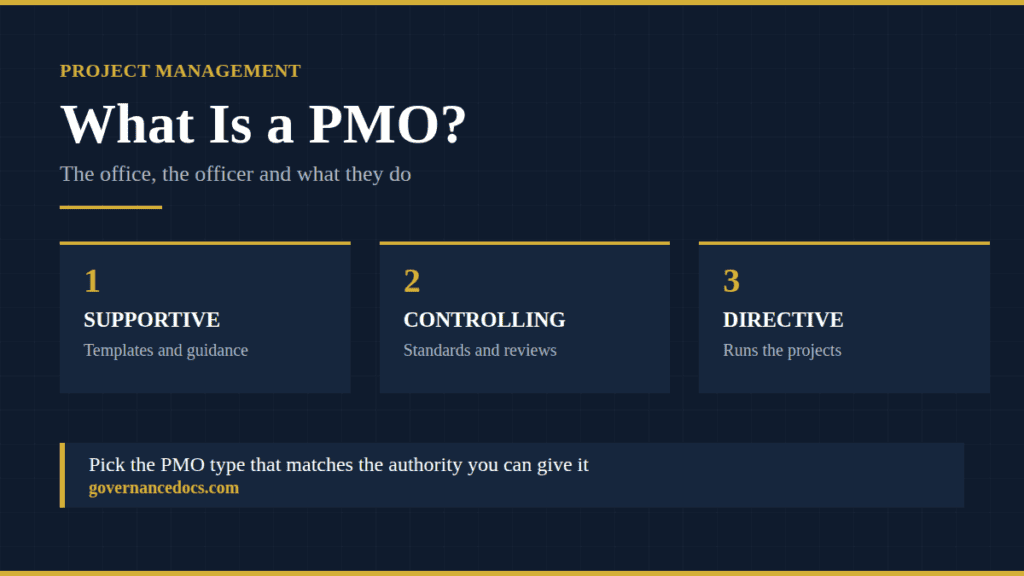
PMO types: supportive, controlling and directive
PMI’s PMBOK Guide describes three PMO types, based on how much control the office has over projects. Most real PMOs sit somewhere on this scale, and many move along it as they mature.
| PMO type | Degree of control | What it does | Fits when |
|---|---|---|---|
| Supportive | Low | Supplies templates, training, lessons learned and advice. Projects choose whether to use them. | Project managers are experienced and leadership wants light-touch consistency. |
| Controlling | Moderate | Requires a set method, templates and reporting; checks compliance through reviews or audits. | Leadership cannot get comparable status data, or audits find inconsistent records. |
| Directive | High | Manages projects directly. Project managers report into the PMO. | Strategic, high-risk delivery needs central ownership of resources and outcomes. |
PMI has also published a structural view. Its 2014 white paper, The Project Management Office: Aligning Strategy & Implementation, lists five common PMO frameworks: business unit PMO, project-specific PMO, project support controls office, enterprise PMO and PMO center of excellence.
In the UK, AXELOS’s P3O guidance (Portfolio, Programme and Project Offices) takes a similar layered approach. It separates a portfolio office, programme offices, project offices and a centre of excellence for standards.
Core PMO functions
Whatever the type, most PMOs deliver some mix of these functions. Write the ones you offer into a service catalogue so project teams know what to expect.
- Standards and method. Lifecycle stages, gate criteria, mandatory documents and templates.
- Reporting. Status collection, portfolio dashboards and exception reports.
- Governance support. Steering committee packs, decision logs, change and risk control.
- Portfolio management. Intake, prioritization, capacity and benefits tracking.
- Capability. Training, coaching, lessons learned and assurance reviews.
For how these functions map to ISO 21502 and PMI practice, see our comparison of ISO 21502 vs PMBOK for project governance.
PMO roles and responsibilities
Job titles vary, so define PMO roles and responsibilities by output, not by title. This table is a starting point you can copy into your PMO charter and adjust.
| Role | Responsibilities | Typical outputs |
|---|---|---|
| Head of PMO / PMO director | Sets PMO strategy and services; reports to the executive sponsor; owns the method and the portfolio view. | PMO charter, PMO roadmap, executive portfolio report |
| Portfolio manager | Runs intake and prioritization; balances capacity and budget across projects; tracks benefits. | Prioritized portfolio, capacity plan, benefits register |
| Project management officer | Checks project compliance with the method; consolidates reporting; runs RAID and change control; supports steering committees. | Consolidated status report, RAID log, change log, steering pack |
| PMO analyst / coordinator | Collects data, maintains registers and the project list, schedules governance meetings, keeps minutes. | Project register, meeting minutes, action log |
| Planner / scheduler | Builds and maintains integrated schedules; tracks milestones and critical path. | Integrated schedule, milestone tracker |
| Methodology / CoE lead | Maintains templates, training and lessons learned; runs project health checks. | Template library, training plan, lessons-learned log |
In a small organization, one project management officer may cover the officer, analyst and planner rows. That is fine, as long as the charter says so and the workload is realistic.
Project management officer vs project manager vs programme manager
The three roles are easy to confuse because they attend the same meetings. The difference is accountability.
| Aspect | Project management officer | Project manager | Programme manager |
|---|---|---|---|
| Accountable for | Method, data quality and governance support | Delivering one project to scope, time and cost | Delivering the combined benefits of related projects |
| Scope | Many projects, across the portfolio | One project | Several linked projects |
| Main decisions | Whether reporting and controls meet the standard | Day-to-day delivery choices within tolerances | Trade-offs between projects; escalations to sponsors |
| Typical documents | Portfolio report, RAID log, change log | Project initiation document, plan, status report | Programme plan, benefits map, dependency log |
A project manager owns the project initiation document and the plan. The PMO checks that both exist, are approved and are kept current.
How to set up a PMO in 6 steps
A new PMO fails most often because nobody agreed what it was for. These six steps put the decisions in the right order.
1. Name the problem and the sponsor
Write down the two or three problems the PMO must fix, such as late status data or projects starting without approval. Get an executive sponsor who will back the PMO when a project manager pushes back.
2. Choose the PMO type
Pick supportive, controlling or directive based on those problems. Most first PMOs start supportive or lightly controlling, then add control once they have earned trust.
3. Write the charter and service catalogue
The charter sets purpose, scope, authority, roles and measures. Our PMO charter guide covers all eight sections. Pair it with a short service catalogue listing what projects get from the PMO.
4. Set the minimum standard
Choose the few documents every project must produce, such as a charter or PID, a plan, a RAID log, a status report and a closure report. Fewer mandatory templates means higher compliance.
5. Fix the reporting rhythm and intake
Agree the status cycle, the portfolio report date and the steering committee calendar. Add an intake route so new projects are registered and approved before work starts.
6. Measure, review and adjust
Report PMO KPIs from the first month and review the PMO with the sponsor after six and twelve months. Close the loop on finished work with a proper project closure and lessons-learned process.
PMO KPIs that show value
Measure what the PMO controls, then what it influences. Set your own baselines in the first quarter rather than borrowing industry targets.
| KPI | How to calculate | What it tells you |
|---|---|---|
| Reporting on time | Status reports received by the deadline ÷ reports due | Whether the reporting rhythm works |
| Governance coverage | Active projects with an approved charter or PID ÷ active projects | Whether intake control works |
| Milestone delivery | Milestones hit within tolerance ÷ milestones due | Schedule predictability across the portfolio |
| Budget variance | (Actual cost − planned cost) ÷ planned cost, per project | Cost control and estimating quality |
| Benefits tracked | Closed projects with benefits measured after go-live ÷ closed projects | Whether projects deliver what the business case promised |
| Stakeholder satisfaction | Short survey of sponsors and project managers, twice a year | Whether the PMO is seen as help or overhead |
Keep the list short. Six well-defined KPIs that the board reads beat twenty that nobody checks.
Project management officer FAQ
Is a project management officer the same as a PMO?
Not quite. The PMO is normally the office or function, and the project management officer is a role within it. Some organizations use “PMO” for the person too, so check the job description.
Does a PMO need a certification or standard?
No standard requires one. Many PMOs base their method on PMI’s PMBOK Guide, PRINCE2 or ISO 21502, and staff may hold certifications such as PMP or P3O. What matters is that the method is written down and followed.
How big should a PMO be?
There is no fixed ratio. Size it to the services in your catalogue and the number of active projects. A supportive PMO for a mid-sized firm can start with one or two people.
What documents should a new PMO create first?
Start with the PMO charter, a service catalogue, a project register, a status report template and a RAID log. Add portfolio dashboards and benefits tracking once the basic reporting is reliable.
Our Project Management Toolkit provides 395 editable templates for the full project lifecycle — including a PMO Charter Template, a PMO Service Catalogue and a PMO KPI Dashboard — for $99.
When a standard changes, know first
One email a month: edition changes, new deadlines, and what they mean for documentation you already have. No sales sequence.

Governance Docs
Governance Docs LLC
Recent Posts
November 27, 2026

November 27, 2026

November 26, 2026
November 26, 2026

November 26, 2026