CART
Transfer risk assessment vs TIA is mostly a question of which side of the Channel your data leaves from. A transfer impact assessment (TIA) is what EU exporters carry out under Clause 14 of the Standard Contractual Clauses and the EDPB’s recommendations. A transfer risk assessment (TRA) is the UK’s version, required before a transfer that relies on the IDTA, the UK Addendum or another Article 46 safeguard. They ask similar questions but apply different tests, and since the Data (Use and Access) Act 2025 the UK test has moved further from the EU one. This guide sets out the differences, and how to run one assessment that satisfies both.
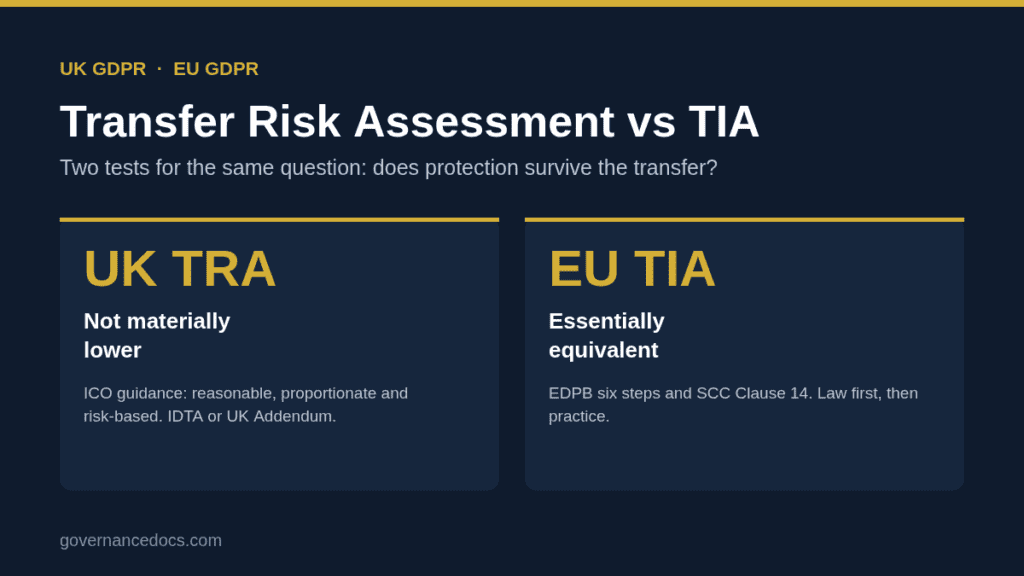
Both assess whether the people whose data leaves the country keep adequate protection once it arrives, taking into account the laws and practices of the destination and any extra safeguards. The EU TIA asks whether protection is essentially equivalent to the EU’s, the standard the Court of Justice set in the Schrems II judgment of 16 July 2020. The UK TRA asks whether protection is not materially lower than under UK law, a test the ICO describes as reasonable, proportionate and risk-based.
| EU transfer impact assessment (TIA) | UK transfer risk assessment (TRA) | |
|---|---|---|
| Applies to | Restricted transfers out of the EEA under the GDPR | Restricted transfers out of the UK under the UK GDPR |
| Required for | Transfers relying on Article 46 tools: EU SCCs, BCRs, codes, certification | Transfers relying on Article 46 tools: IDTA, UK Addendum, BCRs |
| Test | Essentially equivalent protection | Protection not materially lower than under UK law |
| Main guidance | EDPB Recommendations 01/2020 (six steps); SCC Clause 14 | ICO guidance on transfer risk assessments, updated January 2026 |
| Focus of the legal check | What the destination’s law allows public authorities to do, then practice | The risk of harm to people in the circumstances of the transfer, weighed proportionately |
| Help with the US | US safeguards adopted for the Data Privacy Framework apply to all transfers to US companies | The UK government’s own analysis of US law can be used |
| Documented and shown to the regulator | Yes; available to the supervisory authority on request (Clause 14(d)) | Yes; kept as part of accountability |
| Not needed when | Adequacy covers the transfer, or an Article 49 exception applies | UK adequacy regulations cover it, or an exception applies |
The EDPB’s six steps are: know your transfers; identify the transfer tool; assess whether the tool is effective in light of the law and practice of the destination; adopt supplementary measures; take any procedural steps; and re-evaluate at appropriate intervals. Step 3 is the heart of it, and it starts from the law: whether public authorities can access the data, and whether that access is limited to what is necessary and proportionate, subject to independent oversight and open to effective redress. The importer’s practical experience, such as never having received a request, can count, but the EDPB expects it to be documented and supported by other sources.
Where problems are found, the exporter must add supplementary measures that close the gap, or not transfer. The EDPB’s examples show that technical measures, such as encryption with keys the exporter holds, do most of the work; contractual and organisational measures alone rarely stop access to data held in clear.
The ICO’s guidance on completing a transfer risk assessment asks the exporter to decide, acting reasonably and proportionately, that the protection for people’s information will not be materially lower after the transfer. It looks at the specific transfer: the kind and volume of data, who receives it, what they do with it, and how likely and how serious any harm would be. A low-risk transfer can be assessed quickly; a sensitive one needs more.
The ICO offers routes to get there: its own TRA tool, an approach modelled on the EDPB’s, or, for the US, the UK government’s analysis of US law. If the assessment shows protection would be materially lower, the exporter needs extra measures, an exception, or no transfer.
For most transfers the transfer risk assessment vs TIA choice makes no difference to the answer. The differences bite in three places:
For many organizations transfer risk assessment vs TIA is not a choice at all: they send the same data from both the EU and the UK. Running two assessments for one transfer wastes effort and invites contradictions. A combined assessment works well:
Our transfer impact assessment example takes exactly this approach for a retailer with employees in the UK, Ireland and the Netherlands.
Whatever the transfer risk assessment vs TIA answer for a given transfer, the record should cover the same ground:
A record in this shape serves both regulators, and it is the one you will reach for when a supplier changes or a court ruling moves the ground under a transfer.
They do the same job for different regimes. The TIA is the EU term, tied to SCC Clause 14 and the EDPB recommendations; the TRA is the UK term, tied to the UK GDPR and the ICO’s guidance.
Yes. The ICO accepts an approach modelled on the EDPB’s. An assessment that meets the EU test will normally meet the UK one; the reverse is not guaranteed.
No. The UK’s adequacy regulations cover the EEA, so transfers from the UK to it need no TRA. The EU’s adequacy decisions for the UK were renewed in December 2025, so transfers the other way need no TIA either.
No. A DPIA asks whether the processing is high risk; a TRA asks whether protection survives the transfer. See our comparison of DPIA vs LIA for how the other assessments fit together.
Our free transfer impact assessment tool runs the EU TIA and the UK TRA in one assessment: choose EU, UK or both at the start and it applies the right test. For the transfer procedure and the rest of your GDPR records, see the GDPR Toolkit, and for the rules in full, our guide to international data transfers.

October 19, 2026

October 19, 2026

October 18, 2026

October 18, 2026

October 15, 2026

