CART
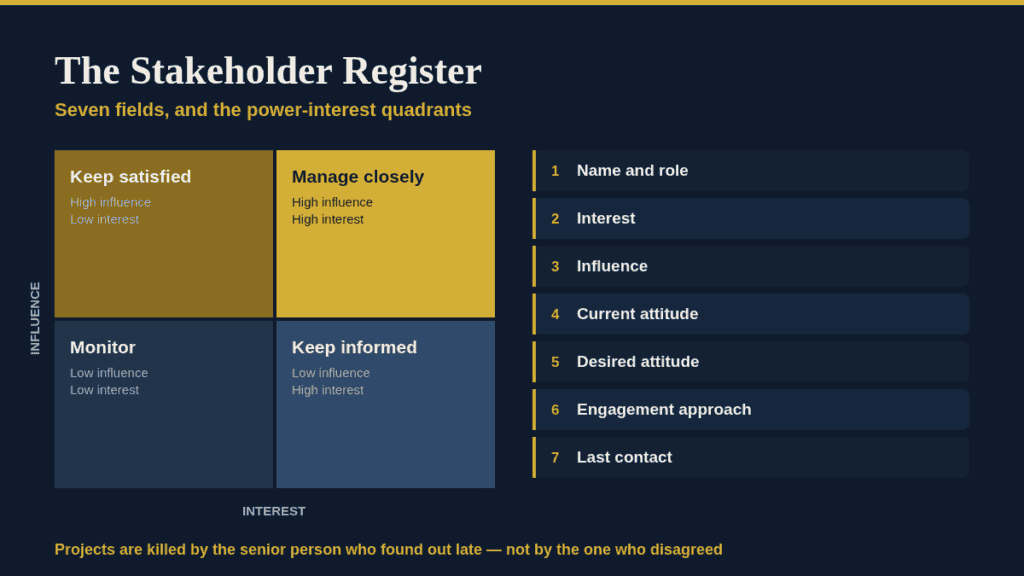
A stakeholder register is the list of everyone who can affect your project or be
affected by it, with enough recorded against each name to act on. Kept properly it is a working tool.
Kept the usual way — a spreadsheet of job titles produced at initiation and never reopened
— it is a compliance artefact that predicts nothing.
Free gap assessment
How consistently are projects actually run?
A vendor-neutral maturity assessment against ISO 21502, free, so predictive, agile and hybrid teams are scored on the same basis.
Run the free project management maturity assessment → or View premium report sample
Seven fields do the work. Anything less and the register cannot drive behaviour; much more and it
stops being maintained.
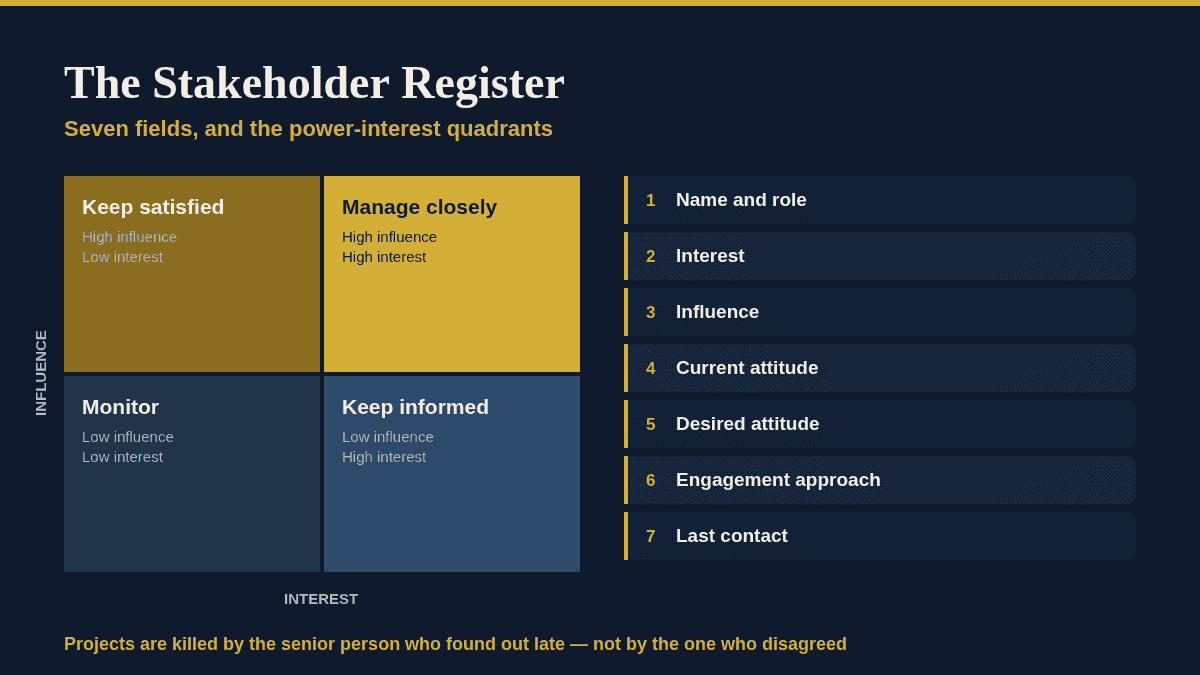
| Field | Why it earns its column |
|---|---|
| Name and role | Individuals, not departments — “Finance” cannot be consulted |
| Interest | What they actually want from this, in their words |
| Influence | What they can do to you — approve, block, delay, resource |
| Current attitude | Supportive, neutral, resistant — today, not at kick-off |
| Desired attitude | Where you need them to be, which is often just “not blocking” |
| Engagement approach | What you will do, how often, and who owns the relationship |
| Last contact | A date, which instantly exposes who has been neglected |
The pair of attitude columns is what turns the register from a description into a plan. Recording
that a director is resistant is an observation; recording that you need them neutral by the design
gate, and how you intend to get there, is management.
Plotting stakeholders on influence against interest gives four groups and four different jobs.
High influence, high interest are managed closely — they belong in governance
and get individual attention. High influence, low interest are the dangerous ones:
they can stop the project and are not paying attention, so they need to be kept satisfied and never
surprised. Low influence, high interest are your most useful volunteers, worth
keeping informed and often worth recruiting as advocates. Low influence, low interest
get monitored, cheaply.
The quadrant that causes damage is the second. Projects are rarely killed by a stakeholder who was
engaged and disagreed; they are killed by a senior person who found out late and reacted badly.
A document recording that a named director is resistant is not something to circulate or attach to
a status pack. Keep it access-controlled, write assessments in professional terms you would be
comfortable defending, and remember that most organisations are subject to data protection obligations
covering personal data held about identifiable individuals — a stakeholder register qualifies.
Assess attitudes towards the project, never the person.
Some stakeholders are genuinely collective — a customer segment, a user community, a union
membership. You cannot hold a relationship with a group, so the register needs a named representative
against each: the person who speaks for them, and who you will actually talk to.
Where no such person exists, that is a finding rather than a formatting problem. A project changing
how two hundred people work, with nobody empowered to represent them, will discover their view during
user acceptance testing at the worst possible moment. Identifying the gap early gives you time to ask
for a representative to be appointed.
Two columns predict trouble if you actually read them. A last contact date more
than a month old against a high-influence stakeholder is a warning. And a current
attitude that has moved the wrong way since last review is worth more than any status RAG,
because attitudes shift before problems become visible in the schedule.
This is also the discipline that makes benefits stick. Benefit owners are stakeholders, and a
benefit whose owner has drifted into disengagement will not be tracked after closure — which is
why benefits realisation and stakeholder
engagement fail together more often than either fails alone.
Thirty-nine stakeholder and communications templates.
The Project Management Toolkit ships 390+ editable MS Office templates. The stakeholder set covers a stakeholder register, a power-interest matrix, stakeholder mapping, a stakeholder management plan and communication plan, a satisfaction survey, a decision register and the status report and meeting formats the engagement plan drives.
PMI’s PMBOK Guide
reached its Eighth Edition in November 2025 and carries stakeholders as one of its seven performance
domains — alongside governance, scope, schedule, finance, resources and risk. The
ISO 21502:2020
guidance treats stakeholder engagement as a practice in its own right, and
PRINCE2 7, current since 4 September 2023, made people the fifth integrated element of
the method.
The common thread is that stakeholder work has been promoted from a soft skill to a managed
discipline with its own artefacts. The register is the artefact.
A stakeholder register is only as good as the identification behind it, and the initial pass almost
always finds the obvious people while missing the ones who cause trouble. Four prompts consistently
surface names a first workshop misses.
Ask the same four questions again a month later. Projects acquire stakeholders as they become
visible, and a register frozen at initiation describes the project you thought you were running.
Worth stating, because the artefact can become the activity. Filling in an influence column is not
engagement, and a register with every field populated and no conversations behind it is a well-formatted
guess.
The register’s real value is that it makes neglect visible. It surfaces the person you have been
avoiding, the relationship that has had no contact in six weeks, and the senior stakeholder everyone
assumed somebody else was handling. Those are uncomfortable things to see written down, which is
precisely why the register earns its place.
What is a stakeholder register?
A controlled list of everyone who can affect or be affected by the project, recording their interest,
influence, current and desired attitude, engagement approach and last contact.
How is it different from a communications plan?
The register records who people are and what they need; the communications plan schedules what gets
sent to whom and when. The plan should be derived from the register.
Who should be able to see it?
The project manager, the sponsor, and relationship owners. It records opinions about named
individuals, so it is not a document for general circulation.
How often should it be reviewed?
Monthly as a minimum, and immediately after any organisational change. Reorganisations invalidate
registers faster than anything else.
What if a stakeholder stays resistant?
Escalate to the sponsor with a specific ask. Persistent resistance from someone with real influence is
a project-level risk and belongs in the RAID log, not in a quiet column nobody reads.
A stakeholder register is a management tool that happens to look like a spreadsheet. Name
individuals rather than departments, record current and desired attitude so the document plans rather
than describes, assign relationship owners because no project manager holds thirty relationships
alone, and put a last-contact date against every line so neglect becomes visible.
Then review it monthly and after every reorganisation, and ask the four identification questions
again each time. The stakeholder who sinks a project is almost never the one being managed closely
— it is the senior person with real influence and no interest, who found out late. The register
exists to make sure that person has a name, an owner and a date.
All of these are covered by the Project Management Toolkit, or start with the free ISO templates.

October 11, 2026
October 11, 2026
October 11, 2026
October 11, 2026
October 11, 2026

