CART
Your SPRS score is a single number between 110 and -203 that tells the Department of Defense how much of NIST SP 800-171 you have actually implemented. It is self-reported, it is a condition of award on covered contracts, and it is the figure a CMMC assessment starts from — which is why an honest one is worth more than a flattering one.
This guide covers how the score is calculated, the two requirements that earn partial credit, how long it stays current, and what a low score does and does not prevent.
Free gap assessment
What would your SPRS score be today?
Score all 110 NIST SP 800-171 requirements, free, plus the DFARS duties around them: plans of action, 72-hour incident reporting and flow-down.
Run the free NIST SP 800-171 gap assessment → or View premium report sample
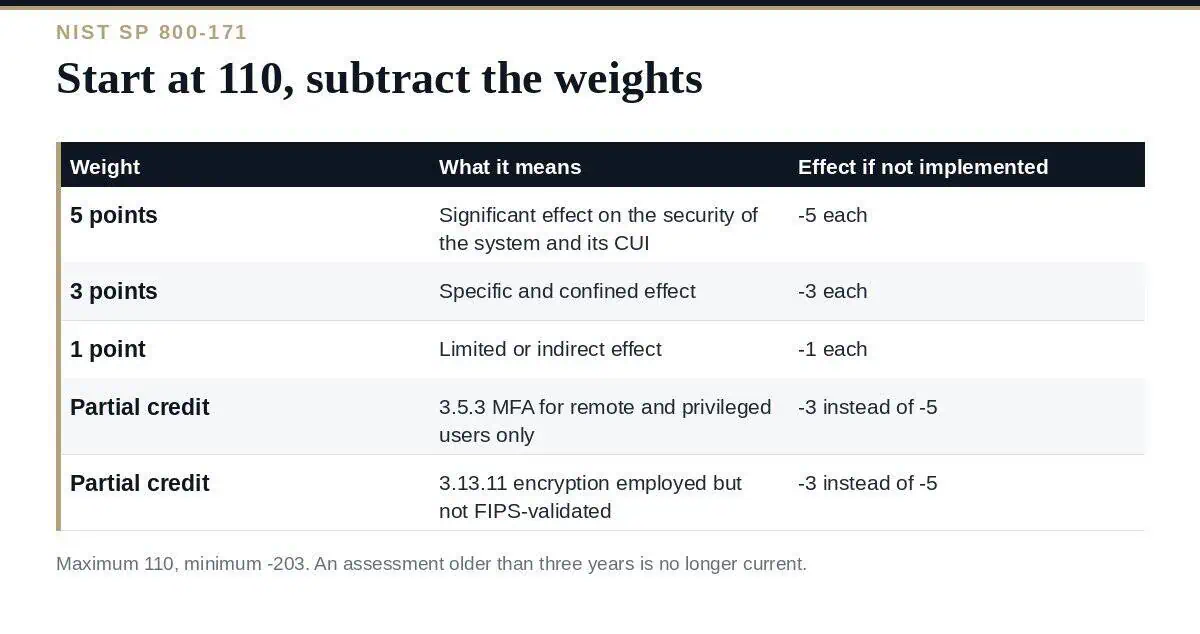
The method comes from the NIST SP 800-171 DoD Assessment Methodology, version 1.2.1, dated 24 June 2020. You begin at 110 — one point for each of the 110 security requirements in NIST SP 800-171 Revision 2 — and subtract a published weight for every requirement not fully implemented.
| Weight | What it means | Effect if not implemented |
|---|---|---|
| 5 points | Absence has a significant effect on the security of the system and the CUI in it | -5 each |
| 3 points | Specific and confined effect | -3 each |
| 1 point | Limited or indirect effect | -1 each |
The weights are fixed in the methodology’s tables. An assessor looks them up; nobody chooses them. Implement everything and the SPRS score is 110. Implement none of it and the arithmetic bottoms out at -203, which is why a negative number is normal for an organization at the start of a programme rather than a sign that something has gone wrong.
Almost every requirement is all or nothing. Two are not:
Everywhere else, “mostly implemented” scores the same as “not implemented”. That is the single most common reason a self-assessed SPRS score comes back lower than the team expected.
Revision 2. NIST published Revision 3 of SP 800-171, but the DoD assessment methodology, the DFARS clauses and the CMMC programme still run on the 110 requirements of Revision 2, and scoring against Revision 3 produces a number nobody can use. Our guide to which revision your contract names covers how to check, and the template set covers how to tell Rev 2 content from Rev 3 without reading every page.
On its own, a low score does not disqualify you from a DFARS 7019/7020 award — having no current assessment posted does. Under CMMC the arithmetic bites harder: a Level 2 assessment needs at least 88 of 110 before unimplemented items may be carried on a plan of action and milestones at all, POA&M items are confined to the lower-weighted requirements so the 5-point ones must be fully implemented at assessment, and the plan has to be closed out within 180 days of the conditional status date or the status expires.
Optimism about scope. A score calculated over a “CUI enclave” that the business routinely works outside of is measuring the wrong system.
Policy counted as implementation. A written procedure with no configuration behind it does not implement a technical requirement, and a High assessment will find that quickly.
A number nobody can reproduce. Keep the working: requirement, status, evidence, weight, deduction. A score you cannot rebuild on request is a liability, because the submission is a representation to the government and inaccurate cyber representations have been pursued under the False Claims Act.
What is a good SPRS score?
110 is full implementation. For CMMC Level 2 the practical floor is 88, since below that no plan of action and milestones is permitted. Anything lower is a programme plan, not a bidding position.
How long does an SPRS score last?
Three years, unless the solicitation specifies something shorter or the environment changes materially in the meantime.
Can the score be negative?
Yes. The minimum is -203, reached when none of the 110 requirements is implemented.
Who can perform the assessment?
A Basic assessment is a self-assessment. Medium and High assessments are performed by the government, and a High assessment includes verification of the evidence rather than acceptance of the claim.
Does a CMMC certificate replace the SPRS score?
No. The scoring methodology underpins CMMC Level 2, and results are recorded in SPRS. The score remains the currency in which DoD reads your implementation status.
Calculate the SPRS score against a real system security plan, score honestly, and keep the working paper that produced the number. Fix the 5-point requirements first — they carry the most arithmetic and cannot be deferred under CMMC — take the partial credit on MFA and FIPS cryptography only where it genuinely applies, and refresh the assessment when the environment changes rather than waiting for the three-year clock. A defensible number you can rebuild beats a high one you cannot.
Scoring worksheets, the system security plan and the CUI policy set are in the NIST SP 800-171 CUI Protection Toolkit, or start with the free ISO templates.


October 13, 2026
October 12, 2026
October 12, 2026

October 12, 2026

October 12, 2026

